The Scharoun Ensemble
consists of members of the Berlin Philharmonic
Orchestra. From the opening of Mozart’s
Clarinet Quintet we sense a refined
warmth and stylish presentation about
their music-making. At the arrival of
the second theme (tr. 1 1:22) the slight
softening and expressive reticence in
the first violin’s second phrase is
made the nucleus of the following clouded
clarinet solo. The development (5:10),
by contrast, is stimulatingly playful
while the clarinet makes the return
of the second theme an expansive commentary
on its nature and potential.
The slow movement is
of serene relaxation, a seamless arioso
with Karl-Heinz Steffens achieving sensitively
soft playing even at the melodic apexes.
At the same time it has quite an animated
flow which gives it an appreciable shape,
rather more than a sense of repose.
Yet the latter comes at the sotto
voce return of the clarinet solo.
The Minuet begins more
formally to point the contrast of first
violin, then clarinet taking flight
in the running quavers of the second
section (tr. 3 0:20). In the first Trio
(1:21) you note the fastidious clarity
of the syncopations and fp effects.
The second Trio (4:03) sports a carefree
clarinet supported by a somewhat more
genial first violin.
The variations finale
is more chipper. Notable is Variation
1 (tr. 4 0:55) with a sunny clarinet’s
deft leaps riding high above the violins
with the theme. Variation 3 (2:51) finds
a morose viola solo smoothly encased
by the ensemble. Variation 5 marked
Adagio (5:10), a wonderful distillation
of the essence of the melody, is given
suitably sustained treatment. Variation
6 (8:11) brings us full circle, chirpily
rounding things off with simplicity
and a satisfying neatness.
I compared the 1998
recording by Janet Hilton and the Lindsays
(ASV CDDCA 1042). Here are the comparative
timings
Timings |
I |
II |
III |
IV |
Total |
Scharoun Ensemble |
8:57 (12:44) |
6:14 |
6:59 |
9:08 |
31:32 (35:19) |
Hilton & The Lindsays |
(9:11) 13:13 |
6:44 |
6:57 |
8:58 |
35:52 (31:50) |
The discrepancy in
the first movement arises because Hilton
and the Lindsays repeat its second half
as well as exposition. My timings show
the effect of both the presence and
the absence of this repeat. Despite
their slightly slower tempo Hilton and
the Lindsays are more keenly expressive
in the opening. The clarinet is more
animated and gets a like response from
the strings which impels the music forward.
The Scharoun Ensemble are content to
smooth forward and simply savour the
opening, reserving a more dramatic approach
for the second theme. Steffens takes
this up as if facing and then coming
out of adversity whereas Hilton makes
it of a more beguiling, enigmatic character.
The Lindsays bring great resilience
to the development. The Scharouns are
more turbulent initially but then smooth
out to prepare for the recapitulation.
Hilton’s slow movement,
slightly slower than Steffens, is more
probingly songlike with radiant, glowing
tone. The airier ASV recording helps.
The Tudor recording is close, comfortable
but a little neutral. The Scharoun Ensemble,
though suavely accomplished, isn’t as
moving. First violin Guy Braunstein
is assured and sweet in his duets with
Steffens but doesn’t have Peter Cropper’s
gentleness. However, Steffens’ reprise
of the melody is melting enough.
The Lindsays’ Minuet
has a touch more bounce at the outset
and a Trio 1 of intricately troubled
melancholy where the Scharouns offer
a sweeter delicacy achieved by stylish
rubato. Both groups sensitively
attend to the duet between first violin
and viola in the second section. Steffens
is more bubbly in Trio 2 where Hilton
relies on comely grace.
The Lindsays’ finale
opens with a blither trimness than the
Scharoun’s. Hilton’s soaring in Variation
1 is more graceful and airy than Steffens’
more physical yet still carefree gymnastics.
The Lindsays show more zest in Variation
2 where the Scharoun’s articulation
is firmer. In Variation 3 Robin Ireland’s
viola for The Lindsays is warmer where
the more measured Ulrich Knorzer is
more lugubrious. The Lindsays’ Variation
4 has an energetic joie de vivre.
The Scharouns are merrier as a contrast
from their sadder previous variation.
In Variation 5 the Lindsays show a poised,
sweet repose while the Scharouns are
more expansively reflective. Variation
6 finds the Lindsays back in zestful
mode where the Scharouns achieve a skipping
canter. The Lindsays focus on the variety
of character found within the variations,
the Scharoun Ensemble keep their relationship
to the theme more on display.
The other work on this
SACD, Brahms’ Clarinet Quintet benefits
from the change of venue to the more
yielding and airy acoustic of the main
hall of the Philharmonie. There’s a
reflective and detailed savouring of
the lyricism of the first movement,
a performance of concentration rather
than flow with often a gripping outcome.
For example, the marked pause at the
crotchet plus semiquaver rest following
the martial figure (tr. 5 1:10) emphasises
its rhetoric yet the intent presentation
of the second group of themes (1:40)
confirms their intrinsic ardour at the
same time as their relaxed contours.
This is a performance of vertical intensity
revealing Brahms’ rich textures, in
particular those of the Quasi sostenuto
section of the development (7:22).
The slow movement has
appreciable poise and sensitivity with
a tender return of the opening material.
Its central section (tr. 6 3:24) seems
here a virtuoso meditation. The third
movement (tr. 7), beginning with a clarinet
solo marked ‘simple’ for me starts a
little too dourly. Its second, very
fast, section (1:26) is given a wispy
animation.
There’s a resolute
purpose about the opening of this variations
finale (tr. 8). The fourth variation
(4:56) is notably wistfully reflective
with clarinet and first violin finely
integrated paving the way for a more
sober fifth variation (6:34) and thus
natural transition to the recall of
the first movement (7:33). As then the
Scharoun Ensemble gives full attention
to the rests, here bringing an especially
elegiac mood.
I compared the 2005 recording on SACD
by Leslie Schatzberger and the Fitzwilliam
String Quartet (Linn
CKD 278).
Here are the comparative timings
Timings |
I |
II |
III |
IV |
Total |
Scharoun Ensemble |
13:19 |
11:19 |
4:40 |
9:27 |
39:00 |
Schatzberger & the Fitzwilliams |
11:27 |
10:23 |
4:24 |
8:25 |
34:39 |
Consistently the Schatzberger
and Fitzwilliams is a faster, more flowing
account, favouring a horizontal focus,
an interpretation of more attack, more
marked dynamic contrasts with a more
spacious surround sound recording. On
the other hand, the Scharouns’ relatively
gentler savouring with every detail
observed and sensitive phrasing has
its own validity, for example the more
laid-back first movement second theme
(tr. 5 1:41), natural recapitulation
(9:19) and then the contrast of a climactic
statement of the first theme at 11:59
as vibrant as you could wish.
The Scharouns’ slow
movement is more mellow and dreamy in
its greater expansive reflection, less
sorrowful than the Fitzwilliams, with
its central section not as dramatic
and declamatory, though its climactic
section (tr. 6 5:42) is firm enough.
The Fitzwilliam first violin, Lucy Russell,
uses portamento, slide between
notes, in solo passages where the Scharouns’
Guy Braunstein uses it, less exposed,
when in duet with clarinet (e.g. at
2:24).
In the third movement
Schatzberger finds an untroubled nonchalance
from which energy and joy spring forth.
Steffens leads a progress which is quieter
in outcome. The Fitzwilliams’ second
section is friskier, with a playful
and animated character throughout. The
Scharouns are nervier and there’s a
strong chiaroscuro effect with enigmatic
shadows falling across the scene.
The Fitzwilliams’ variations
finale begins with a natural, accepting
flow but the Scharouns bring more wistfulness
to the first variation (tr. 8 1:04)
with appreciable care in its presentation
and the interrelation of the instruments.
Their vigour in the second variation
(2:16) doesn’t match the Fitzwilliams’
fiery scintillation but their fastidious
elegance in the third (3:29) and merry
clarinet in the second section is as
distinctive as the Fitzwilliams’ winsome
delicacy. Their fourth variation has
a dreamy gaze, not quite the Fitzwilliams’
golden lyricism but clearly the happiest
time and gateway to their sensitive
shading of the close of the movement.
These are beautifully
played orthodox performances of a cultivated
homogeneity. For me they’re a touch
overmuch on the quiet and sober side
but you might find the Scharoun Ensemble’s
contemplative manner eloquent.
Michael Greenhalgh
























 for
details
for
details
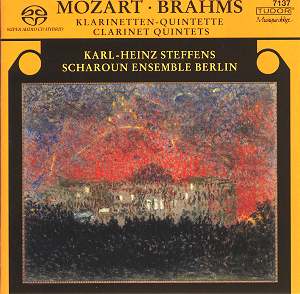
 Scharoun Ensemble Berlin: (Karl-Heinz
Steffens (clarinet), Guy Braunstein (violin
1),
Scharoun Ensemble Berlin: (Karl-Heinz
Steffens (clarinet), Guy Braunstein (violin
1),  TUDOR
7137 [70:44]
TUDOR
7137 [70:44]