During
1946 and 1947 the great Wagnerian tenor Lauritz Melchior was
in Hollywood making films. He had shown his comic talent when
imitating Frank Sinatra. Now MGM saw an opportunity to cash
in on the big Dane, while at the same time Melchior found it
convenient to have “a little vacation from Valhalla”. While
in Hollywood he also recorded a number of 78 rpm sides with
repertoire we don’t normally associate with him: operetta, musical
comedy and some Italian opera arias. Two of the titles are from
the soundtrack of the movie Luxury Liner: track 13 Spring
came back to Vienna and track 27 Helan går, a Swedish
drinking song.
In
a note in the booklet Mark Obert-Thorn comments on the problems
he encountered when making the transfers. All these recordings
were dubbings from other media, so there was already a loss
of quality. Moreover Melchior was miked very closely and to
compensate for the risk of distortion in louder passages the
MGM engineers used limiters, which in effect means that the
dynamic range of his voice is compressed. In spite of these
shortcomings – and the fact that some of the shellacs were rather
noisy – it is still interesting to hear the singer in this repertoire.
Not all the music is really suited to his voice or temperament
but he sings everything wholeheartedly and with great enthusiasm
and his diction is exemplary. His large voice is still in good
shape, remarkably so when one considers his enormously heavy
schedule for so many years, singing 223 Tristans, 183 Siegmunds,
144 Tannhäusers, 128 Siegfrieds, 107 ‘elder’ Siegfrieds, 106
Lohengrins, 81 Parsifals and around 2,100 concerts! It isn’t
as easily produced as it was a few years earlier – I have a
live Lohengrin from the Met, where he is glorious and
even more so in the mid-1930s when he recorded that legendary
first act of Die Walküre with Lehmann and Bruno Walter.
The tone is slightly drier and there are some traces of strain
but it is still good to hear his ring up high and he can scale
down and sing softly, a capacity one can’t always take for granted
with Heldentenöre, not even those a generation younger than
Melchior was at the time.
The
opening number, Hildach’s once very popular Der Lenz,
isn’t very inviting. It is sung as though it were Siegmund’s
Spring Song, at a near-constant fortissimo, glorious no doubt
though not without strain and totally unsuitable to the song
in question. Youmans’ Without a song is more low-key
with several nuances and almost elegant delivery. Dein ist
mein ganzes Herz, sung in English, as are most of the titles,
is heavy and unsubtle – a far cry from Tauber’s caressing tone.
One of the best songs is actually the Danish children’s song
(track 5) where he is simple and unaffected and avoids the operatic
chest-tones. Bizet’s Agnus Dei, which is an arrangement
of the Intermezzo from the Arlésienne suite is straightforward
with admirable tone and conviction, while he croons his way
through Easy to love, backed up by an angelic chorus.
Swings
and roundabouts, as can be seen, and so it continues. Poor Adam’s
Cantique de Noël is belted out while The Rosary
is more intimate, verging on the sentimental. Bach/Gounod’s
Ave Maria is made even more syrupy by having a Hammond
organ playing the introduction and Im chambre séparée
sounds unidiomatic and heavy sung by a male voice. Go to Elisabeth
Schumann for the real thing! Torna a Surriento, sung
in Italian, has glow but misses the elegance of the best Italian
tenors and he should have been fined for shouting Kern’s beautiful
The song is you almost to pieces. Was ist Sylvia?,
Schubert’s masterful song, suffers from being sung in English
and accompanied by full orchestra but he doesn’t lack insight.
The
four opera arias are more his domain but Recondita armonia
is sung at too monotonous a forte, whereas in E lucevan le
stelle he starts meditatively and then expands to a glowing
end. Best of all are the two excerpts from Pagliacci.
He recorded Vesti la giubba in the 1920s and there was
more sap in the voice by then but unfortunately he sang it in
German. Here, in the original Italian, he feels very much inside
the role, one feels the pain and he ends the aria with a deeply
affecting quiver in the voice but shuns the disfiguring sobs
of Gigli or Del Monaco. No, Pagliaccio non son! is a
horrifying thriller, sung with enormous intensity and this will
presumably be the number I want to return to most often on this
disc – unless it be the final song, the Swedish drinking song
Helan går. Actually he opens with an introductory recitative
and then follows a tribute to “Halvan”; then comes the real
treat, a vital and swaggering “Helan går”. And here it might
be convenient to insert a short paragraph explaining the exotic
– some would say barbaric – Scandinavian drinking traditions.
As
Melchior says in his spoken introduction, when Scandinavians
drink their aquavit – or ‘snaps’ as it is in Swedish – with
their smorgasbord, they are prone to sing, and from this tradition
has developed a number of songs, differing from region to region.
Each ‘snaps’ has a number, the first one is “Helan” (The Whole),
then follows “Halvan” (The Half), “Tersen” (The Third), “Kvarten”
(The Fourth), “Kvinten” (The Fifth) and “Sexten” (The Sixth).
It goes without saying that when – mostly also if – they reach
“Sexten” there are very few members of the party still able
to stand up, even less able to sing and if they still manage
the texts they will most certainly be muddled. Lauritz Melchior
is, wisely, content with “Helan” and “Halvan”, although he reverses
the order as I mentioned earlier.
Swings
and roundabouts, no doubt, but it is interesting to have this
greatest of Wagnerians in off-beat repertoire. His involvement
and enthusiasm are never in question. As a bonus those who want
a party feeling can always revel in Melchior’s frothy “snapsvisa”
and his concluding Skål!
Göran
Forsling






















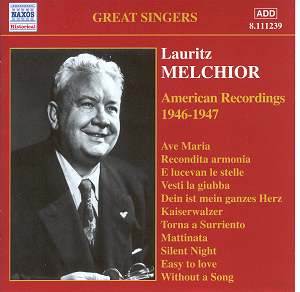

 Lauritz
Melchior (tenor)
Lauritz
Melchior (tenor)