Editorial Board
MusicWeb International
Founding Editor Rob Barnett Editor in Chief
John Quinn Contributing Editor Ralph Moore Webmaster
David Barker Postmaster
Jonathan Woolf MusicWeb Founder Len Mullenger
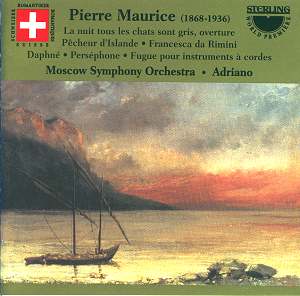
Pierre MAURICE (1868-1936)
Overture, La nuit tous les chats sont gris, Op 35 (1924), [4:51] Pêcheur d’Islande, impressions musicales d’après Pierre
Loti, Op 8 (1895, rev 1911) [23:14] Francesca da Rimini, poème symphonique d’après Dante,
Op 6 (1899) [14:21] Daphné, prélude pour orchestre,
Op 2 bis (1894-7, ed. Adriano) [3:15]
Suite: Perséphone, Op 38 (1930) [27:12]
Fugue for stringed instruments, Op 20 (1901) [5:00] Moscow Symphony
Orchestra/Adriano
rec. Mosfilm Studios, Moscow, January 2003. DDD STERLING
CDS 1053-2 [78:17]
As
obscure as the Swiss composer Pierre Maurice undeniably is
to us today, in his own time he was reasonably well connected.
Amongst his array of teachers were Massenet, Fauré, Lavignac
and Gédalge, he knew Jaques-Dalcroze (see review of his music also on Sterling),
Guy-Ropartz and Koechlin, and his music, which enjoyed performances
across Europe, attracted the attention of conductors such
as Mahler and Weingartner. Curiously for a composer who had
studied in Paris, whose music was titled in French and exhibited
many Francophile characteristics, Germany was the country
where he scored his greatest successes and where he settled
for almost twenty years, returning to his native Switzerland
only after the close of the Great War. However, Maurice was
a devoted follower of Wagner, so it was only natural that
he should look first and foremost to Germany as his spiritual
home. After his death, on Christmas Day 1936 from a suspected
stomach ulcer, his music fell into almost total neglect.
It
is unfortunate that the majority of the works presented here
exist in alternative and better-known treatments by other
composers. Pêcheur d’Islande (“Icelandic
Fisherman”) is Maurice’s “most successful orchestral piece”,
according to Adriano’s very detailed and enthusiastic booklet
notes. It deals with the same story, from Pierre Loti’s famous
novel, as had been covered four years before by his friend
Joseph Guy-Ropartz. Ropartz left us an orchestral suite derived
from incidental music to a stage dramatization. Ropartz’s
three movement suite (reviewed on Timpani
1C1095) was overtaken by Maurice’s,
at least in numbers of performances. Overall though it is
the Ropartz that to my mind retains the greater immediacy
with vivid scoring that lets one taste the salt spray and
feel the motion of the sea. Maurice’s suite, by contrast,
is less evocative of the element and more symphonic in construction.
The two treatments of the wedding (Ropartz’s finale, placed
second by Maurice) are very telling in defining each composer’s
approach. Nonetheless, Maurice’s version is given here in
its 1911 re-composition which reduced the length of the whole,
dropping the original finale and splitting the original third
span into two. It is a finely written work if not quite the “magnificent
score” conductor Adriano claims for it.
Adriano
seems to me still wider of the mark in his assertion that
Maurice’s symphonic poem Francesca da Rimini (1899)
is “the finest of the story’s different symphonic incarnations”.
Indeed he states “in its inspiration, impact, structure and
orchestration I consider it perfect.” Impressive advocacy,
and there is no denying his commitment from the podium either,
but I just do not hear what in Maurice’s rather bland treatment
of the famous episode from Dante’s Inferno can have
inspired such devotion. There is none of the passion or sheer
excitement that one finds in Tchaikovsky’s rightly celebrated
overture-fantasia, written twenty-three years before. Maurice’s
rather Wagnerian piece gives few hints of Dante’s terror
in viewing the condemned lovers, nor the “infernal storm” in
which they are caught up.
The
prelude Daphné was
Maurice’s first orchestral essay, a pretty enough trifle
lasting a little over three minutes. A miniature tone poem,
the prelude has a programme of the composer’s devising based
on the episode from Ovid that also inspired Richard Strauss
in his under-rated opera. However, it was Debussy’s music,
as Adriano points out, that was the starting point and indeed
Maurice retained an impressionist streak in his musical make-up
throughout his life. Yet there is a touch of the Bavarian
in Maurice’s longest purely orchestral work, the diptych Perséphone,
written just three years before Stravinsky’s all-too-neglected ballet-oratorio.
By a strange coincidence, Maurice’s version would also be
staged successfully in 1934. By comparison to Stravinsky’s
work, the Maurice piece seems inflated - although it lasts
under half-an-hour - and bland. The two panels describe successively
Persephone in summer and her abduction by Hades, culminating
in a wild gallop to Hades: the only point where the music
seems to create any real excitement. This is followed by
the desolation of winter and Hades’ eventual agreement to
allow his bride to spend half of the year in the sun. What
Adriano refers to here as “straightforward and fascinating
music” I found turgid and dull, full indeed of the ennui
that the conductor asserts it avoids.
There
are some pluses on the disc, however. The concluding Fugue
for stringed instruments originated as a movement for string
quintet - with double bass rather than second viola or cello.
Given here in its string orchestral version, it comes across
as a well-crafted piece. It seems a shame that it is his
only piece for strings, indeed of chamber music at all. He
preferred to write operas - there are at least seven - plus
a ballet, oratorios and vocal works. The piece that made
the greatest impression on me is the overture to his short,
two-act comic opera La nuit tous les chats sont gris (“All
cats look the same in the dark”). Based on an Italian Renaissance
story, it deals with a pair of Venetian wives, neighbours,
who discover that their husbands are in love with the other
and arrange to switch places at their amorous and wayward
spouses’ trysts. All ends well, of course, and Maurice’s
overture reflects the light and slightly frivolous nature
of the story. It is beautifully orchestrated, too.
Sterling’s
sound is very good and the performances by the Moscow Symphony
Orchestra are mostly well-played. That of the Fugue does
show up a few infelicities of ensemble in the strings.

























 Moscow Symphony
Orchestra/Adriano
Moscow Symphony
Orchestra/Adriano