Editorial Board
MusicWeb International
Founding Editor Rob Barnett Editor in Chief
John Quinn Contributing Editor Ralph Moore Webmaster
David Barker Postmaster
Jonathan Woolf MusicWeb Founder Len Mullenger
Giuseppe VERDI
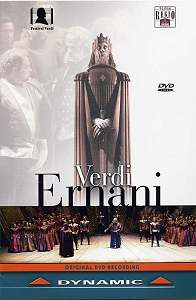
(1813-1901) Ernani - lyric dramain four parts (1843)
Ernani, the
bandit - Marco Berti (ten); Don Carlo, King of Spain - Carlo Guelfi
(bar); Don Ruy de Silva, a Spanish grandee - Giocomo Prestia (bass);
Elvira, Silva’s niece and loved by Ernani - Susan Neves (sop); Don
Riccardo, the King’s equerry - Samuele Simoncini (ten); Jago, equerry
to Silva - Alessandro Svab, (bass)
Orchestra and chorus of the Teatro Reggio, Parma,
Italy/Antonello Allemandi
Performed in the Critical Edition by Claudio Gallico
rec. live, Teatro Reggio, May 2005, annual Verdi
Festival
Director, Set and Costume designer: Pier’Alli
Presented in dts digital surround sound, Dolby,
PCM 2.0. Vision 16:9 Colour
Menu language: English. Subtitles: Italian (original
language), English, German, French, Spanish, Chinese.
Notes and synopsis: Italian, English, German, Italian,
French
DYNAMIC 33496
[126:00]
Ernani is
the fifth opera in the Verdi canon and is based on Victor Hugo’s
play Hernani. It was first performed at the Teatro la
Fenice, Venice, on 9 March 1843. In the Verdi oeuvre it follows
directly after Nabucco and I Lombardi premiered
at La Scala in March 1841 and February 1842 respectively. These
works had been resounding successes and placed the thirty-year-old
Verdi alongside his older compatriot, Donizetti, at the forefront
of Italian opera composers. When the Society that owned the
Gran Teatro la Fenice in Venice assembled to decide on the names
of opera composers for the coming season Verdi was high on their
list. La Fenice was La Scala’s biggest rival in Northern Italy
and was the theatre where Rossini had won international fame
with Tancredi in 1813 and also concluded his Italian
career in triumph with Semiramide in 1823. After that
performance Rossini was escorted to his lodgings by a flotilla
of gondolas, a water-borne band playing a selection from his
score. A success in Venice had its own particular flavour and
the prospect was an attraction for Verdi.
Count Alvise di
Mocenigo, president of La Fenice, entered into correspondence
with Verdi, much of which survives. The composer, aware of his
increasing value drove a hard bargain by which La Fenice would
stage I Lombardi as well as presenting the new opera
to a libretto of Verdi’s own choice. To write the verses he
chose Piave, a native of Venice, and who was to be his collaborator
in many subsequent works. Although the subject of Ernani
had already been featured in operas by others, and even
considered by Bellini, Verdi’s music brought out the story as
no other had done before. Verdi’s Ernani is written in
traditional form with arias, cabalettas and group scenes with
virile chorus contributions an additional attraction for composer
and audience. Verdi brings out the character of the conflicting
roles, and their various relationships, so that each has clear
identification in the music. This manner had, perhaps, been
missing in his earlier successful operas, which had succeeded
on the basis of the popular appeal of their thrusting melodies.
Ernani has a density of musical invention and melody
that is perhaps only matched by Macbeth before being
equalled in Rigoletto, all with libretti by Piave, and
the great mature period operas that followed. Nevertheless Ernani
had only a moderate success at its premiere, the vocal limitations
of some of the soloists being to blame and it had to wait until
productions at Vienna in May 1844, and La Scala six months later,
for full recognition of its qualities. For the La Scala performances
Verdi made additions to the role of Silva. These included an
added cabaletta in act one to accommodate the distinguished
bass of the time and promote the role from comprimario to primo
basso. Ernani was the first of Verdi’s operas to be translated
into English and was admired by George Bernard Shaw.
Ernani remained
in the Italian repertoire in Verdi’s lifetime, falling from favour
in the early part of the twentieth century; even today performances
are scarce. Initially this perhaps reflected a period of suspicion
of early Verdi as being superficial; nowadays a shortage of voices
able to do it justice is a drawback. In the UK, Sadler’s Wells
Opera staged the work around 1967 but did not tour it and I had
to travel to London to catch a first glimpse of it in stirring
performances at the home theatre. Twelve years later Welsh National
Opera and the Royal Northern College of Music shared a production
by Elijah Moshinsky in easily manoeuvrable and evocative sets.
Both have revived the production since and I have not had a bad
night in several viewings with different casts. In view of Verdi’s
easily listened-to melodic invention I am surprised at the paucity
of recorded versions in the original language. As I note in part
1 of my Verdi
Conspectus studio recordings are relatively few. In that medium
the 1967 Rome recording with Bergonzi as Ernani and Leontyne Price
as Elvira remains the best-sung version (RCA), really only being
challenged by the1982 live La Scala performance under Muti of
Luca Ranconi’s production with the starry cast of Domingo, Bruson,
Ghiaurov and Mirella Freni (EMI). This is also available on DVD
and a Review
by a colleague can be seen. The most recent original language
studio recording features the final collaboration on record of
Joan Sutherland and Pavarotti with support from Nucci and Burchuladze
under Bonynge. Made in 1987, it sat in Decca’s vaults for eleven
years before seeing the light of day. To my ears the reason is
not difficult to determine with the diva’s heavy vocal beat, lack
of steadiness and poor diction being only one drawback. A colleague’s
review
is on this site.
When reviewing this
performance on CD I recounted that I had never had a bad
night in the theatre with Ernani in the UK. Being impressed
by the photographs of a resplendent staging in the accompanying
booklet. I conjectured that a DVD might have distracted from
some rather variable singing, particularly from the male soloists.
That is in fact how it turns out. Marco Berti’s rather tight
top is not improved by his wooden acting but his dry tone (Part
1 CH. 4) does warm as the performance progresses (Part 2 CH.
8) and even exhibits signs of vocal sensitivity in the finale
(Part 4 CHS. 4-5). Both Carlo Guelfi as Carlo and Giocomo Prestia
are physically imposing, the latter’s acted portrayal of the
old and implacable Silva being particularly convincing. There
are times also when Carlo Guelfi’s strong tones as Carlo enable
the dramatic situation to come over in a ‘better seen than merely
heard’ manner as when Carlo first threatens dire consequences
on the plotters, but after his elevation to the crown of Charlemagne
is more clement (Part 3 CHs. 4-7). The other side of the coin
comes with Susan Neves as Elvira. She is by far the strongest
and most vocally secure and elegant singer in the cast, but
she tends to float around the stage like a galleon in full sail
in her ornate full-skirted 16th century costumes.
Her introductory Sorte la notte to Ernani involami
(Part 1 CHs. 5-6) is a little tentative, but once into her stride
her full-toned voice, with good variety of tonal colour of modulation,
is a greater strength when heard; her poor acting is a distraction
from her vocal strengths. Antonello Allemandi’s conducting is
variable in tempi between the fast, for the trios of Part 1
and 2, and a more languid approach for the solos where he seems
over-eager to support his singers by allowing time for them
to phrase, but putting them under extra pressure to hold the
vocal line. He ups the tempi for the vibrant choral singing
of Ernani’s troops, which is as viscerally thrilling as early
Verdi scenes of this nature should be, particularly with the
chorus in virile voice as they are here.
Important as the
singing and playing are, which is what you get on CD, the virtue
of DVD is seeing the performance. If the direction, sets and
costumes are true to the composer and allied to even reasonable
acting, many of the limitations of the aural performance are
mitigated. This is the case with this fine staging and production
from Teatro Reggio recorded during the annual Verdi Festival
in May 2005. There are no stage props and the direction and
sets serve to illuminate the plot and the music without the
interference of the dreaded producer concept and which so often
comes, in my case at least, in the way of enjoyment. The theatre
looks quite intimate (CH. 1) and which might indicate a comparatively
small stage area. This would explain the appearance of the rear
stage scenery as appearing curved towards the audience, except
its centre which portrays aspects of Silva’s castle. In Part
3 you will note the large upright effigy of Charlemagne’s tomb;
it swings round to an imposing screen door. The first scene
of Part 1 is rather dark but thereafter lighting and varied,
in-period costume colours give vivid life to the evolving drama.
The director has the chorus well regimented in tableaux form,
which does tend to make some of their marginal out-of-sync movements
rather obvious. As an eminent singer once told me, Italian choruses
do not do acting involvement in the wholehearted and committed
manner of those of British opera companies. But I forgive the
minor visual incongruities for the native squilla and vibrancy
they can bring to their contribution, particularly in early
Verdi, and that is what they do in this performance. The sound
is good although in the finale I detected some momentary echo
on the voices (CHs. 4-5).
The accompanying booklet
has a synopsis, an introductory essay and black and white photographs
of the production. In the usual, but idiosyncratic manner of Dynamic,
the Chapters are numbered from 1 in each part. This doesn’t make
it easy for a critic to go back and double-check details.
Robert J Farr
Please support our advertisers below by clicking on the logos for further information.

























 Ernani, the
bandit - Marco Berti (ten); Don Carlo, King of Spain - Carlo Guelfi
(bar); Don Ruy de Silva, a Spanish grandee - Giocomo Prestia (bass);
Elvira, Silva’s niece and loved by Ernani - Susan Neves (sop); Don
Riccardo, the King’s equerry - Samuele Simoncini (ten); Jago, equerry
to Silva - Alessandro Svab, (bass)
Ernani, the
bandit - Marco Berti (ten); Don Carlo, King of Spain - Carlo Guelfi
(bar); Don Ruy de Silva, a Spanish grandee - Giocomo Prestia (bass);
Elvira, Silva’s niece and loved by Ernani - Susan Neves (sop); Don
Riccardo, the King’s equerry - Samuele Simoncini (ten); Jago, equerry
to Silva - Alessandro Svab, (bass)  [126:00]