Editorial Board
MusicWeb International
Founding Editor Rob Barnett Editor in Chief
John Quinn Contributing Editor Ralph Moore Webmaster
David Barker Postmaster
Jonathan Woolf MusicWeb Founder Len Mullenger
Charles-Henri
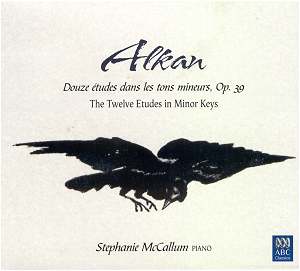
Valentin ALKAN(1813-1888)
Douze Études dans les Tons Mineurs Op. 39 Comme le vent (Like the wind) (A minor) [5:30] En Rythme Molossique (In Molossian Rhythm) (D Minor) [8:44]
Scherzo Diabolico (G minor) [4:30]
Allegro (C minor) [10:37]
Marche Funèbre (F minor) [6:53]
Menuet (B-flat minor) [5:41]
Finale (E-flat minor) [4:44]
Allegro Assai (G-sharp minor) [30:48]
Adagio (C-sharp minor) [11:51]
Allegro alla Barbaresca (F-sharp minor) [11:03]
Ouverture (B minor) [15:49] Le Festin d’Esope (Aesop’s Banquet) (E minor) [9:50] Stephanie
McCallum (piano)
rec. 28 July 2004 (4-7); 11 February 2005 (1-3); 6 October
2005 (8-10); 12 December 2005 (11); 6 December 1999 (12),
Eugene Goossens Hall of the Australian Broadcasting Corporation’s
Ultimo Centre, Sydney. DDD ABC CLASSICS
4765335 [46:44 + 79:31]
First,
we need to get the ‘Guinness Book of World Records” aspect
out of the way. With this recording Stephanie McCallum becomes
the first person in the world to record the complete Alkan Études
Opp. 35 and 39, having recorded the Op. 35 major-key études
in 1995. Secondly, it must be said that all the descriptors
usually applied to Alkan’s music: virtuosic, formidable,
super-human - could as easily be applied to Ms. McCallum’s
performances on these discs. Thirdly, like Liszt’s Transcendental Études,
the Alkan études can be listened to in part, but yield new
emotional and structural values when listened to as a whole.
Stephanie
McCallum has long been known as an exponent of Liszt and
Alkan, as well as of contemporary music. Indeed, she has
recorded some of the Op. 39 before. But in this set she not
only demonstrates the supernal technique necessary for Alkan
but also an over-arching sense of the entirety of the twelve études.
In addition she demonstrates an attention to detail within
each piece that enables one to explore aspects of Alkan not
usually thought of amidst all the bravura.
Alkan’s études
are frequently considered his masterpiece. Certainly they
represent both a peak of pianistic difficulty at the same
time as encompassing Alkan’s largest structures - four of
them (nos. 4-7) comprise a full-scale symphony while nos.
8-10 represent a complete fifty-five minute piano concerto.
Both these works are justly famous for their differentiations
among “instruments” in the piano writing. The Concerto is
followed by an overture and a set of twenty-four variations
on an original theme while a true étude (no. 1) is followed
by a study in rhythm and a scherzo.
I
called the first étude (Comme le vent) a true étude
because it is exactly that - a study in fingering
at the same time that it excellently portrays various wind
effects. Ms. McCallum not only negotiates the technical demands
with complete assurance, but also ensures that all that virtuosity
does not cloud innate musical values. The second étude (en
rythme molossique) refers to a poetic form involving
three syllables to a metrical foot. I find this the least
interesting of the twelve pieces. The Scherzo diabolico is
exactly that - showing a quality frequently associated with
Alkan plus an inexorable quality worthy of La Damnation
de Faust. Ms. McCallum brings out all these aspects brilliantly.
We
now come to the four pieces comprising the symphony: Allegro,
Funeral March, Minuet and Finale. The Allegro is full of
delightful music, showing a Schumannesque side to Alkan’s
personality. Ms. McCallum has just the requisite touch for
this type of music as well as for the more symphonic aspects
of the piece. Her cascades of notes leading to a dead stop
of a finale are thrilling. The funeral march - perhaps this
gave an idea to Taneyev for his piano concerto - is slightly
jaunty with a more normal, contrasting second theme. Ms.
McCallum keeps the various melodic lines distinct in spite
of the large groups of notes she has to play. Given a jaunty
funeral march, a frenetic minuet is perhaps not too surprising.
However, in the contrasting trio we return to more normal
territory, although I felt the pianist did not manage this
transition well. The Finale continues the restless feelings
of the previous movement: a rondo-form (more or less) eventually
leading back to Schumannesque elements. This is followed
by a brilliant finale that Ms. McCallum takes almost too
fast, if that is possible, involving negotiating cascades
of notes before a definitive ending to the entire Symphony.
If
the Symphony is compact in form and clear in harmony the
Concerto (8-10) is very long, rather dense, and relies more
upon thematic differentiation, although its structure is
equally clear-cut. The opening Allegro provides a lovely
contrast of thematic material and the central Adagio is in
many ways the highlight of the twelve études. Here the legato
playing is beautiful and precise - Ms. McCallum demonstrates
her great knowledge of Alkan’s music with her phrasing and
sense of dynamics. The final Allegro Barbaresco again shows
the composer’s sense of humour although this gives way to
a whirlwind of notes requiring the pianist to range all over
the keyboard. Ms. McCallum ably dispatches these while not
forgetting the overall sense of the movement.
After
the excitement of the Concerto the Overture is something
of a letdown although the soloist is in even more control
of the glissandi and roulades than was evidenced in the last
movement of No. 10. Alkan’s quick changes of mood and tempo
are very evident here. The last étude is Aesop’s Feast with
a theme and two dozen variations, each variation eight bars
long. This is one of Alkan’s best-known works and one that
requires a great variety of techniques in a comparatively
small space of time. One should mention Ms. McCallum’s playing
of the tenth and sixteenth variations as especially noteworthy.
The
recording quality on these discs is serviceable, but the
sound could be both warmer and a little closer in, although
this is only a small problem. While most of the Op. 39 études
have been recoded individually several times and there have
been two or three complete sets recorded, notably the 1976
Ronald Smith discs, Ms. McCallum’s version is the one to
have. Her combination of pianism, enthusiasm and completeness
cannot be topped.
William Kreindler
Please support our advertisers below by clicking on the logos for further information.

























 Stephanie
McCallum (piano)
Stephanie
McCallum (piano)