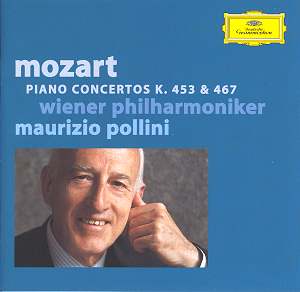
A wonderful disc
in many ways. Pollini has never taken off as a conductor, but
he did record a Rossini opera (La donna del lago) and
he has previously directed orchestras in concertos. I heard
him as long ago as 1982 with the ECO in Manchester's Free
Trade Hall in Nos. 14 and 17; then again a few years later at the
Queen Elizabeth directing No. 21 - the orchestra escapes me.
This is his first
Mozart concerto recording minus the intermediary of a separate
conductor. As such it opens a new chapter in Pollini's recorded
legacy. The 'live' element brings an added edge to the concertos
along with the occasional characteristic Pollini singalong
or gruntalong!
Pollini played
No. 17 in the above-mentioned Manchester concert; the first
time I encountered great pianism. His Vienna reading is perhaps
a little less spontaneous, yet it contains myriad details culled
from a lifetime's experience. Similarly, the VPO - perhaps
as a result of his conducting - seem a little lacklustre. Amazingly
it is easy to forget the greatness of the orchestra and instead
concentrate on Pollini's contribution. Yet Pollini's playing
is consistently insightful, clear and always supremely intelligent.
For the G major,
he plays Mozart's own cadenzas, always with conviction. The
slow movement is a dream - here, more than in the first movement,
one feels soloist and orchestra are working as one. Interestingly,
in an online interview,
Pollini refers to Mozart's cantabile; in his Mozart Year
recordings, Martino Tirimo also refers to the vocal - specifically
the operatic - nature of Mozart's piano writing. It is in the
slow movement that this concept is most evident. The
finale continues the good work. Pollini's left-hand dexterity
is a marvel and here his direction of the orchestra is surer.
The structure of the movement is as clear as Pollini's articulation,
the coda appearing as the perfect way to close, bustling with Figaro-like
energy.
The concerto K467
is arguably the most popular of the cycle. Maybe that is why
Pollini intriguingly used cadenzas by his contemporary, Salvatore
Sciarrino, to add a new dimension? A daring and provocative
move, it adds a further layer of interest to the experience.
The first movement
balances the tense opening with moments of tender relaxation.
At times it almost seems as if Pollini is loving the music
as he plays - a very uncharacteristic trait, one might argue.
Sciarrino's cadenza is exploratory - more so than most - but
remains within its Mozartian remit. The famous Andante features
string lines spun of the finest silk and speaks of truly Mozartian
repose. True, there is angst in the sforzandi around
the 4:40 mark, but this seems to highlight the prevailing calm.
The finale begins in the spirit of opera buffa before a short
extempore from Pollini. Energy abounds here, with Pollini eschewing
any temptation to needlessly indulge in rubato. The cadenza
is a veritable explosion, and so acts as a logical extension
of Mozart's inexhaustible energy. This is tremendous, life-affirming
Mozart playing, marking Pollini's welcome return to this territory.
Colin Clarke



 Vienna Philharmonic
Orchestra/Maurizio Pollini (piano).
Vienna Philharmonic
Orchestra/Maurizio Pollini (piano).