For many people the
German baroque is first and foremost
represented by Johann Sebastian Bach.
But in his time his colleague Georg
Philipp Telemann was by far the most
celebrated composer in Germany. There
are a number of reasons for this, but
probably the two most important are
that Telemann composed for a wide circle
of music-lovers, from amateurs to professional
players, and that a large part of his
musical output was published during
his lifetime, mostly by himself. Today
Telemann is still a very popular composer
among instrumentalists, as the many
recordings of his orchestral and chamber
music testify, but among the public
at large he is not always valued. It
is perhaps necessary to be a player
yourself to really appreciate the quality
of Telemann's compositions and his idiomatic
writing for every single instrument
– one of the features of his compositional
style.
Bach and Telemann were not just colleagues:
they knew each other well, and had a
friendly relationship, as the fact that
Telemann became the godfather of Bach's
son Carl Philipp Emanuel shows. In his
autobiography Telemann appears to be
a rather modest and friendly character,
without a big ego. He not only was on
friendly terms with Bach, but also with
Handel, with whom he corresponded, among
others, about their mutual interest:
flowers. In a way one could call Telemann
a 'multicultural composer', as he travelled
a lot – hence the title of this disc:
'Virtuoso traveller' – and incorporated
everything he heard into his own music.
Here we not only find characteristics
of the traditional German style – in
particular polyphony – but also influences
of the Italian and the French styles
as well as traces of Polish folk music.
His chamber music reflects
his versatility as a composer, as he
used several forms and several styles
and wrote for almost every instrument
around. Four of the six pieces on this
disc are from the last collection of
music he published, 'Essercizii Musici'.
When the publication was advertised
in 1740 he announced his withdrawal
from publishing. The collection consists
of 12 solos – sonatas for one instrument
and bc – and 12 trios. The form of the
trio sonata was something he especially
valued: "I paid particular attention
to trio-composing, and so arranged it
that the second part seemed to be the
first, and the Bass developed in a natural
melody and in closely following harmony,
every note of which had to be this way
and not any different. People sought
to flatter me, too, saying that I had
shown my best powers in this composition."
The many trio sonatas
Telemann composed are evidence of his
love for this form, and they are well-represented
in the catalogue. One wonders why they
are so often recorded, whereas other
pieces in Telemann's output are still
neglected. Having said that Amarillis
has made a good choice for this disc,
in which tradition and innovation are
represented. The trio sonatas scored
for two treble instruments – recorder,
oboe or violin – and bc are examples
of tradition: many works of this kind
were written in the first half of the
18th century in Germany and elsewhere.
The first item on the disc, which is
not in the collection, also belongs
to this category. The innovation comes
with the sonatas with obbligato harpsichord
– unusual at the time, and the first
sign of the emancipation of the keyboard
from a mere basso continuo instrument
in the ensemble.
There is much to enjoy
in this recording. The playing is lively,
the fast movements are played at the
appropriate speed, and there is no lack
of expression in the slow movements.
But there are some minuses which can't
be overlooked. I like the ornamentation
the players are adding, but there is
some inconsistency here: in some movements
there is plenty of it, whereas in others
there is very little. The same is true
for the use of accents and the differentiation
between notes. The first two movements
of the first item of this disc, the
Trio Sonata in d minor, are quite different
in this respect. In general I had liked
more contrasts in dynamics and articulation.
The sound of the violin
is a bit thin: I have heard players
with a fuller and stronger tone than
David Plantier produces here. As a result
the balance between the violin and in
particular the oboe (Sonata in g minor)
is not ideal. That is also the case
in the sonatas with obbligato harpsichord
– the latter is playing the second fiddle,
which is contrary to Telemann's intentions.
This probably is a matter of recording
technique.
There are some moments
when the tempo slows for a moment –
something which can be used to great
effect for rhetorical reasons, but here
they seem a little arbitrary, for instance
towards the end of the last movement
of the last sonata on the programme.
In that movement the rhythmic pulse
is enhanced by a prominent role of the
archlute, partly used as a percussion
instrument. This seems to be the fashion
of the day, which I definitely don't
like. In this movement it is something
not called for. The same happens in
the last movement of the first sonata,
but there it is part of a specific interpretative
approach, as Héloïse Gaillard
writes in the booklet: "we have chosen
to underline the folk-like character
with a hurdy-gurdy effect in the violin's
double stops". Whether one likes it
or not, from this perspective the adding
of percussive elements makes sense.
The sonata for cello
and bc comes from another of Telemann's
collections, 'Der Getreue Music-Meister'
of 1723. It must be one of the first
sonatas for cello in Germany, where
at the time the viola da gamba was still
very dominant. Emmanuel Jacques gives
a lively and contrasting performance,
although not always very subtle.
To sum up: these are
generally good and enjoyable performances
of fine music, but inconsistent and
unbalanced in some respects. For the
complete collection 'Essercizii Musici'
the best choice is still Camerata Köln
(deutsche harmonia mundi).
Johan van Veen
























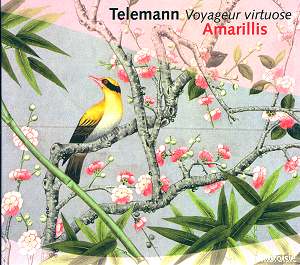
 Amarillis: (Héloïse Gaillard
(recorder, oboe); David Plantier (violin);
Emmanuel Jacques (cello); Laura Monica
Pustilnik (archlute); Violaine Cochard
(harpsichord))
Amarillis: (Héloïse Gaillard
(recorder, oboe); David Plantier (violin);
Emmanuel Jacques (cello); Laura Monica
Pustilnik (archlute); Violaine Cochard
(harpsichord))