Editorial Board
MusicWeb International
Founding Editor Rob Barnett Editor in Chief
John Quinn Contributing Editor Ralph Moore Webmaster
David Barker Postmaster
Jonathan Woolf MusicWeb Founder Len Mullenger
Buy
through MusicWeb
from £15.80/16.60/17.10 (SACD) &
£14/14.75/15.30
(CD)
postage
paid. You
may prefer to pay by Sterling cheque or
Euro notes to avoid PayPal. Contact
for details
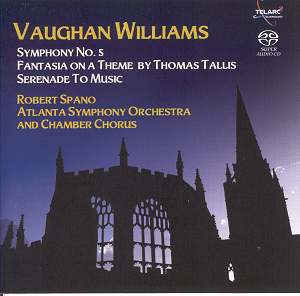
Thomas TALLIS (1505-1585) Why fum’th in fight? (1567)[0:54] 1 Ralph VAUGHAN WILLIAMS (1872-1958) Fantasia on a Theme by Thomas Tallis (1910) [16:17] 2
Symphony No. 5 in D major (1943) 3 Serenade to Music (1938) 4 4Jessica
Rivera (soprano); 4Kelley
O’Connor (mezzo); 4Thomas Studebaker (tenor); 4Nmon
Ford (baritone); 1,4Atlanta Chamber Chorus; 2Cecylia
Arzewski (violin 1); 2David Arenz (violin 2); 2Reid
Harris (viola); 2Christopher Rex (cello); 2-4Atlanta
Symphony Orchestra/Robert Spano
rec. Woodruff Arts Center, Symphony Hall, Atlanta, 25 September, 1, 3 October
2006. DDD TELARC SACD-60676 [70:32]
(also available as normal CD: CD-80676)
Now
here’s an innovation, prefacing Vaughan Williams’ Fantasia
on a Theme by Thomas Talliswith a performance of
the theme to its original words, Why fum’th in fight? which
make clear this is a song of protest. However, this edge
isn’t altogether evident in Spano’s Fantasia. Perhaps
the achievement of sheer density of string sound clearly
caught in surround sound leads to more focus on sonority
and balance than rhythm and drama. The opening is smooth,
almost pastoral, that natural swaying motif in the lower
strings slightly wary and then an untypical dramatic and
therefore very effective sudden fp (tr. 2 1:00) calls
you to attention to introduce the theme. This is rich and
imposing with the shimmering first violins’ descant, its
repeat treated with great breadth but not really appassionato as
marked. The declamatory first orchestra and devotional smaller
second orchestra are neatly differentiated but I feel the
string quartet of soloists, whose contributions are movingly
expressive, are a little too much in the foreground. Spano’s
approach as the piece develops is consistently broad but
the climax (11:02) is a little lacking in bite because the poco
a poco animando from 10:30 leading up to it is too careful.
I
compared the 1962 recording by the Sinfonia of London/John
Barbirolli (EMI 5672642). This has an opening of more pristine
calm, a great fiery surge of appassionato repeat of
the theme and more startling dynamic contrasts between the
two orchestras. The section featuring solo quartet is notably
more animated, as marked, which gives it a freer, more folksong
like character. Spano’s approach here is more emotive, paying
more attention to the tempo rubato marking, but this
slows things down to a point from which it’s more difficult
to generate pace up to the climax. At that climax Barbirolli’s
greater animation aids the lyrical outpouring and creates
an effect almost of spontaneous combustion culminating in
a great declamation. Not as scrupulous in balance as Spano
but more gripping in outcome.
Spano’s
SACD continues with Vaughan Williams’ Fifth Symphony,
a work of similarly strong contrasts. In this recording the
significance of the cellos and double-basses’ groundswell
is always clear. From the start they move everything purposefully
forward. So here’s a calm of sure progression, indeed of
urgency of continuity of theme as the first violins go into
upper tessitura (tr. 3 2:15). The second theme and change
to E major (3:27) comes like a sudden blessing. The development
(5:25) clearly pitches the half-lights of swaying pianissimo strings
against a sinister falling motif in the wind. Spano makes
its climax sufficiently stormy without upstaging the greater
blaze of the second theme’s return (8:37) in the recapitulation.
Spano
is sensitive to the contrasts within the second movement
Scherzo: a feathery opening of misty, muted strings, then
a jocular theme which bounces along. The first Trio features
a rather gaunt tune in cor anglais, clarinets, bassoons and
horns (tr. 4 1:57). The second Trio (3:38) is chirpy. The
magical moment is at 4:24 when the fast opening and recurring
material is presented becalmed, as a kind of yawning stretch.
Vaughan
Williams headed the manuscript of the third movement Romanza with
a quotation from The Pilgrim’s Progress: “Upon that
place there stood a cross and a little below a sepulchre.
Then he said, “He hath given me rest by his sorrow and life
by his death”” and these latter words are sung in Vaughan
Williams’ opera by the Pilgrim to the first theme of this
movement, a rich cor anglais solo as provided bySpano
after a rapt strings’ backcloth. This is followed by a strings’ meditation
of great humanity and density. Yet Spano allows the movement
to unfold easily, with woodwind arabesques creating an active
atmosphere which leads logically into a more restless development
(tr. 5 5:40). The recapitulation (8:10) provides a consolation
of luminous warmth presented first by the orchestra as a
vast community, then in terms of individual souls through
the solos in the coda of violin, horn, viola and cello.
The
Passacaglia finale in Spano’s hands has a spring in its step,
gusto to the close of the opening section and a paean of
triumph about it as the brass open the second section (tr.
6 1:41) confirmed by its thrilling climax and that vivid
capping of the horns and trumpets’ ff chord by trombones
and bass trombone at 3:25 to usher in the third section,
a resolute course charted through more shadowy paths. But
at 6:13 comes the return of the symphony’s opening and coda,
the violins’ material tenderly recalled before a warm, expansive
version at 7:27 of the passacaglia’s counter-melody. Spano
shows the breadth and repose this movement has hastened towards.
I
compared the only other recording on SACD, made in 1997 by
the London Symphony Orchestra/Richard Hickox (Chandos CHSA
5004). Here are the comparative timings:
I
II
III
IV
Total
Spano
12:10
5:09
11:50
10:21
39:30
Hickox
12:14
4:57
12:01
10:00
39:30
The
Chandos recording has more sense of space and dynamic contrast;
the Telarc is more of a close-up experience. Despite an identical
overall timing, Spano’s first movement is more
urgently presented. Hickox favours a more patient evolution.
His second theme has a lighter assurance than Spano’s. From
his opening sensitive pp strings Spano makes the development
more dramatic but the clear directness of his recapitulation
doesn’t have the composure or burnished climax of Hickox.
Spano’s climax is more formal.
Hickox’s
Scherzo is all finesse, a shimmering haze of mysterious activity.
The first Trio is still other-worldly, the second spicier.
I prefer Spano’s firmer articulation, more pointed humour
to the oboe and cor anglais interventions from tr. 4 0:58.
There’s more sense of activity, a jauntier swing. Spano’s
first Trio theme is more deliberate and the movement’s closing
becalming seems more natural if less smooth.
In
the Romanza Spano’s more heart-on-sleeve approach
and more sonorous strings are more moving, though Hickox
creates more of an unearthly stillness in the opening and
his more pointed contrasts in tempi give more sense of fervour.
He brings drama to the development but Spano is still starker.
Hickox’s woodwind arabesques are more poised, Spano’s more
natural. In the recapitulation the LSO strings have a golden
sheen but the Atlanta orchestra displays an even finer breadth.
Hickox’s
Passacaglia has an easy flow and sense of blossoming. Its
second section is sunny, full of joy and life, its third
section a beauteous sorrow, the closing counter-melody more
emotively presented than on the Telarc disc but the violins
at the end quieter and more ethereal. Spano’s opening has
more urgency, his second section more majesty. His third
section is slower which makes it more intently troubled,
his working to a climax more arduous than Hickox’s but his
closing counter-melody then a smoother acknowledgement of
journey’s end. Overall, I’d say honours are about even.
Finally
on this SACD Spano brings us a work of comparable serenity,
the Serenade to Music, Vaughan Williams’ selected
setting of the dialogue between Lorenzo and Jessica at the
beginning of the final scene of Shakespeare’s The Merchant
of Venice. It’s all idealization, ‘How sweet the moonlight
sleeps upon this bank’, but the musical setting matches the
charm of the poetry. The violin solo in the introduction,
beautifully played here with gentle touches of portamento, makes
it an assured personal reverie. The chorus to those opening
words is as balmy as you could wish. But there’s an incandescent
centre as well when the tenor soloist pictures in fiery fashion
angelic song (tr. 7 5:10) and the chorus affirms with strength
the harmony of immortal souls (5:31). Not just then the limpid
ascent of the opening and closing soprano solo nor the greater
warmth of the emotive mezzo’s ‘Music! Hark!’ (9:15).
The
work was originally scored for sixteen vocal soloists who
also made up the chorus. Spano here presents one of the practical
variants authorized by the composer: four soloists and chorus.
The disadvantage is that the distinction of timbre between
the soloists is thereby lost, notably in the bass where ‘The
reason is, your spirits are attentive’ (7:55) requires a
baritone solo but ‘The motions of his spirit are dull as
night’ (8:36) a basso profundo. I compared the 1969
recording by Adrian Boult and the LPO
(EMI 7640222) which uses sixteen soloists. Vocally this is
preferable because of the subtle distinctions. Another example
is ‘Come, ho! And wake Diana with a hymn’ (6:35). For Boult,
Sheila Armstrong is more assertive here than Norma Burrowes
in the opening solo, but still pearly and both gain from
lacking the vibrato of Spano’s soloist. On the other hand
a benefit Spano and the surround sound bring is a more sensuous
orchestral backcloth, especially for the opening chorus where
it seems lovingly to wrap around the voices.
In
sum, this is a well-balanced programme of perceptive performances.
At its best, in the inner movements of the symphony, it’s
very convincing.
Michael
Greenhalgh
Please support our advertisers below by clicking on the logos for further information.






















 for details
 4Jessica
Rivera (soprano); 4Kelley
O’Connor (mezzo); 4Thomas Studebaker (tenor); 4Nmon
Ford (baritone); 1,4Atlanta Chamber Chorus; 2Cecylia
Arzewski (violin 1); 2David Arenz (violin 2); 2Reid
Harris (viola); 2Christopher Rex (cello); 2-4Atlanta
Symphony Orchestra/Robert Spano
4Jessica
Rivera (soprano); 4Kelley
O’Connor (mezzo); 4Thomas Studebaker (tenor); 4Nmon
Ford (baritone); 1,4Atlanta Chamber Chorus; 2Cecylia
Arzewski (violin 1); 2David Arenz (violin 2); 2Reid
Harris (viola); 2Christopher Rex (cello); 2-4Atlanta
Symphony Orchestra/Robert Spano  [70:32]