It’s been four years
since a stereo only recording of Dido and Aeneas has
appeared. I shall compare this new one from Valentin Radu with
his predecessor, Le Concert d’Astrée/Emmanuelle Haim (Virgin
5456052). Purcell’s only full opera is a difficult work to perform
because everything happens so quickly there’s little time to
get all the effects right. Radu starts well with an Overture
whose introduction is quite pacy before a second section, marked
‘Quick’ still more so, which gives an impression of extreme
bustle, restless and urgent. Haim’s quick section is lighter
and friskier. Radu throughout uses strings only with theorbo
or baroque guitar and harpsichord. This gives an intimate, small
scale theatre feel. Haim doubles the strings at times with oboes,
recorders and bassoon and also uses organ and archlute continuo.
This makes for a somewhat grander effect and allows her the
opportunity of contrast in repeats by adding or removing the
doubling instruments. Overall this makes a more vivid impact.
For Radu Andrea
Lauren Brown is cajoling as sister Belinda in her arioso to
Dido, Shake the cloud from off your brow, with arrestingly
florid ornamentation for the repeat of the refrain. For Haim
Camilla Tilling is more assertive, a queen in waiting. Radu’s
chorus of courtiers, Banish sorrow, banish care, has
a more rugged than smooth character. Haim’s chorus is more assured
and courtly, as it is generally.
For Radu Julianne
Baird’s Dido is a passionate, imposing presence in her opening
aria, Ah Belinda, I am press’d with torment but with
a recurring element of sotto voce, for example at ‘I
languish’ (tr. 3 1:41) vividly conveys the personal, secretive
quality about the infatuation which haunts this aria. Her generous
application of ornamentation on repeats, however, suggests rather
more artifice in her make-up though the crestfallen quality
Radu gives the orchestral ritornello which concludes the aria
mirrors her earlier sotto voce. For Haim Susan Graham’s
Dido combines a fiery imperiousness and melting sorrow impressively
but is less engaging because less womanly. She makes the aria,
which is marked ‘Slow’ more stately, taking 4:06 against Baird’s
3:20. By varying the tempo in the following recitative Baird
sensitively contrasts the soft and fierce aspects of Aeneas
and then provides an eloquent indication of her capacity for
pity. She does this more effectively than Graham. Also in this
Lyrichord recording the Second Woman is better differentiated
from Belinda and Dido by being a little further back which puts
her firmly in her place in the hierarchy. Similarly she’s very
much the backdrop in her duet with Belinda, Fear no danger
to ensue, which is fair enough given that Belinda has the
top Gs and adds showy ornaments.
For Radu Timothy
Bentch’s Aeneas emphasises the lyrical overmuch at the expense
of the dramatic with the result that by his second recitative
he’s in bleating mode. For Haim Ian Bostridge presents a more
manly, rounded Aeneas. For Radu Belinda’s Pursue thy conquest,
Love is too savoured, not conveying the momentum intended
by the marking ‘Quick’. Haim’s Belinda has a more breathless
character. Yet Radu’s following chorus and Triumphing Dance
have the requisite eagerness, the orchestra with the folksy
decking of harpsichord and baroque guitar.
In Act 2 Scene 1
for Radu Tatyana Rashkovsky’s Sorceress has an appropriate archness
but her diction and intonation falter from time to time. Curiously
this makes her more exotic. The First and Second Witch are unctuously
attentive and their duet, But ere we this perform, is
of spiteful clarity and relish. The chorus of witches has great
fun with Harm’s our delight and a closing shriek as a
bonus. Their Ha ha chorus is a true cackle but the fast
tempo given to the echo chorus blunts its venom. The echoes
are distant and sepulchral but the effect should be just as
marked for the soft passages in the following Echo Dance of
Furies. For Haim Felicity Palmer’s Sorceress has surer tone
and malevolence only thinly veiled but the witches, singly and
in chorus are more and I’d say too polite, Haim’s emphasis being
on the virtuosity of Purcell’s music.
In Act 2 Scene 2
for Radu Belinda’s Thanks to these lonesome vales is
pleasingly savoured and stylishly ornamented, a case where all
the artifice of the court is appropriate, but the chorus repeat
takes a while to match her assurance with its own ornaments.
Haim’s Belinda is too intense here though her chorus is more
relaxed. From Radu the Second Woman’s Oft she visits this
lone mountain, the one ground bass aria not sung by Dido,
disappointingly lacks tension because, timing at 1:40, it’s
taken too slowly whereas Haim at 0:57 takes it too quickly which
blunts the tension that is nevertheless more apparent. For Radu
Belinda’s Haste, haste to town and the chorus repeat
are delivered with a trim clarity that impairs the momentum
better realized by Haim. Fran Bjomeby Kraemer’s Spirit of the
Sorceress for Radu is distinguished by being distanced in a
supernaturally reverberant acoustic but her wobbly vibrato is
less effective. Haim uses a countertenor, David Daniels, which
creates a supernatural effect without any distortion of tone.
For Radu Bentch’s Aeneas makes the best of his arioso Jove’s
commands shall be obeyed, taking his time to show his emotions
unfolding, with an anguished rising ornament on ‘weigh’d’ and
fine sotto voce effects beginning at ‘But ah’ (tr. 10
1:13), though the expansive added appoggiatura on the
final ‘die’ veers towards indulgent self pity. For Haim Bostridge,
resolute but tormented, is more convincingly heroic if not as
human as Bentch.
Come Act 3 Scene
1 for Radu Dennis Kalup’s First Sailor is unmemorable and rather
upstaged by the guitar accompaniment just as the livelier chorus
repeat is by an added tambourine, a nice touch which continues
in the following Sailors’ Dance. For Haim Paul Agnew sports
an appropriate sailor class accent, after which the chorus seems
curiously posh. Radu’s First and Second Witches’ duet, Elissa’s
ruin’d! ho ho! inhabits an uneasy midpoint between being
fast and cackling and slow and malicious. The following chorus
settles on cackling. Haim’s witches, as earlier, focus on the
virtuosity of Purcell’s music and the chorus is again too polite
but her Witches’ Dance, beginning quietly and later growingly
flamboyant, is itself a bit of magic.
For Radu Baird’s
arioso opening the final scene, Your counsel all is urg’d
in vain, sets the tone of tragic dignity and nobility within
the context of a personal affront. The exchange of recitative
and duet with Aeneas is taken quite slowly to well considered
effect. A crestfallen Aeneas turns to a desperate one while
Dido throughout has a concentrated understanding of the situation.
For Haim Graham’s arioso has a passionately regal, epic quality.
Aeneas is sorrowful but resolute, then changes his resolution.
For Radu the chorus Great minds against themselves conspire
is rather matter-of-fact in its pacy approach where Haim gives
it a more epic sense of philosophy, mirroring Dido’s immediately
preceding clearsightedness. For Radu Baird brings moving anguish
and pathos, as well as courageous resolve to Dido’s Lament.
Consistently for Haim Graham shows a more epic quality of epitaph,
though the final ‘Remember me’ is softened, as Baird does for
the entire repeat. In the final chorus Radu shows how the smooth
formality of funeral rite gives way to a growing personal protest
from ‘Soft and gentle’ (tr. 16 0:53) as the rhythms break up.
Radu realizes this more starkly than Haim and also makes the
repeat on instruments alone.
As a bonus Radu
gives us ten instrumental items from The Fairy Queen,
the semi opera, that’s half opera, half play. It’s an anonymous,
very free adaptation of Shakespeare’s A Midsummer Night’s
Dream, but that’s not enough reason to call this bonus A
Midsummer Night’s Dream suite. It begins with the Prelude
before curtain up, played with fair gusto but the first section
repeat quieter, as is consistently done with repeats. Next the
Hornpipe, also before curtain up, neatly articulated with an
airy skipping quality but rather thin in tone. Then the Overture
in Act 3, Symphony while the Swans come forward, begins
more gracefully but its second section is rather shapeless.
The following item, here called ‘Air’, is the Prelude to Act
3, an instrumental version of the soprano song If love’s
a sweet passion which is played with an unassuming grace.
This is followed by the Rondeau from the music before curtain
up, played lightly and fleetly. Now comes the vibrant Prelude
to Act 2 which has a fair density because of the crisp handling
of the semiquaver clusters. The Entry Dance from Act 5 is next
and is light on its toes. The Third Act Tune Hornpipe is nifty,
followed by, also from Act 3, the Dance for the Fairies,
clearly and deftly articulated, the small scale appropriate
to fairies. Finally comes the closing Chaconne which goes with
a fair swing and is generally crisply done. The third appearance
of the ground (tr. 26 0:23) is delicate, the fourth (0:35) jauntier,
though the seventh (1:08) needs to be gentler with a bit more
space and the twelfth (2:17) more jubilant before the triumphant
thirteenth (2:29). As sometimes here and in Dido, a little
more density of string tone would be advantageous.
There are sound
samples for all tracks available on the Lyrichord website. To
sum up, this CD is good in parts, especially Baird’s Dido, but
it’s not consistently effective.
Michael Greenhalgh
























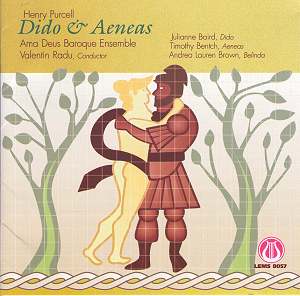

 Dido: Julianne
Baird (soprano)
Dido: Julianne
Baird (soprano)