Editorial Board
MusicWeb International
Founding Editor Rob Barnett Editor in Chief
John Quinn Contributing Editor Ralph Moore Webmaster
David Barker Postmaster
Jonathan Woolf MusicWeb Founder Len Mullenger
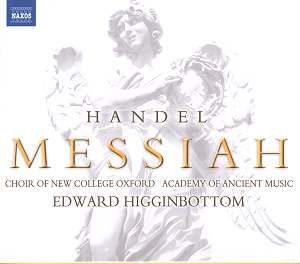
George Frideric HANDEL (1685-1759) Messiah - oratorio in three parts (1751 version)
(HWV 56) Henry Jenkinson;
Otta Jones; Robert Brooks (treble); Iestyn Davies (alto); Toby
Spence (tenor); Eamonn Dougan (bass)
Choir of New College Oxford
The Academy of Ancient Music/Edward Higginbottom
rec. January 2006, St John's, Smith Square, London, UK. DDD NAXOS 8.570131-32 [69:14
+ 73:05]
Today Handel's Messiah is
definitely his most popular piece, judging by the numerous performances
all over the world,
and by the long list of recordings. In England it has become
a kind of national monument. But that hasn't always been
the case, and certainly not in England in Handel's own time.
It was only from 1750 onwards that Handel began to perform
it annually; in the years between 1745 and 1749 his attempts
to revive it were far from successful. When it was first
performed in London in March 1743 it received a mixed reception.
Some people took offence at the fact that the performances
were given in the Covent Garden Theatre, with opera singers
as soloists. The Universal Spectator published a letter which
said: "An oratorio either is an Act of Religion or it
is not; if it is, I ask if the Playhouse is a fit Temple
to perform it in, or a Company of Players fit Ministers of
God's Word".
How different the reception was when it was first performed in Dublin
in April 1742! In the autumn of 1741 Handel had received
the invitation to perform his music in Ireland, and in December
the first concert with some of his vocal works took place
to the general approval of the audience. The performance
of Messiah in April of the following year received
wildly enthusiastic reviews. The Dublin Journal wrote: "Words
are wanting to express the exquisite Delight it afforded
to the admiring crowded Audience. The Sublime, the Grand,
and the Tender, adapted to the most elevated, majestick and
moving Words, conspired to transport and charm the ravished
Heart and Ear."
In the booklet for this recording Simon Heighes emphasizes that Messiah was
first and foremost meant as 'entertainment'. He states that "there
is no evidence that Handel himself ever intended an evangelical
purpose. (…) Handel's purpose was to delight and charm his
listeners …". And here he refers to the quotation from
the Dublin Journal given above. But this doesn't say anything
about Handel's intentions, only about the way some in the
audience might have received it. In the booklet of his recording
Nicholas McGegan writes: "In Handel's lifetime, Messiah was
sometimes called a 'Grand Musical Entertainment'. When complimented
on this, he is reported to have replied, 'I should be sorry
if I only entertained them; I wished to make them better'".
In Handel's time there was no fundamental difference between
entertainment and moral edification anyway. The word German
composers – among them Bach – often used, 'Gemüths-Ergötzung',
is much more than just recreation. It is something like a
spiritual uplift which seems to me the appropriate description
for Handel's Messiah as well.
Heighes also refers to the fact that Handel usually performed Messiah for
charity. That started in 1749 with performances at the Foundling
Hospital. As was quite usual in those days, music was adapted
to the circumstances, and as a result a number of different
versions of Messiah exist. Perhaps the most frequently
performed version is that of Handel's performances at the
Foundling Hospital. In the case of the present recording
one of these performances is specifically followed: the one
that took place in 1751, in which Handel chose the soprano
parts to be sung by trebles. It is not known why he did so,
but one may assume that the Chapel Royal at the time – which
was the resource of Handel's singers – had some fine trebles
available, who were able to sing the solo parts. The principal
difference between this particular version and the usual
Foundling Hospital version is the use of trebles. In addition
the aria 'Rejoice greatly' in Part 1 is sung by a tenor,
whereas it was usually performed by a soprano. As far as
I know this is the first recording of this particular version
and it makes for interesting listening for the light it casts
on the history of Handel's own performances.
It is not the first recording where the solo parts for soprano are
sung by trebles. David Willcocks once made such a recording,
but in that case the solo parts were sung by more than one
treble singing unisono. Apart from the fact that this approach
is not very convincing from a musical point of view, it is
certainly not historically justified. As Edward Higginbottom
and the Choir of New College Oxford are strongly attached
historical performance practice it is only logical that this
particular version has been chosen. The conductor himself
explains why he wished to record Messiah with his
choir: "The occasion of my thirty years at New College,
coinciding with by sixtieth birthday, provided the impetus
to get it done in 2006. The project is also, and very decidedly,
a celebration of the Choir's continued excellence in the
field of performance." He continues: "The recording
is intentionally a manifesto: here is what a collegiate choir
with trebles can achieve, admirably supported by one of UK's
leading early music ensembles, the Academy of Ancient Music." I
know many recordings of New College Oxford, and its qualities
are beyond all doubt. And it is not surprising that the highlights
of this recording are the choruses, which show the virtues
of this fine choir.
At the same time I have to say that the interpretation as
a whole doesn't quite satisfy me. There are several factors
which
are responsible for this. Often I find the tempi too slow.
The accompanied recitative which follows the overture, "Comfort
ye", is a striking example. Here there is also a lack
of declamation which is particularly important in recitatives,
even in accompanied recitatives where the orchestral accompaniment
reduces the freedom of the singer. I am also disappointed
that Toby Spence adds hardly any ornamentation at this point.
The alto aria, "He was despised", is very slow
too: it takes more than 12 minutes, about two minutes slower
than Christopher Hogwood's recording of the Foundling Hospital
version, and he is anything but fast. The orchestra sometimes
doesn’t do enough to express the text. There’s an example
in the accompanied recitative "For behold, darkness
shall cover the earth". Too often there are too few
dynamic accents in the orchestral playing. By contrast, in
the chorus "Since by man came death" the contrasts
in the text are worked out very well.
The three trebles do their job quite well, although they
all have a slight tremolo in their voice now and then. I
don’t see
the point in dividing the recitative "There were shepherds
in the field" between two trebles. One of them sings
the words of the angel, which suggests this is a role – but Messiah doesn't
have any roles, and Hogwood rightly decided to use just one
voice. Otta Jones is the best of the three, giving a fine
performance of "How beautiful are the feet". Henry
Jenkinson's interpretation of "I know that my redeemer
liveth" could have been more energetic and lively. Iestyn
Davies has a nice voice, but uses a little too much vibrato,
in particular on unaccentuated notes, and especially on the
lower ones. I can't imagine that this is intentional. Toby
Spence and Eamonn Dougan use too much vibrato, and I think
both could have been more generous in regard to ornamentation.
I am sorry to say that their singing never really touched
me.
As I have said, the choruses are the best part of this recording.
In most of them we find the kind of declamation and dynamic
accents sorely missing in the solos. The tempi are mostly
more satisfying too. Examples are "He trusted in God" and "The
Lord gave the word". But the choruses "Halleluja" and "Worthy
is the lamb" are less exuberant than they should be.
Time to sum up. It is fully understandable that Edward Higginbottom
wished to record Messiah with his choir. From a choral
perspective this release is well worth listening to. But
I would have liked to hear an interpretation with more differentiation
and more contrast. For me this recording is a little flat,
sometimes even lacklustre. The choice of soloists is less
than ideal too, in particular regarding tenor and bass. As
much as I prefer performances of this kind of repertoire
with male voices only, I doubt that I will return to this
recording very often.
Johan
van Veen
Please support our advertisers below by clicking on the logos for further information.























 Henry Jenkinson;
Otta Jones; Robert Brooks (treble); Iestyn Davies (alto); Toby
Spence (tenor); Eamonn Dougan (bass)
Henry Jenkinson;
Otta Jones; Robert Brooks (treble); Iestyn Davies (alto); Toby
Spence (tenor); Eamonn Dougan (bass)