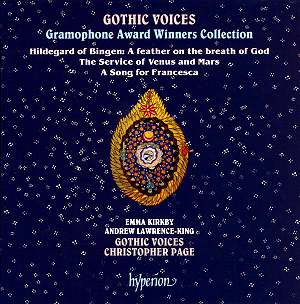
This boxed set of
three discs from Hyperion featuring Gothic Voices, directed
by Christopher Page, makes an excellent addition to the collection
of any mediaeval music enthusiast. The presentation is extremely
attractive, as one would expect, the works are intriguing, the
sound super, and performances exemplary.
The first disc is
entitled “A feather on the breath of God” – a seemingly apt
description Hildegard of Bingen gave herself. Apparently divinely
inspired - she had a vision of flames descending upon her from
heaven - she produced an incredible corpus of works, ranging
from poetry and plays through to academic works on natural history
and medicine, and music. Not only was she prolific, but her
works were composed on a grand scale, as evidenced by some of
the songs that feature on this disc, particularly the Sequences,
which are interspersed with hymns. Intricate religious imagery,
rich and vibrant descriptions and imaginative tableaux are presented
through music that is at once simple yet burns with intensity.
The sumptuousness of the depictions and vividness of the stories
make for a curious contrast against the purity of the plainchant
line and occasional droning accompaniment.
I was much impressed
by the performance approach here. As mentioned in the sleeve-notes,
the performers have attempted to recreate the notion of singing
almost as an act of meditation, as a devotion into which body,
mind and soul are plunged, allowing the music effectively to
sing itself through the performers. It works to spine-tingling
effect.
The second disc,
“The Service of Venus and Mars”, contains works which might
have been heard by Knights of the Garter. This was the great
Order established by Edward III in a possible attempt to recreate
King Arthur’s Round Table, and immortalised by the tale of the
gallant king chastising sniggering courtiers with the famous
phrase “Honi soit qui mal y pense”, when his dancing partner’s
garter fell to floor and he chivalrously picked the item up
and put it on his own leg. Although most of the courtly music
and songs from this period has been lost, some of the existent
works can be linked to several Knights, and this disc has been
programmed around that idea. We open, therefore, with Edward
III himself, with the second track, Singularis laudis digna,
lauding the king by name, while the French works - Philippe
de Vitry’s Gratissima virginis, Molins’s Do ce quo
fol pense, and the anonymous work based on the previous
piece - might have been played to King John II of France, Edward’s
hostage - particularly Molins’s, given that he was a chaplain
of John’s during his captivity. Several of the pieces on the
disc were written by composers known to have worked for some
of the Knights – Pycard (Gloria), for example, was a
clerk in the chapel of the Duke of Lancaster, John of Gaunt;
Leonel Power (the dignified Sanctus) was the chaplain
and chorister director in Thomas, Duke of Clarence’s chapel;
John Pyamour (Quam pulchra est) was a member of the Chapel
Royal. The celebrated composer Dunstable (Speciosa facta
es) composed for Humphrey, Duke of Gloucester, and Soursby
- who composed another Speciosa facta es - was chaplain
to Richard Beauchamp, Earl of Warwick. The programmers also
include a few carols – Lullay, Lullay and Ther is
no rose of swych virtu, and some instrumental works. The
graceful and gently lilting Le Grant Pleyser, is for
example, the kind of work that Henry V might have played on
the harp that we know he owned and presume he played. This song
is an English version of the slightly more stately and less
dancing previous track, the French Le Gay Plaisir - intriguing
to compare the two! The disc concludes with a joyful and bold
rendition of the famous Agincourt Carol – an appropriate
work on which to end with its strong Henry V association! This
second disc presents some fine and accomplished pieces, all
superbly performed, with perfect intonation and flawless ensemble
singing.
The final disc,
“A Song for Francesca” presents a century of musical composition
from 1330 onwards. The works come from Italy - first part of
the disc - and from the Northern European composers with whom
Italians were, at that time, fascinated, despite their own flourishing
musical tradition (track 10 onwards). Named after the track
Amor mi fa cantar a la Francesca, which has the double
translation of “Love makes me sing to Francesca” and “Love makes
me sing in the French style” (as the scholarly sleeve notes
explain), the disc includes a wide range of styles and forms.
It opens with two polyphonic ballata by the less-well-known
Florentine composer and organist, Andreas de Florentia – Astio
non mori mai and the evocative Per
la ver’onestà. Two more from the better known Francesco
Landini follow later - the hauntingly melancholic Ochi
dolenti mie and Per seguir
la sperança. The eponymous and anonymous Amor
mi fa cantar a la Francesca is included as an example of
monophonic ballata - probably popular music of the educated
classes. This extremely attractive song is exquisitely performed
by Rogers Covey-Crump. The disc also includes polyphonic madrigals,
such as Quando i oselli canta
and Johannes de Florentia’s Quando la
stella, utterly charming pieces for the harp (Constantia
and Non na el so amante), and
an ethereal Latin motet to the Virgin, O regina seculi/Reparatrix
Maria, which has an amazing feeling of timelessness and
space, with its long, floating voicelines. It is so accomplished
that Christopher Page in his sleeve-notes asks whether it might
be an anonymous work by Dufay. Most of the second half of the
disc is taken up by rondeaux, the most popular song-form of
the 15th century, not least the intriguing Confort
d’amours, with its experimental rhythms and chromaticisms.
With performers including
Rogers Covey-Crump, Emma Kirkby, John Mark Ainsley and Andrew
Lawrence-King, it comes as no surprise that the music-making on
these discs is of the very highest standard, and the singing in
particular, is superlative. The works themselves cover a varied
range of styles, all full of interest, and even include some premiere
recordings - of Hildegard of Bingen Sequences and some of the
Knights of the Garter songs. Only too rightly have these discs
all won Gramophone awards – and I join my voice to those others
who have commended them highly.
Em Marshall

























 Emma Kirkby
(soprano); Emily van Evera (soprano); Poppy Holden (soprano); Judith
Stell (soprano); Margaret Philpot (contralto); Caroline Trevor (alto);
Rogers Covey-Crump (tenor); John Mark Ainsley (tenor); Leigh Nixon
(tenor); Andrew Parrott (tenor); Kevin Breen (tenor); Howard Milner
(tenor); Peter Harvey (baritone); Colin Mason (baritone); Andrew Lawrence-King
(medieval harp); Doreen Muskett (symphony); Robert White (reed drones);
Christopher Page (director/medieval harp)
Emma Kirkby
(soprano); Emily van Evera (soprano); Poppy Holden (soprano); Judith
Stell (soprano); Margaret Philpot (contralto); Caroline Trevor (alto);
Rogers Covey-Crump (tenor); John Mark Ainsley (tenor); Leigh Nixon
(tenor); Andrew Parrott (tenor); Kevin Breen (tenor); Howard Milner
(tenor); Peter Harvey (baritone); Colin Mason (baritone); Andrew Lawrence-King
(medieval harp); Doreen Muskett (symphony); Robert White (reed drones);
Christopher Page (director/medieval harp)