Although educated in
England, Rudyard
Kipling was born, and spent his
early years, in India, a country that
had a strong influence on him throughout
his life, and for which he retained
an abiding affection. When he returned
to India as a journalist in his late
teens, he set about collecting material
that he could later use in his other
writings. Amongst his jottings were
stories from, and notes about, the soldiers
doing garrison duty at Lahore. Returning
to England aged 24 to launch his career,
Kipling realised the potential appeal
of songs about army life after seeing
the popularity of Music Hall songs.
Drawing upon his previously collated
observations and anecdotes, he started
writing the Barrack Room ballads. The
first volume was published as "Barrack
Room ballads and others verses"
in 1892 and proved an immediate success.
The editor of the Scots Observer was
so overwhelmed by them he was said to
have stood up and danced on his wooden
leg. So a second series was published
four years later.
Gerard
Cobb was born twenty seven years
before Kipling. Trained in the sciences,
he was a Fellow of Trinity College,
Cambridge, and had a wide range of sometimes
eclectic interests. These included the
Tractarian movement, cycling and municipal
concerns. In his later years he dedicated
most of his time to composition, and
his output is comprised songs – over
120 of them - as well as chamber, piano
and church music. He also wrote a few
larger works, such as his Song of
Trafalgar. His songs were generally
quite popular, and the Barrack Room
settings were no exception. The first
set of five - along with one song by
another author - appeared the same year
as Kipling’s original poems, and was
a huge success. He composed a second
set - of the same number - the following
year. When these proved equally popular,
a third set - of six, also from Kipling’s
first series - and two single songs
from Kipling’s second series followed
four years later.
There are numerous
settings of Kipling’s
Barrack Room Ballads and
many
of these have been recorded. These
Cobb settings are easily amongst the
finest - if not necessarily the best
known. The most famous is surely Oley
Speaks’ version of On the Road to
Mandalay. This disc is the first
recording of the complete Cobb settings.
At first sight, the
disc looks rather amateurish - the graphics
of the front cover are awful. This impression
is borne out by the recorded sound which
is a little poor. There’s a somewhat
tinny-sounding piano and the baritone’s
voice is just slightly coarse and harsh.
That said, this rougher quality is probably
quite authentic for the music type.
Let none of this put you off! The notes
are scholarly, informative and interesting,
and give full biographical information
as well as details of the songs. We
also read about the performers’ approach
to the music, and there are explanations
as to why omissions have occurred. I
was delighted that the performers decided
to stick to the authentic versions and
keep in words that would now be extremely
politically incorrect. I also find it
a sad indictment that they have to explain
their decision to place musical authenticity
over political correctness. In any case,
many of the songs that could be taken
as offensive to ‘ethnic minorities’
are actually being affable and approving
towards them.
The songs themselves
are possibly an acquired taste, but
if one enjoys military-style ballads,
are fantastic. They are very varied
in range, and combine the best of music-hall
numbers, Victorian/ Edwardian ballads
and art songs (Soldier, Soldier,
Ford over Kobul River and 18
for example), sometimes with a hint
of folksong. They range from the humorous
(11), light-hearted marching songs (4),
to contrasting ones full of pathos (8,
9, ) and others that are just incredibly
moving.(2, 15). Some blend elements
of all these, such as 6 - brilliantly,
scintillatingly funny yet also desperately
touching – handkerchiefs at the ready!
Ralph Meanley has a
robust baritone that suits this sort
of music very well indeed – characterful
and buoyant, if slightly too rough to
be beautiful in tone. My only real criticism
is of his grace notes, which can sound
quite ugly (4). He also strains a bit
at some of the higher notes. Yet in
songs such as 5 his voice comes across
as quite attractive and he shows he
can do sensitive as well as blustering.
His accents are excellent (10 and 2),
and he communicates the personae of
the songs brilliantly. This is possibly
not surprising – he was a regular on
Friday Night is Music Night and
Songs from the Shows. David Mackie,
his accompanist, worked as a repetiteur
and conductor for D’Oyly Carte and is
a Gilbert and Sullivan and Cobb expert.
His delicate and sensitive accompaniment
shows his experience. The performers
are not afraid to add characterisations,
fill out the piano part and interpret
where they feel the need.
This is a disc that
charmed, amused, delighted, and moved
me to tears. It is a shame that it is
not better produced, but these songs
– though they may come across as twee
to some - are certainly worth hearing.
Furthermore, as a valuable historical
record, they are an important part of
our heritage. Personally, I deem this
disc worth its weight in gold.
Em Marshall
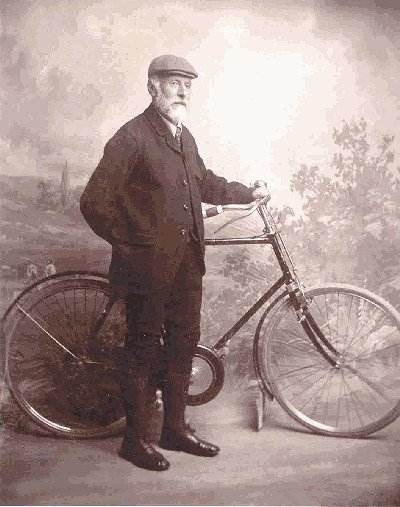
see GERARD
FRANCIS COBB (1838-1904) by David
Mackie
























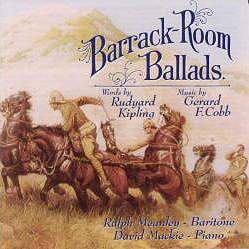
 for
details
for
details
 Ralph Meanley (baritone), David Mackie
(piano)
Ralph Meanley (baritone), David Mackie
(piano)