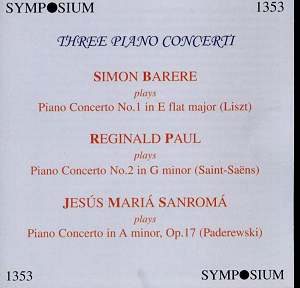
This triptych of concertos
bears witness to three soloists - which explains the rather
cumbersome title of the disc. In essence we have one superman,
one klaviertiger of ravenous divinity, the great Barere,
one pianist whose star has waxed and waned over the years
- Jesús Mariá Sanroma – and one almost unknown, Reginald
Paul. The dice are loaded against Paul biographically so
let’s start with him.
Alan
Bush, who was at college with him, always maintained that
Paul was the best sight-reader he’d ever met. That’s not
necessarily a qualification for pianistic status but Paul
was undoubtedly a fine chamber player and later an equally
fine teacher. Born in London in 1894 he was a Matthay pupil
at the Royal Academy and later formed a duo with violinist
Harold Fielding, who’d taken lessons with Sammons and was
later a well-known music promoter. Paul founded the London
Pianoforte Quartet in 1932 a group that contained the core
of the Stratton Quartet (George Stratton, Watson Forbes and
John Moore). He taught at his old college for many years.
Yet he didn’t record heavily and this makes this 1930 traversal
all the more valuable as a document of his playing in its
youthful prime.
Recorded
for Broadcast in 1930 this performance of the Saint-Saens
G minor concerto was the first electric set to be issued.
Arthur de Greef and Landon Ronald had earlier collaborated
on an HMV acoustic. Broadcast Twelve was one of the cheap
British labels that proliferated at around this time and
copies often turn up in less than pristine condition. The
set used here is generally fine but has some scrunchy moments
and some blasting at fortes. Paul proves a good soloist,
though not one who could attain the degree of sparkle that
someone such as, say, Moiseiwitsch could find in this work – even
granted that Moiseiwitsch sounded a touch tired in his 1947
recording with Basil Cameron. Paul has the work under his
fingers and if he can seem a touch reserved in the finale
he compensates with fine legato and a sure stylistic awareness.
This
is fine retrieval work from Symposium and while I have the
floor they would do a real service in investigating the rest
of the Broadcast and other catalogues. Paul’s British contemporary
Maurice Cole made a number of highly impressive discs for
Broadcast – I think especially of his Chopin, Rachmaninov
and the Grieg Concerto with the same Metropolitan band (and
Stanley Chapple) that accompanies Reginald Paul. He also
made some less well-known sides for Aco – and they are no
less impressive. Cole is an undeservedly neglected figure
though some will remember his Bach LPs from the 1960s. He
was married to the fiddler Winifred Small, with whom he also
recorded, and we should have examples of his musicianship
on CD. End of sermon.
Jesús
Mariá Sanroma gives us his excellent Paderewski concerto
but unlike the Paul, which has hitherto never been reissued,
this is terra cognita. Pearl has an all-Sanroma disc
but this Symposium is better done and better pitched as well.
Whatever the vicissitudes of his career and reputation I’ve
always greatly liked his playing. Maybe he doesn’t have Earl
Wild’s leonine magnetism in this kind of work – but then
few do - but he’s rhythmically alert and vivacious and has
a beautiful cantabile tone in the slow movement. The first
movement cadenza is played with romantic finesse and freedom.
It’s a slight pity that there’s some flutter in the copy
used for the finale as it’s slightly distracting from the
performance. Symposium omits the recording date, which was
1939.
There’s
not much to be said about the blistering Liszt. This has
seen service on APR’s Barere edition but again this Symposium
has the better copy. It’s a more immediate transfer, sharper
in detail without being graphic; less muffled and indistinct.
So a big improvement for Barere adherents. The performance
is occasionally accident-prone but the dropped notes are
mere bagatelles in the face of such coruscating and occasionally
exhausting pianism. Barere’s singing line in the slow movement
is a wonder in itself. Symposium is reluctant to credit an
orchestra; it was the New York Philharmonic.
Yoking
together these three very different pianists and concertos
obviously has pitfalls and I can imagine objections. For
collectors, though, one could advance counter-arguments as
to the desirability of hearing the Paul, and the technical
advances in the other two concerto performances. And let
me repeat my hopes regarding the rest of the Broadcast catalogue.
Jonathan Woolf
BUY NOW
AmazonUK ArkivMusic
|
Help us by making a donation through PayPal
|



 Simon
Barere (piano)
Simon
Barere (piano)