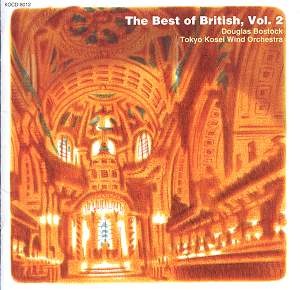
Readers are referred to my review
of the first volume in this excellent series for a general introduction
to its aims.
We
start with a bang since Holst’s Suites are classics of the genre,
quite remarkable demonstrations of the range of sonorities that
a wind band can produce. I have always loved Boult’s recording
(on Lyrita) of the March from the First Suite in Gordon Jacob’s
orchestration, but I’m not sure that Bostock isn’t more exultant
still, and of course he has the original instrumentation.
The
Second Suite has remained a little less known. Holst himself
did nothing to push it, maybe because he immediately rearranged
the last movement for strings as the finale to the “St. Paul’s
Suite”. The effect of his first thoughts is quite different
for, while the “Dargason” and “Greensleeves” blend in easy dialogue
in the string version, they work in exciting opposition on the
wind band. The music sounds much more original in this form
and perhaps I prefer it.
A
more intensely “private”, retiring composer than Bridge could
hardly be imagined, hardly the man to go to for pompous patriotic
music to be played at the 1911 Pageant of London. For the most
part he takes refuge in dead-pan professionalism. The Pavane
uses a tune that later reappeared in Warlock’s “Capriol Suite”
and the comparison only points to the fact that Bridge’s version
is not much more than technically adept. Considerably more spirited
is the concluding March which is arranged from an earlier organ
piece and so not originally intended as patriotic fodder. Moreover,
it acquires here an entertaining trio on the Westminster Chimes
which isn’t in the organ original.
Another
composer invited to contribute to the Pageant of London was
Frederick Austin, a composer whom Bostock has been championing.
He certainly seems more suited to the job than Bridge, though
nothing particularly original emerges. Any memories this music
may leave behind it are rapidly swept away by Bliss’s striking
dances from “Checkmate”.
Every
time I hear a work by Alan Bush (which is not often) I always
hope it will be better than the last, but so far he has always
appeared as drab and colourless as the East Germany he idolized.
I’m afraid this overlong Scherzo is no exception.
Grainger’s
well-known setting of “The Londonderry Air” brings a rare miscalculation
from Bostock. At first I thought I was hearing an introduction
and waited for the theme to enter, but then it crossed my mind
that the theme enters immediately in this arrangement and I
realized that it was there, played on the horn, but practically
submerged by the other instruments. The Grimethorpe Band had
it standing out much better in “Brassed Off”. Incidentally,
Lewis Foreman’s note, giving the history of this melody, states
that it was first published in 1855 in the Petrie Collection
and then used by Stanford in his First Irish Rhapsody of 1902,
the same year as Grainger’s first (choral) setting. He suggests
that Grainger might have got it from Stanford. This is perfectly
possible, but Stanford himself had already published an arrangement
in Songs of Old Ireland of 1882 (the year Grainger was born),
where it was called “Emer’s farewell to Cuchullain” and it was
already quite well-known by 1902. So Grainger probably didn’t
get it directly from Stanford but knew it already through Songs
of Old Ireland. In any case, the frontispiece to Grainger’s
piano setting seems clear enough: he acknowledges the 1855 Petrie
publication, Songs of Old Ireland and also The Irish Song Book
(ed. A.P. Graves, 1894), and requested that this information
“be used in full in programs, where possible”.
The
Dam-Busters March was an encore favourite with Boult and again,
I have long enjoyed his Lyrita recording of it. This time I
still prefer Boult, finding Bostock a notch too fast, if infectious,
as a result of which he has to broaden out to much at the end.
And in this case it is Boult who has the original instrumentation.
There
are more ups and downs to this volume than the first but if
you don’t have the Holst Suites in some other recording they
are enough to make purchase essential and the performances are
superb.
Christopher
Howell
AVAILABILITY
Kosei
Publishing Co.



 Tokyo Kosei Wind Orchestra/Douglas
Bostock
Tokyo Kosei Wind Orchestra/Douglas
Bostock