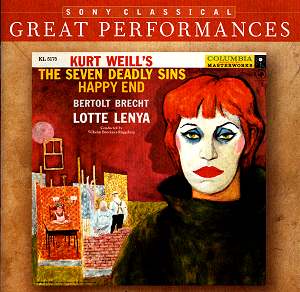
Kurt Weill’s fusion
of styles – serious, music hall and
jazz, here makes for compelling listening
in recordings made in the decade after
his death and featuring his widow, Lotte
Lenya. Her voice had quite a limited
range - necessitating some transposition
- and a metallic quality that was hardly
beautiful. But it was amazingly characterful
and she managed to convey every sub-plot
in these two powerful works. Others,
notably Ute Lemper, have since taken
up Weill’s cause to great effect but
recordings like these are unlikely to
be superseded.
The Seven
Deadly Sins was premièred
in Paris in 1933, shortly after Weill
had fled the Nazis. It is a ballet with
song which follows on from an earlier
collaboration with Brecht – The Rise
and Fall of Mahagonny. The key element
is the "Siamese sisters that exist
in the nature of every woman".
Lenya plays both Annas – one practical,
the other emotional as the seven sins
are sequentially committed, framed by
a prologue and epilogue, and with contributions
from "the family". An unsettling
work – it seemingly ends happily as
the two Annas head home for Louisiana.
Happy End, a
play with music, was an earlier work
and one in serious danger of being forgotten
until around the time this recording
was made. At the time of the première
in Berlin in 1929 playwright Bertolt
Brecht had many critical enemies. The
story was supposedly written by one
"Dorothy Lane" and adapted
by Elisabeth Hauptmann (Weill’s former
mistress) but no-one has heard of Lane
before or since. This did not fool the
drama critics, and they tore into Brecht.
Much of their animosity was political
and the music, it seems, was a much
lesser consideration. Viewed with the
benefit of hindsight, and this recording,
it is surprising that numbers such as
The Sailor’s Tango, The Mandalay
Song and Surabaya Johnny
weren’t immediate hits. Instead, it
was rapidly withdrawn, left unpublished
and not revived until 1958. Even now,
there seems to be uncertainty about
the ordering of the musical material
– David Atherton’s 1975 recording for
DG groups the songs in a completely
different way.
The unnamed orchestra
consisted of players from the Hamburg
State Opera under one of their resident
conductors of the time, Wilhelm Brückner-Rüggeberg.
He was apparently a Handel specialist
and the orchestral players were previously
unfamiliar with the music. That sounds
unpromising but the accompaniments are
effective and idiomatic.
The recording quality
was certainly reasonable for the time
and this has scrubbed up very well in
the latest remastering. Lenya’s voice
is forwardly balanced, especially in
The Seven Deadly Sins
but one adapts to a feeling of her being
"in your face" at the beginning
of the disc. Arguably, this is a legitimate
part of the experience anyway.
The booklet is quite
fat, majoring on the works and providing
some background on the recordings. There
is little said about Lenya and there
are no texts, which are considerable
minuses.
This disc is a reissue
in Sony Classical’s "Great Performances"
series. The implied accolade is well
justified; almost fifty years old after
they were made these recordings maintain
an authenticity that makes you tingle.
Lenya and Brückner-Rüggeberg
made other Weill recordings for CBS
around the same time, notably The
Rise and Fall of Mahagonny and Der
Dreigroschenoper. At the moment
these also seem to be available on Sony
Classics.
Patrick C Waller



 Lotte Lenya (singer)