This unusual coupling
represents volume 46 - it’s not just Hyperion … - in Phaedra’s
In Flanders’ Fields series. Adherents of the overlooked,
obscure and downright under-appreciated will have their appetites
whetted by the promotional details contained in the booklet
of this disc, which lists them all. Fans of Jongen, Benoit,
Meulemans (Arthur and Herman) and such as de Boeck and de Blockx
will have occasion to rue their limited income when confronted
by the rich variety of things on offer. An excellent catalogue.
But to business
with this almost-latest; I see volume 47 is already out and
maybe others as well. There’s no biographical significance to
coupling the short-lived Lekeu with his long lived contemporary,
Arthur de Greef, but their trios do make for a strong contrasting
brace; the hothouse Franckian fervour and tortured melancholy
of the former and the patrician lyricism and Brahmsian vigour
of the latter.
De Greef is the
more unusual and he’s better known as a performer of course,
one of Grieg’s favourite interpreters. Pearl has a good disc
devoted to him and you can find his late 1920s HMV sonata recording
of the Kreutzer with Isolde Menges; it’s even had the
dubious honour of being pirated.
As a composer he’s
much less well known – maybe a few piano morceaux but most will
be unfamiliar with the Trio. The idiom is an interesting conflation
of influences. As it begins one thinks broadly Franco-Grieg
but there’s Brahmsian cut and thrust to the piano writing and
to the unison string phrases that reminds one that de Greef
was an excellent Brahms player (though the two Brahms sonata
recordings on the Menges disc were not with de Greef). There’s
maybe a touch of Fauré as well, especially the earlier Fauré,
and a lovely Rachmaninovian lyricism in the slow movement. The
finale is a touch prosaic though enlivened by beefy piano writing,
and especially powerful chording from the piano, which is pretty
much in charge for most of the time in this movement at least.
Lekeu’s 1891 Trio
predates the de Greef by fully forty-four years. Franckian and
famously intense it’s a difficult work to pace, as is a work
cast in a similar vein, Magnard’s Violin Sonata. The underlying
melancholia and grief is not overstated in this performance.
Instead there’s a sense of forward motion in the opening movements
which contrasts with some older performances that have bathed
deeply in the extended dramas - I think of the old Musique en
Wallonie LP by the Salone-Demilhac-Boufil trio which took a
quarter of an hour over the slow movement; here we have 10.20.
Even the scherzo tends to zip by; clearly structural matters
have been seriously addressed in rehearsal. Incidents such as
the second fugato are handled with a certain earthy vigour even
if there were moments in the corresponding first fugato when
intonation wandered. There are a few other recordings in the
catalogues but this is a work that tends to come and go. Strong
competition comes from the Spiller Trio on Arts (coupled with
the incomplete Quartet where they’re joined by Oscar Lysy no
less). I prefer the Spiller performance; slower and more intimate
in the slow movement, more subtle and arresting in phrasing
throughout; the strings are warmer as well. The performances
and the coupling will probably decide things.
The recording is
rather close-up and this can become a touch tiring. It’s sufficiently
close up to catch quite a lot of anticipatory sniffing. A final
word about the quartet’s unusual name; it’s from a Herman Hesse
poem.
Jonathan Woolf
see also Review
by Hubert Culot
BUY NOW
AmazonUK



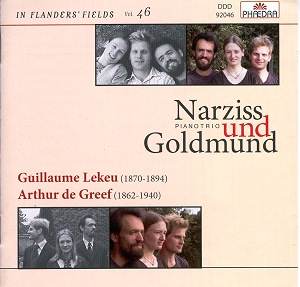
 Piano Trio Narziss
und Goldmund
Piano Trio Narziss
und Goldmund











