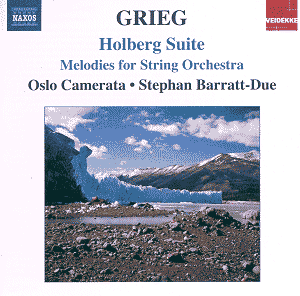
Edvard Grieg wrote a great deal of music
for string orchestra. In it he showed an almost unsurpassed
ability to draw the very best from the medium. This is
a little surprising, in that Grieg was a pianist and, as
far as I can determine, never learned to play a string
instrument. Yet the violin is of course a central instrument
in Norwegian folk-music, and he also had the life-changing
experience at a young age of meeting the great violinist
Ole Bull and hearing him play.
Whatever the reasons, the musical outcome
as represented here is rich and varied, and this highly
enjoyable CD contains his most extended work for the medium.
This is The Holberg Suite – to give it its full title From
Holberg’s Time: Suite in the Olden Style – named after
an important Norwegian writer of the 18th century. Following
on from that, we have a number of shorter character pieces,
finishing with the famous Death of Åse from the
first Peer Gynt Suite.
Grieg has a long-established reputation
as the most charming of the late Romantic ‘Nationalists’. But
what always strikes me is how very important he was for
younger composers of the day. His influence on Grainger
and Delius is well documented; more surprising was the
strong whiff of Tippett that I detected in the Air (track
4) of the Holberg Suite (thinking of the Corelli Fantasia);
and even more so the clear hint of Schönberg’s Verklärte
nacht in the expressive chromatic harmonies of track
6, Våren (given here as ‘Last Spring’). I’m used to hearing
it called ‘The Last Spring’, which means, of course,
something quite different. Any ideas on which is correct?
(see Göran Forsling's reply).
Barratt-Due and the Oslo Camerata give
performances here that are both highly committed and highly
polished. Intonation, ensemble and string tone are all
very fine, and the recording is of Naxos’s best quality. Occasionally,
it seems as if these players try a bit too hard;
this is noticeable in much of the slower music, including
the already-mentioned Våren. Here I feel that something
of the magical inner quality of the music is compromised
by a welter of highly explicit, and possibly exaggerated
expressive detail. The same quality is felt in Åses
dod, tr. 14; the music needs more sweep and a little
less fussy emphasis.
But this slight reservation in no way seriously
detracts from the many delights found here. Some of the
perhaps less familiar pieces are really exquisite; listen
to the poignancy of the major/minor shifts in track 8, Det
første Møde (The First Meeting), recalling Solveig’s
Song from Peer Gynt. Or the straightforwardly
bucolic Kulokk (unpromisingly translated as ‘Cow
Call’!), track 12, with its mysterious little introduction. Track
9, Bådnlåt (At the Cradle) is a little gem,
contrasting solo strings with the full body, while Stabbelåten (Peasant
Dance) is immensely bracing, and includes its own built-in
tuning-up for good measure!
The disc is on the short side – just under
52 minutes – but this is largely because of the selection,
which is inherently limited in quantity - though I can
think of two or three other pieces I would have liked to
have found here. This is a veritable smorgasbord of
simply scrumptious music!
Gwyn Parry-Jones
BUY NOW
AmazonUK AmazonUS
|
Advertising
Rates
Visitor
stats
MusicWeb
International
has over 40,000 Classical CD reviews on offer
Discs
received
Having a problem
Donating?

Gerard
Hoffnung Concerts &
The
Bricklayer Story
MusicWeb
can now offer
you discs from the following catalogues:
Prices include postage
There will be NO
VAT Rises
Musicweb
Special
Offers
Monthly
Best Buys
New
Releases

New
Releases


MusicWeb
sells the Polish
catalogue CDAccord
£10.50 post free W-W

MusicWeb sells the
Arcodiva catalogue
£12.00 post free W-W

£11.75
post-free world-
wide
Google
Ads - for information about privacy matters, click here.
Amazon Musicweb International is a participant in the Amazon
EU Associates Programme, an affiliate advertising programme designed to provide
a means for sites to earn advertising fees by advertising and linking to Amazon.co.uk
and Amazon.com
|