Charles Burney visited C.P.E. Bach in Hamburg in October 1772,
publishing his account of the encounter in The Present State of
Music in Germany, the Netherlands, and United Provinces
in the following year. He observed that "Hamburg is not, at
present, possessed of any musical professor of great eminence,
except M. Carl Philip Emanuel Bach; but he is a legion!" For
Burney, although he admired Bach's "vocal and miscellaneous
compositions", Bach's genius was most evident in "his productions
for his own instruments, the clavichord, and piano forte, in
which he stands unrivalled". Visiting Bach at his home, Burney was
overjoyed when Bach "was so obliging as to sit down to his
Silbermann clavichord, and favourite instrument, upon which
he played three or four of his choicest and most difficult
compositions, with the delicacy, precision, and spirit, for which
he is so justly celebrated among his countrymen. In the pathetic
and slow movements, whenever he had a long note to express, he
absolutely contrived to produce, from his instrument, a cry of
sorrow and complaint, such as can only be effected upon the
clavichord, and perhaps by himself". The experience confirmed
Burney - no bad judge - that Bach was "one of the greatest
composers that ever existed, for keyed instruments".
He doesn't hold quite such a position in modern times. No doubt
some of C.P.E. Bach's contemporary fame owed something to his own
skills, as the passage from Burney implies. But his works for
keyboard are, in themselves, fascinating and often remarkable. He
was the author of the Essay on the True Art of Playing
Keyboard Instruments (1753-62), one of the most
important musical treatises of the eighteenth century. He had, in
short, thought long and hard about the writing and playing of
keyboard instruments, drawing on his own very extensive experience,
the instruction he had received from his father and his observation
and study of the playing and compositions of others. His own
keyboard sonatas can, in one light, be viewed as a kind of bridge
between his father, J. S. Bach and Haydn. Certainly there are
places - particularly in the early works - where the influence of
his father is readily apparent and there are others where, as he
developed the empfindsamer Stil (the "highly-sensitive
style"), one hears anticipations of the keyboard writing of Haydn
(and beyond). The danger in viewing his work in this light is,
however, that we don't pay sufficient attention to the music
itself, rather than to where it has come from or is going to,
stylistically speaking.
One problem for the modern performer/listener is that Bach was
himself devoted to the clavichord, which was very much his
preferred instrument in the keyboard family. The intimacy of the
instrument, its capacity for the production of distinctively
'personal' sounds, perhaps encouraged the experimental and
subjective sides of Bach's personality. Much of his writing for the
keyboard eschews strict adherence to the principles of classical
regularity; simple repetitions are often avoided, there is a
fascination with surprising and strongly characterised sonorities.
How adequately the modern piano can do justice to these must be a
doubtful matter. Miklós Spányi has recorded, for BIS,
a long series of works for the solo keyboard, played on a
clavichord; he plays the music with great love and understanding,
with a quasi-improvisatory intimacy and a rich palette of tone
colours. This would, I think, be my preferred way of hearing this
music. But we needn't exclude other alternatives - any more than we
do with the music of Bach's father. Certainly many hearers seem to
have enjoyed Mikhail Pletnev's flamboyant 1998 recording of
Sonatas and Rondos by Bach (on DG), which exploits something
like the full resources of the modern grand. Pletnev certainly
stresses the 'romantic' anticipations in C.P.E.'s writing; I
remember one reviewer remarking that, at times, one seemed to be
listening to Liszt rather than C.P.E. Bach. There is also a fine CD
by Carole Cerasi on metronome, on which six sonatas are played on
the harpsichord.
On this new issue from Naxos, the young Austrian pianist
Christopher Hinterhuber we have performances which might be
'located', as it were, somewhere between Spányi and Pletnev.
The music is played on a modern piano, but with a sense of scale
and sonority which is stylistically very sympathetic, and without
the sometimes excessive flamboyance of Pletnev. I was very
favourably impressed by Hinterhuber's playing on a recent Naxos
disc of piano concertos by Ferdinand Ries, and that favourable
impression is confirmed here. He plays this complex music, full of
unexpected twists and turns, abrupt transitions of mood and
direction, with attractive lucidity of thought and clarity of
technique.
If you re a devotee of C.P.E. Bach's solo keyboard music,
Spányi's series is the place to go. If you prefer the sound
of the modern piano, and want a sampler of this music,
Hinterhuber's recording will serve your purposes well.
Glyn Pursglove



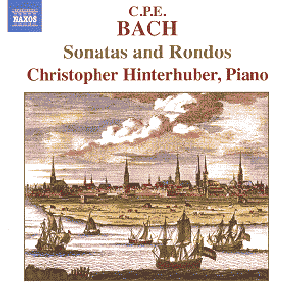
 Christopher Hinterhuber (piano)











