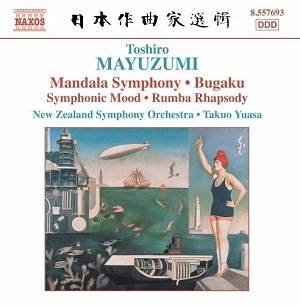
The son of a sea captain,
Toshiro Mayuzumi came to be recognized
as one of Japan’s foremost composers.
Heavily influenced by the music of Debussy,
Ravel and Stravinsky, Mayuzumi was also
lured by the exotic. Since his father
was so widely traveled, the young composer
was exposed to a number of foreign cultures
early on. Shifts in the political make-up
of Japan, and the effects and after-effects
of the Second World War also played
a major role in his style. As such,
the music he left behind covers a wide
range of styles and ideas.
The Symphonic Mood,
dating from 1950 clearly pays homage
to Debussy. Its harmonic structure and
broad, sweeping gestures are instantly
reminiscent of La Mer and the
Nocturnes. Mayuzumi does expand
upon the earlier composer’s harmonies,
however, stretching even impressionist
tonalities to a breaking point.
Bugaku lies
in stark contrast to the more familiar
territory of the Symphonic Mood,
makes broad use of traditional eastern
instruments, and relies heavily on pentatonic
harmonies prevalent in eastern musical
traditions. Somewhat more challenging
at first, the work’s haunting tonal
landscape makes for some pretty captivating
listening. The second movement is considerably
more rhythmic than the first and relies
heavily on the percussion section, giving
the impression of increased forward
motion and less of a dreamscape.
I found the Mandala
Symphony to be considerably more
formless and random than the first two
works. I must confess that music that
wanders aimlessly around the orchestra
with a bleep-bleep here and a wahhh-wahhhh
there punctuated by the occasional blat
from the brass and bang from the percussion
does not appeal to me. The second movement
has more to offer than the first, with
its slow underpinning ostinato and dreamy
harmonic colors.
During the Second World
War, American Jazz was verboten in Japan,
but Latin American popular music was
still permitted. As such, a number of
South American Dance forms such as the
rumba and the tango found a way into
native music. The Rumba Rhapsody
from 1948 is especially attractive
music, and shows just how well the composer
could make a foreign musical style his
very own.
Maestro Yuasa leads
first rate performances here and upholds
the integrity of the music. Even in
the works that held less allure for
me, I could still greatly appreciate
the craftsmanship of this conductor
and his dedication to the music. The
New Zealand Symphony Orchestra plays
splendidly and is obviously dedicated
to the music.
Naxos have provided
us with a sonically satisfying recording,
and the program notes by Morihide Katayama
are informative although not over-long.
Given that this composer is relatively
unknown to western audiences, a little
extra might not hurt us.
Kevin Sutton
see also review
by Rob Barnett



 New Zealand Symphony Orchestra/Takuo Yuasa