After studies in Europe
Mayuzumi returned to Tokyo in 1953.
There he co-founded with Dan and Akutagawa
the composers' pressure group known
as the Sannin no Kai or the Group
of Three.
John Huston's 1965
epic The Bible starred Richard
Harris, Ava Gardner, George C. Scott,
Peter O'Toole, and Huston himself. The
imposing music for the film was provided
by Mayuzumi - his only Hollywood score.
It was not his first film score though.
He wrote the first ever Japanese score
using electronic music in the early
1960s for Akasen-chitai (Red
District). In 1964 there was the
music for the film Tokyo Olympic.
With this he won the Mainichi Music
Prize.
In 1987 Philips issued
a Mayuzumi CD (30LD-1016) coupling his
temple bell-inspired Nirvana Symphony
(1958) played by the NHK Symphony
Orchestra and the Japan Chorus Union
conducted by Yuzo Toyama with the Mandala
Symphony played by the same orchestra,
this time conducted by Kazuo Yamada.
Now that is a CD I would like to hear!
Turning to the present
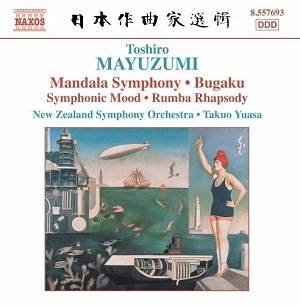
Naxos disc ...
Symphonic Mood
is the most accessible music
here. It is distinctively French in
style - more Ravel than Debussy. Amongst
Ravel's works Ma Mère L'Oye
comes closest. An Oriental overlay
is spliced with the rhythmic violence
of Stravinsky's Rite and the
motoric impetus of Honegger's Pacific
231.
Bugaku is
in two parts and is in a more advanced
idiom than Symphonic Mood. Its
ululating melismatic violins recall
the wails and mysticism of Hovhaness's
Fra Angelico overture and of
Penderecki's Threnody for the Victims
of Hiroshima. The second section
is memorable for thundering expressionless
bass drum impacts and for a return to
slithering melisma. Bugaku won
the Otaka Prize in 1967. It is part
of a group of works in which Mayuzumi
returned to the traditional roots of
Japanese culture - here the music of
the enclosed world of the Imperial Court.
The Mandala Symphony
is quite short. It takes a step
out into a chilling and clamorous avant-garde
world. The effect is made distinctive
by mystical Buddhist iterative cells.
Then again Mayuzumi can surprise by
the sweetness of his ideas and treatments
- as in the solo violin 'song' in the
second movement. Mandala Symphony
is part of a group of Buddhist-influenced
works: the cantata Geka (Pratidesana),
Sange for male chorus, the Nirvana
Symphony and the symphonic poem
Samsara (1962). Samsara is
also available on CD having been recorded
on Marco Polo 8.220297 with Phonologie
Symphonique and Bacchanale.
Samsara is also on a First Edition
CD (FECD-0030) that also includes Mayuzumi's
Pieces for prepared piano and strings
(1957) and the Essay for string
orchestra (1963).
The final work here
is Rumba Rhapsody. It
takes us back two years before Symphonic
Mood. Uproarious and full of eye-glinting
ruthless rhythmic activity it is a sort
of gelignite amalgam of Honegger, Stravinsky,
Mossolov and Markevich. Entertaining
stuff.
A varied and striking
conspectus of Mayuzumi's music. Once
sampled I suspect most people will want
to try some of his other scores as well.
Rob Barnett



 New Zealand Symphony Orchestra/Takuo Yuasa