It’s refreshing when a major record label issues music
from the lesser performed byways of the Romantic concerto repertoire.
These two contemporaneous scores fit the bill admirably. Paganini’s
Violin concerto No. 1 has rather fallen out of favour
with performers although there are several recordings in the
catalogues and Spohr’s Violin concerto No. 8 is virtually never
heard in the concert hall and I am aware of only a small number
of available recordings.
Paganini and Spohr
were virtuoso violinists who in the 1800s travelled extensively
as celebrities throughout Europe dazzling audiences with their
brilliant playing. As close contemporaries they knew each other,
although accounts differ as to how often they met. Furthermore
they liked to play their is own works to their audiences. Spohr,
who played as a soloist far less as the years went by, tended
to concentrate more on teaching and composing, gaining great
prominence in his day with a prolific output of works in most
genres. Six of Paganini’s violin concertos have survived. He
also wrote
a substantial amount of compositions for the guitar. Another
factor that they have in common is how interest in their music,
with only a handful of exceptions, began to wane soon after
their death. Their music fell rapidly out of favour.
Both Paganini and Spohr as experienced touring performers
would have been very aware of the variable nature of the orchestral
resources that would accompany them. As these two violin concertos
clearly demonstrate the orchestral writing is largely undemanding.
At times
it felt as if I was hearing music that could easily be within
the capabilities of a village orchestra; yet strangely it doesn’t
seem to matter. Not surprisingly the committed and highly professional
Swedish Radio Symphony Orchestra under Eiji Oue never
seem taxed but no matter how hard they play they cannot play
the music better than it is.
Born in Genoa, Italy in 1782 Paganini holds an esteemed
status as probably the world’s finest ever virtuoso violinist and certainly
the best known. Paganini’s
exhibitionist Violin Concerto No. 1 is, to use a literary analogy,
more Dan Brown than William Shakespeare but highly entertaining
nevertheless. Even with a performance as fine as this from Hahn
it is the sort of work that I can probably hear only a couple
of times before wanting to hear a concerto more substantial
in content.
Composed
around 1817-1818 Paganini’s remarkable three movement concerto
has been performed over the years in a number of truncated versions
but here Hilary Hahn is disposed to use the original version
with a cadenza by Emile Sauret.
It
is fascinating how one can wince at the vulgarity of Paganini’s
writing but the next moment be enchanted by his ingenuity, charm
and warmth. It is often difficult to forecast what Paganini
will do next and his unpredictability is a characteristic that
can be highly appealing. However what becomes predictable, and
almost unbearable, is the simultaneous bass drum and cymbal
crash with which Paganini peppers the score in the manner of
a village Oompah Band.
Hilary
Hahn in the opening allegro maestoso brings out an abundance
of charm and fun. In the central adagio Hahn’s playing
is endearing in music that combines Paganini’s innate lyricism
and frequent passion with pomposity and brashness. In her expert
hands the final rondo, allegro spirituoso becomes
a tempestuous and high-spirited roller-coaster. Paganini’s dazzling
pyrotechnics present little difficulty for the gifted Hahn who
treats the music with utmost respect.
My
confident first choice in the Paganini is from Itzhak
Perlman. My version is from a three disc set of the ‘Great Romantic
Concertos’ with the Royal Philharmonic Orchestra under Lawrence
Foster. This was recorded in London 1971 and remastered on EMI
Classics CMS 7 64922 2. Perlman’s ultra-confident, direct and
robust performance brings out a strong gypsy-like feel in the
music, compared to Hahn’s vibrato-laden and less fluid yet far
more delicate and restrained approach.
One
of the best known alternative versions of the Paganini is the
vivacious and exciting performance by Salvatore Accardo with
the London Philharmonic Orchestra under Charles Dutoit. I have
this Accardo account on a three disc set of the ‘Six Violin
Concertos’ released in 1992 on Deutsche Grammophon 437 210-2.
Born
in 1784 in Braunschweig (Brunswick) in the Duchy of Brunswick-Lüneburg,
now Lower Saxony in Germany, Ludwig (Louis) Spohr is primarily
remembered today as a distinguished concert violinist rather
than for his extremely successful composing career. Spohr completed
fifteen violin concertos with the sophisticated Violin concerto
No. 8 being generally acknowledged as the finest of them all,
with the Violin concerto No. 9 in D minor also receiving considerable
praise.
In
the opening allegro molto, with its notable song-like
subject, Hahn’s approach is fluent and sweet-toned also turning
in a tender and songful adagio. I enjoyed Hahn’s sparkling
and splendidly judged performance of the dramatic final allegro
moderato. Throughout I was conscious of her preference for
strong vibrato and at times I sensed a hint of unease.
From
my own collection an account of the Spohr that I favour over
Hahn is the highly characterful and irresistibly spirited performance
from Pierre Amoyal and the Orchestre de Chambre de Lausanne
under Armin Jordan. This was recorded in 1979 in Switzerland
and has been remastered on Warner Classics Apex 2564 60428-2.
The coupling of the Concertante in G for violin and harp,
WoO 13 and the Sonata in G for cello and harp, Op. 115
adds to the attraction of this excellently recorded disc.
Although
not part of my collection I have friends who highly regard the
version of the Spohr by Ulf Hoelscher and the Rundfunk-Sinfonieorchester
Berlin under Christian Fröhlich on the CPO label. The recording
is available either on a single disc with the violin concertos
No.12 and 13 on CPO 999 187 or as part of a 6 disc set of the
complete violin concertos 1-15 on CPO 999 6572.
Hahn’s
Deutsche Grammophon recording has a warm and soft focus with
the violin closely caught; although one occasionally feels a
sharp edge to her tone. The booklet notes include a gushing
and somewhat uninspiring essay from Hahn entitled “The violin
as a voice”. Tully Potter’s booklet notes are interesting
and whet the appetite for more information about the scores
and the composers.
These
fine performances are not my first choices in these two fascinating
concertos. However, the release is rewarding and makes an attractive
proposition for any lover of Romantic violin concertos.
Michael
Cookson



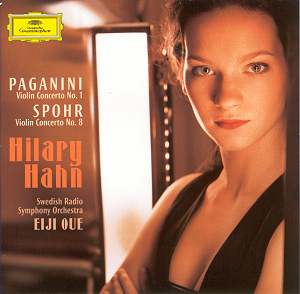

 Hilary Hahn (violin)











