I’ve reviewed
a couple of previous Balada discs in Naxos’s series but
they were recent works (see links below). They certainly
didn’t prepare me for the avalanche of avant-gardism explored
in the main work here.
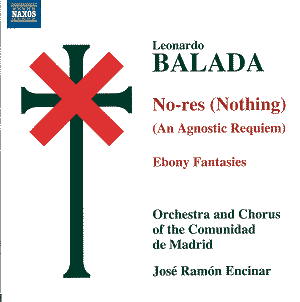
No-res
dates from 1974 and is subtitled A Symphonic Tragedy
in Two Parts written for narrator, chorus, orchestra
and tape. Its genesis is owed to the death of Balada’s mother,
and similarly that of the librettist, the French writer
Jean Paris. The resultant work, which lasts forty minutes,
is a protest of avant-garde extremity and one that bears
kinship with absurdist drama of the time, though its means
are unremittingly trenchant. The text is fused of a number
of different languages, indeed one of Paris’ own making
slips in as well; Catalan, French, German, English, Latin,
with words or phrases in other languages; there’s a phrase
in Czech, maybe Japanese, an African language or two – more,
probably.
It opens with
a taped wolf howl which the chorus picks up in imitation;
Balada includes tape of breaking glass, a tree felling,
his narrator’s lines are interspersed with vicious percussive
“full stops” and we also hear the sound of car horns. Aleatoric
features abound, as well as dramatic fanfares (some vaguely
reminiscent of Copland, though the resemblance is fleeting)
and so do vestiges of Latin Renaissance chant, though they
are subsumed into a torrent of vicious sounding writing.
Much of the text here reads rather like snook-cocking adolescent
swathes from The Waste Land before Ezra Pound got
hold of it and immeasurably refined it into cohesive form
(look at the Faber edition of the embryonic text). The second
part is in English though Balada wishes it to be sung in
the language of the country in which the work is performed.
There’s a defiant cry of “Never” as earlier Balada and Paris
had pursued the multi-lingual implications of the word “shit”
and a powerful, more concise theatrical interplay. I understand
that Balada was investigating the idea of “hopeless fatality”
and a militant defiance of death but as the Scottish jazz
clarinettist Sandy Brown once wisely observed; “Whilst I
appreciate the desire of young musicians to push the boundaries
of the music, I reserve the right not to listen.” He couched
it rather more strongly.
Balada has also
written a cantata called Ebony Fantasies, a rather
lurid title for four well-known spirituals that he has completely
re-worked - so forget Tippett and Mahalia Jackson. Naturally
the composer can call it what he likes but cantata is a
pompous name for it, not least when the original melodies
are submerged, substituted or only peripherally recognisable.
Nobody knows the trouble I seen has a pizzicato
kick and a certain ebullience, I got a crown features
the choir singing short stabby repeated notes apart from
the held note of “Glory”, a reasonable touch to be sure.
Were you there? has shimmer and the melody emerges
at the end.
I can only say
that the recording quality is first class and captures the
massive sonorities and taped sounds with fidelity. I’ve
no idea if the performances are accurate but they sound
formidable and kudos to Naxos for their investment. Clearly
I found most of this a miserable experience and can’t pretend
otherwise. If that was the intention then the composer has
succeeded admirably.
Jonathan Woolf



 Dennis Rafter (narrator)











