Whether all geniuses
are crazy has not been established,
but we definitely know that some geniuses
are crazier than others. Whether religion
is madness or not — the Greeks warned
that at least too much religion was
madness — we definitely know that some
people are more religious than others.
What turns most people
off to the symphonies of Bruckner is
that he was crazy with religion and
if you can’t appreciate that, if you
are unfamiliar with spiritual orgasm,
then his music seems to be ungainly,
ugly, noisy, pointless. Bruckner is
so much more spiritual than Wagner that
Wagner in direct comparison sounds more
like [Johann] Strauss. Bruckner perfected
the art of stopping exactly at the point
of "if he plays that one more time
I’ll scream." However if you are
susceptible to spiritual orgasm, even
from an artist practising a faith not
your own, then the Bruckner Seventh
Symphony is one of your very favorite
works and even the Ninth Symphony
seems too brief. Sober, well-adjusted
conductors can’t make any sense out
of either work whereas, with Bruckner,
Carlo Maria Giulini is in his glory.
So, what is Bruckner
doing writing chamber music? Proving
that he was, in addition to being a
musical prophet, a capable musical craftsman?
It seems so. Just before beginning work
on his Sixth Symphony, Bruckner
wrote this quintet at the request of
Joseph Hellmesberger for his eponymous
quartet. Eventually, Bruckner provided
a simplified scherzo at the request
of the dedicatee, but these ‘Vienners’
play the original version in this recording.
Both works are in the classic four movement
form. How these artists get away with
naming themselves just one letter and
one number different from the famous
Vienna Philharmonic Quartet I can’t
explain. Bruckner did not acknowledge
his String Quartet of 1862, hence
officially this quintet is the only
chamber work he ever wrote. You might
be startled to read in your Winter 1995/6
Schwann catalog that Bruckner wrote
two violin sonatas; however, this is
a misprint; the Busoni sonatas are intended
instead.
You might expect at
least some of Bruckner’s quintet writing
to have an "orchestral" sound
to it, complete with the chromatic steps,
repetitions and long crescendos for
which he was famous; and you’d be right.
But you might be surprised to hear sections
which have a "concerto grosso"
sound, where a group of solo instruments
are accompanied by the remaining ones.
Makes one wish Bruckner had written
a double concerto for violins. The uncredited
annotator uses the words "beautiful"
and "sublime" to describe
the adagio, and I can’t think of better
ones; the performance is deeply affecting.
In the final movement this group interpret
lebhaft bewegt to be more of
an andante maestoso emphasizing
the symphonic cast of the music. If
you love Bruckner you must have this
work, and if you don’t like Bruckner,
you ought to listen to this work because
it might change your mind.
The word on Franz Schmidt
is that if you didn’t grow up in Vienna,
you are incapable of liking his music
and if you did grow up in Vienna you
rank him among the very greatest. This
conundrum has prevented most people
from ever even hearing any of the music
until recently. This quartet was originally
written for Paul Wittgenstein, the pianist
who lost his right hand in WWI, but
the present arrangement by Friedrich
Wührer is for normally equipped
pianists.
The Schmidt Piano
Quartet begins with a burst of [Richard]
Straussian harmonies in a bright and
lively style, blowing the moodiness
of the Bruckner right out the window.
You want to nominate Schmidt to be the
seventh member of "Les Six"
showing that Paris and Vienna were not
that far apart in 1926. Parts of the
work are pure Debussy, other places
we are reminded of Mendelssohn or even
d’Indy. The piano part has not completely
shed its one-handed sound, showing that
Herr Wührer’s emendations were
very conservative. If you have a friend
who says Schmidt is "too heavy"
play her this recording.
Be careful not to confuse
Franz Schmidt with Ole or William Schmidt,
Florent Schmitt, Erich or Heinrich Kaspar
Schmid, Othmar Schoek, or Alfred Schnittke.
Got all of that?
Excellent performances
and recordings of two very worthwhile
but unfamiliar works. As on most of
these Eloquence pressings, the sound
is exceptional, at its best approaching
SACD quality.
Paul Shoemaker



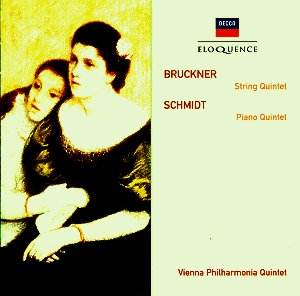
 Vienna Philharmonia Quintet: Wolfgang Poduschka,
Alfred Staar, vv; Josef Staar, Helmut Weis (Bruckner
only), vlas; Wolfgang Herzer, vc; Eduard Mrazek,
piano (Schmidt only)
Vienna Philharmonia Quintet: Wolfgang Poduschka,
Alfred Staar, vv; Josef Staar, Helmut Weis (Bruckner
only), vlas; Wolfgang Herzer, vc; Eduard Mrazek,
piano (Schmidt only)