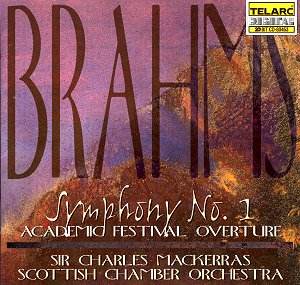
The Brahms symphonies
can readily be described as ‘central
repertoire’, meaning that all orchestras
play them season on season, and there
are recordings in abundance.
It may seem surprising
to find a chamber orchestra entering
what is symphony orchestra territory,
but by ensuring that the strings are
up to strength, this is a distinct possibility.
The clarity of ensemble and excellence
of the players are things for which
the best chamber orchestras, including
the Scottish Chamber Orchestra, are
well known.
So it proves here in
these recordings made in 1997 and released
on three CDs, available separately,
of all four symphonies plus a few additional
items. The additional items on this
first disc are particularly interesting
and successful. The Academic Festival
Overture, commissioned in 1880 by the
University of Breslau in the hope that
Brahms would write a symphony instead,
is sharply focused under Sir Charles
Mackerras’s direction, with some particularly
distinguished playing by the woodwinds.
The addition of percussion makes an
impact in the recorded sound too, in
this exciting performance.
The other additional
item derives from the First Symphony,
the principal material on the disc and
the music which probably caused Brahms
more trouble than anything else he composed,
save perhaps the Piano Concerto No.
1. Work on the symphony began many years
before the premiere, which took place
in 1876 when the composer was well into
his forties. It is therefore intriguing
to hear the discarded version of the
slow movement, which sounds very much
like the movement we know, save that
it keeps moving in unexpected directions.
Of course the first version seems inferior
to the second, but that is because knowing
the final version makes us listen with
expectations of how the musical argument
will develop.
The ghost of Beethoven
looms large over the symphony, and in
many ways. The sweep from C minor to
major with the trombones reserved for
the finale in order to add their weight
to proceedings recalls the Fifth Symphony,
and the main theme of that movement
has a clear relationship to the ‘Ode
to Joy’ in Beethoven’s Ninth. ‘Any fool
can tell that’, said Brahms.
The First is the most
openly epic and heroic of the four symphonies,
and therefore the work in which the
size of the performing ensemble might
most obviously be at issue. Not that
the Scottish Chamber Orchestra is or
sounds puny. The booklet helpfully lists
the players, and though there are just
six cellos and four double basses, the
lower strings as a whole sound warm
and full-bodied. In this performance,
and elsewhere in the collection besides,
it is the violin sound that poses questions,
in that when the music moves above the
stave there is often a lack of warmth
and body. Overall this is an issue that
affects the experience of the music,
not least in the large-scale argument.
For example, in the finale the momentum
and power of the conception are influenced
by the sound itself, and in an adverse
way.
This is a pity, since
Mackerras brings plenty of attack and
drama to the first movement and a wonderfully
lyrical line to the second. The latter
features sensitive attention to details
of dynamic and some really distinguished
playing. This is one of those recordings
in which it is difficult to tell whether
the issue of the string sound lies in
the original performance or in the way
that the recording has captured it.
Terry Barfoot



 Scottish Chamber Orchestra/Sir Charles Mackerras