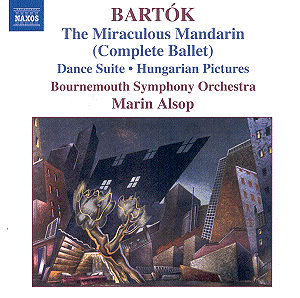
That The Miraculous
Mandarin is one of Bartók’s
greatest scores there can be no doubt.
Yes, it does betray post-Rite of
Spring elements, particularly the
reliance on rhythm and brutal dissonances,
but then how many great scores of the
1920s don’t owe some debt to Stravinsky?
But Bartók goes a stage further,
showing us a modern, complex world that
exudes Expressionist anxiety and an
almost suffocating sexual tension.
The score has brought
out the best in a host of conductors
and orchestras over the years, so the
recorded competition is fierce. I’m
particularly gladdened to see how many
opt to record the full ballet, including
wordless chorus and gentler, ethereal
ending, and it makes for a much more
satisfying whole, especially on disc.
Marin Alsop’s credentials in music where
rhythm dominates are impressive, particularly
in native American scores (Bernstein,
Adams, Rouse) but I have to report that
in Bartók the results are, alas,
disappointing.
My first impression
of Mandarin’s opening, with its
savage depiction of an alienating cityscape
of glaring lights and blaring klaxons,
was that she plays too safe with the
swirling strings and jagged, syncopated
brass. The recording is a mite backwardly
balanced for me, but most of the problem
must be with the conductor. Turning
immediately to my chief comparisons,
Abbado and the LSO (DG) and Fischer
and the Budapest Festival Orchestra
(Philips) is like entering a different
world. The way the animalistic trombone
fanfares are rasped out, the tightness
of the string ostinatos, the characterisation
of those oily, slithering clarinet solos
that precede each chase, all are in
a different league. Alsop does certainly
bring out the pathos in the score (the
final embrace is heart-rending) and
she teases out comparisons with Debussy
here and there, especially the kaleidoscopic
colours of Jeux. But ultimately
it all sounds too tame for this piece.
Abbado’s panic-ridden rendition has
the 1982 LSO playing for their lives,
and Hungarian-born Fischer and his Budapest
band play, quite literally, as to the
manner born. The woodwind have an authentic
Gypsy-style reediness, the brass and
percussion a forceful, visceral impact
that never become raucous. The Philips
recording is absolutely in the demonstration
category, and overall this version,
which won a Gramophone Award in 1998,
must take the palm as the most miraculous
of current mandarins, albeit at full
price.
The Dance Suite
suffers in much the same way. Here the
folksong and peasant dance origins are
at their strongest, but Alsop’s rather
stodgy, leaden approach does nothing
to make you feel this. Again, she is
best in the more tender episodes, such
as the molto tranquillo section
(track 16), but a comparison with my
benchmark, Solti and the Chicago SO,
show just what is missing. It’s not
just sheer speed (Solti shaves nearly
two minutes off Alsop’s 17’33) but bite
and attack. Yes, Solti can be a shade
too brutal and hard driven in some passages,
but the earthiness and energy carry
the day, easily being preferable to
Alsop’s softer-grained reading. In fact,
Solti’s Bartók collection, of
which this Dance Suite forms
a part, is now on a budget Double Decca
and makes an ideal starting point for
this composer.
The Hungarian Pictures
make a reasonable filler (Fischer includes
them, there called Hungarian Sketches,
as well as three other orchestrated
folk collections) but will hardly be
the reason for buying the disc. It is
cheap, but here is a case where paying
the extra will be worthwhile.
Tony Haywood



 Bournemouth Symphony Chorus and Orchestra/Marin
Alsop
Bournemouth Symphony Chorus and Orchestra/Marin
Alsop