Berkeley’s chamber
and solo piano music is an under-appreciated part of his output.
Naxos has had the sensible idea of grouping together works
spanning the early Five Short pieces to the slither of a Mazurka
written in 1982, seven years before the composer’s death.
Not only does it add some fine performances of under-recorded
music but it also makes for varied listening, in which the
ear never tires of Berkeley’s inventive sonorities.
The primary recording
venue has rather an echo-y acoustic, with here and there a
touch of ambient noise – this is South Melbourne Town Hall
where the majority of the recordings were made – but that
won’t impede enthusiasm for the performances to any appreciable
degree. Certainly in the 1942 Violin Sonatina we can hear
some bold and confidently etched writing in which Berkeley’s
Lento picks up the reflective qualities that ended the opening
Moderato. The slow movement is a kind of highly compact threnody
with ascending piano writing; the effect, whilst different
in terms of scale and melodic impress, is actually not unlike
the similar movement in Ireland’s Second Violin Sonata of
1917. Puckish and light, the finale banishes care though even
here there are moments of easeful lyricism. The Sellers-Vorster
duo does well by it – nothing outsize.
The Five Short Pieces for Piano go back
to 1936. The second has a dash of Poulenc and a tablespoon
of promenading insouciance, whilst the fourth, an Andante
lasting two minutes, is pastel shaded and rather hypnotic.
The Andantino for Cello and Piano is a considerably later
work than these early pieces – one of the virtues of this
recital is that we shift forward and backwards through Berkeley’s
compositional development – and a very warm work lasting barely
three minutes. Berkeley wrote well for winds as the Three
Pieces for Clarinet attest – and he can’t resist some baroque
hints, with dotted figures, in the Lento. The late Mazurka
has a Scottish accent and a salon style but a work of stronger
character is the Duo for cello and pinao, a tightly argued
piece with plenty of room for contrastive material – good
opportunities as well for bowing colour and harmonic and melodic
interest. It’s a real Duo as well, a meeting of equals – and
at six minutes is an impressively concise and would make a
welcome addition to the questing cellist’s recital repertoire.
The Six Preludes
(1945) are ripplingly Francophile in orientation – the opening
Allegro builds up a fair head of steam and the central Allegro
Moderato is arresting, pert, and full of drama and capricious
sweep. Which leaves the Concertino with its engaging brightness
and catchy airiness to the fore in the first movement. The
melancholy ground for flute and cello of the first Aria is
followed by an even more overtly expressive one for violin
and piano and both show Berkeley at his most lyrically concise.
The finale receives a sappy reading here, bright and ebullient
and sharply witty. It adds to the pleasures of this enjoyable
and convincingly performed ensemble outing.
Jonathan
Woolf



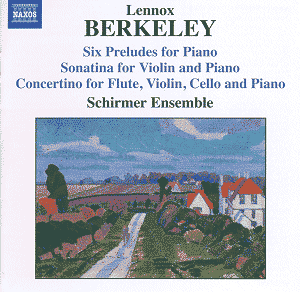
 Schirmer Ensemble











