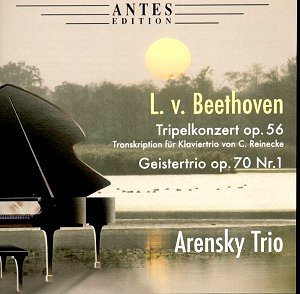
I seem to have spent
quite some time recently reviewing chamber
arrangements of some of Beethoven’s
large-scale works. Hot foot from chamber
reductions of the Eighth Symphony et
al we now have Antes’ transcription,
by Carl Reinecke, of the Triple Concerto.
This was one of many works that the
tireless Reinecke arranged and transcribed
for domestic use. What distinguishes
it from, say, the anonymous transcription
of the Eighth Symphony, which was done
whilst Beethoven was still alive and
could have been by one of his pupils,
is obviously that Reinecke was writing
fully sixty years after Beethoven’s
death.
Unlike the transcription
of the Pathetique Sonata for string
quintet, which amounted to a comprehensive
recasting and which was also carried
out during Beethoven’s lifetime and
quite possibly with his sanction, Reinecke’s
is a very much straighter transcription.
There are few textual deviations and
the most diverting feature is the clever
and democratic distribution of tuttis
between the three solo instruments.
The Arensky Trio show a fine sense of
unanimity in phrasing; their actual
sound is quite discreet and small-scale,
clean and narrow of vibrato. The cello
bears the brunt of technical demands
in this work and those demands are by
and large well met.
Coupled with the Concerto
is the Ghost trio, a perfectly
logical choice, to balance the novelty
of the Reinecke. This reveals a few
limitations; some of the phrasing in
the first movement sounds rushed and
there’s a certain air of rhythmic heaviness
and over emphasis. The slow movement
is lean and spare though not ungenerous;
broadly classical in outlook. It’s certainly
worth getting to hear the bare bones
Triple, though I think once is probably
enough, even with a performance as generally
sympathetic and adequately recorded
as this one.
Jonathan Woolf



 Arensky Trio