Other Links
Editorial Board
-
Editor - Bill Kenny
Assistant Webmaster - Stan Metzger - Founder - Len Mullenger
Google Site Search

SEEN AND HEARD INTERNATIONAL OPERA REVIEW
Kaija Saariaho,
Emilie: Karita Mattila (soprano) Orchestra de l'Opéra national de Lyon Opéra Conductor, Kazushi Ono, Het Muziktheater, Amsterdam 21.3.2010 ( BK)
Production – Opera National de Lyon with De Nederlandse Opera. Sung in French with Dutch surtitles
Libretto, Amin Maalouf
Director, François Girard
Sets, François Séguin
Costumes, Thibault Vancraenenbroeck
Lighting, David Finn
Dramaturge, Serge Lamothe
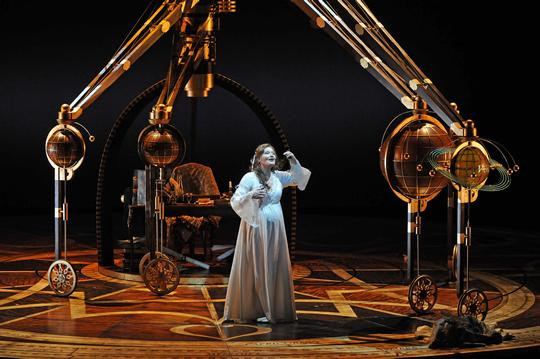
Production Picture © Jean-Pierre Maurin
Kaija Saariaho’s latest opera takes an episode from the life of the 18th century French aristocrat Emilie du Châtelet as its subject.
Prodigiously intelligent from infancy, Emilie was
unusually fortunate among women of her time, because her father took the almost unprecedented step of ensuring that she was educated to the highest standards possible. She became an expert in physics, mathematics, philosophy and linguistics,
and eventually established herself as an acknowledged member of Europe’s intellectual elite.
After marriage to the Marquis du Châtelet
at the age of 19 and raising a family of three children, Emilie continued with her intellectual life, publishing numbers of important scientific works in physics and astronomy, particularly on the
nature of energy. She was apparently beautiful and
witty as well as intelligent, and became the philosopher
Voltaire's lover when she was 27, establishing a deep and lasting relationship with him as his
intellectual equal for the rest of her short life. For
reasons that are unclear Emilie also took a
second lover, the poet Jean François de Saint-Lambert and became pregnant by him
when she was 43:
it is at this point that the opera begins.
By the time of her pregnancy, Émilie has nearly finished her French translation of Newton's Principia Mathematica - still apparently a standard work in France - and as she works she contemplates her
scientific achievement and the rest
of her life, while having presentiments about the possibility of dying in childbirth, a serious risk for a woman of her age. In actuality, Emilie du Châtelet died only six days after giving birth, surrounded by friends including the distraught Voltaire, who according to the programme note by Sybille Wijffels,
wrote to a friend that ‘he had lost not only a mistress but his other half; his ideal soulmate.’
Just as they did in the oratorio La Passion de Simone a monodrama with chorus on the life of the philosopher and ascetic Simone Weil who deliberately starved herself to death (see review) and
in the full-scale opera Adriana Mater
(review),
Saariaho and librettist Armin Maalouf have again set a work around
contemplative themes – episodes when everything hangs in suspension for the
protagonist and in which life potential may
easily turn to dissolution. In this respect, Saariaho continues to emulate the musical and dramatic legacy of Messiaen – a great influence on her decision to write opera - whose St François d’ Assise was also presented by De Nederlandse Opera in 2008 (review). Within a state of almost complete inaction, an entire life is revealed and considered
here: the music reflects this stasis, combining with the libretto to give
an impression of timelessness which encapsulates Emilie’s last moments. There is nothing more that can be done; everything is as it is.
The set is equally confining. It consists of a vast orrery
surrounding Émilie's desk and nothing else
other than a backdrop lit with stars. Emilie sits, when working, at the heart of a solar system in which the planets bear the names of the men who have influenced her. The lighting (which is
often very beautiful) changes with each of the nine sections of the work and the planets themselves revolve around the desk and the woman.
Saariaho's intense and personal operatic work is often wholly engaging
with music beautifully attuned to the profound thought of
her chosen texts. L'amour de Loin, for example, was a work that managed brilliantly to look at the concept of courtly love – a modern opera which successfully conveyed a mediaeval concept that could hardly be further from today's way of thinking. Similarly, Adriana Mater
combined words and music which conveyed a potentially shattered series of lives transcending their social confines. By contrast
with these works, Emilie fails.
In part, this is because the nature of the music is mostly in
conflict with the dynamic woman at its heart. Emilie du Châtelet was a powerful, fulfilled person who was anything but confined by the expectations of her time. She was a scientist at a time when the world was perceived as a deeply orderly place within a deeply ordered universe. Rationalism and enlightenment was the prevailing mood and Voltaire was not only her lover, but her soulmate; they were equals in intellect and vision, a fact that they acknowledged mutually. In essence then, this monodrama felt as if it was a work about an
entirely different kind of woman, a romantic rather than a leading light of the age of reason.
The giant orrery - which rotates to mimic planetary movements around Emilie’s desk - confines her too often in a manner
that is in conflict with the story and suggests
too that her social environment was equally confining.
A rigidity is implied here which does not fit well with the fluid and amorphous nature
of the music - which itself is curiously uniform for each of the nine tableaux into which the opera
divides.
Despite a carefully constructed electronic underlay to the 25 piece orchestra, very little seems to happen
to the music as it flows through Emilie’s musings on the different episodes in her life – her scientific discoveries, her lovers, her thoughts about her unborn child and her forebodings about death. Perhaps
this Saariaho's deliberate choice because this woman is at a point in her life which is simultaneously both timeless and strictly time-limited.
Even so, the sound world varies hardly at all between tableaux describing very different emotions and the only character on stage – Karita Mattila for whom the work was written - is cast as both observer and reporter.
Karita Mattila and conductor Kazushi Ono
gave their best to the score but the vocal line
was never particularly interesting and had
little variety: Ms Mattila was in excellent voice however and doubtless
paid her music full justice. But the work felt
monotonous and far too long whether at the reported 72 minutes of the original French performances, or the estimated 90 minutes of this one. Three quarters of an hour at
best is all that might have sustained interest.
Bill Kenny