| Search MusicWeb Here | ||
 |
||

|
Founder: Len
Mullenger (1942-2025)
|
| Search MusicWeb Here | ||
|
||
|
Founder: Len
Mullenger (1942-2025)
|
paid for
|
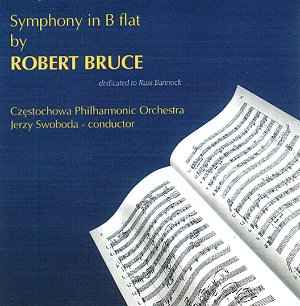
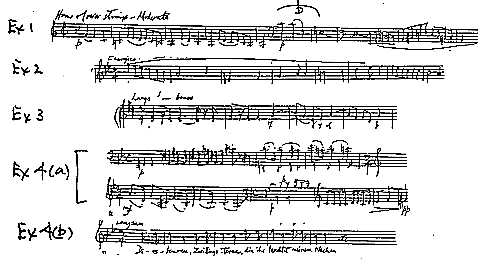
There must always be a reason for writing a Symphony. The discipline involved in following the accepted 'classical' form would usually indicate a psychological 'raison d'etre'. The few British Symphonists of the earlier half of this century more often than not expressed in symphonic terms of one kind or another essentially tone-poetical ideas. The analytical note which the Scottish born (1915) composer Robert Bruce provides with his (to date) only Symphony - written between 1953/7 - reveals a markedly classical approach and an organic coherence in this four movement work. Only for the final movement is a programmatic origin given and it will be seen to have deep psychological implications and is in no real way tone-poetical. The overall tonal scheme involves a strong architectonic pattern - moving from B flat, through G minor, D major, G flat minor (as F sharp minor in context - 'a key of fear and disquiet for me' he confesses,) and returning via D major to "the quiet peace of B flat the first and third movements are contemplative: the 2nd and 4th are active" The mere outlining of this scheme of things gives little indication of the richness of this fine score, or of the power of the writing, at once classical in impulse yet wholly original - the principal reason for both being the conveying of symphonic thought without recourse to the more colourful devices of orchestral atmospherics so often (in Julius Harrison's words) "superimposed on the music after true invention in the act of composition has ceased". The thematic material is memorable (and eminently singable) and is expounded in instrumental terms that recall, in the quality of the scoring and the orchestral sound, Beethoven, Brahms and Sibelius - even Nielsen - a lineage that few British composers of this century (except perhaps Rubbra) might have said of them. The work opens in the composer's words 'with a question' (EX1 ) entrusted to horns and lower strings - a very personal thematic idea which contains three distinct phrases whose contrapuntal development, inversion and augmentation, provide all the material for the first tightly constructed movement. Especially prominent is the drop of a fifth (EX1b) which falls, in a kind of doubting anguish, to the Enatural below. Fragments of the theme, in insistent repetitive patterns drive the music forward, with some highly individual scoring, Urgent contrapuntal development, with the theme and its inversion combined, lead to the exploration, on solo oboe, of the more lyrical aspects before an abrupt cadence forcibly ends the argument. A strong rhythmic impulse of three hammer-like blows drives the Scherzo in which further insistently repetitive figures force the pace. A lyrical interlude on clarinet, as lovely as anything in Brahms (EX2 ) appears, the accompanying bass line acquiring a melodic identity of its own. This fuels much of the ensuing development before, after a moment of Silence, the movement ends with an impatient gesture. The Largo third movement , though in a bright D major, has a nobly tragic brass theme in which the falling third has especial significance (EX 3) Strings reflect on this under a clarinet obbligato - and this material occupies the whole movement, rising in impassioned intensity as the interval of the third is broadened to the fifth in strings. A throbbing pulse underpins the resumption of the theme with its benediction-like cadence appearing. in the composer's words "as punctual and unsentimental as in a Baroque ritornello movement from which this springs". The final movement has its psychological origins in the composer's wartime experience as navigator in night sorties over enemy airfields. The particular event which was the motivating force for this movement was the destruction of a ME110 on the ground. The climax of the movement, with its harsh stuttering evocation of the 'four 20mm cannon .... firing under one's feet' is the only moment that might be considered programmatic. Infinitely more subtle is the heightened nervous tension of the undertaking, (EX4a) expressed in Sibelian string and woodwind figuration (in F sharp minor) and in the brilliantly conceived correlation with Schubert's setting of Mayerhofer's "Schiffers Nachtlied".(EX4b):
This melody tentatively enters the music at the outset, its drop of a third perhaps reflecting the earlier Largo theme. The climax with the destruction of the German plane, is followed by triumphal shouts in brass - and, as the Schubert melody now in B flat appears more fully, it seems to suggest that a landmark has been found to guide the voyagers home. How apposite is the relationship between the fisher seeking direction and blessing in the twin stars, and the navigator in the aeroplane - both voyagers in the two elements least hospitable to man. The recording is given a powerful reading by the Poles - a disc that should not on any account be missed. Recorded at the Czestochowa Philharmonic Concert Hall, May 1999 produced by Robert Bruce in association with Classical Recordings & Concerts ul. Szpitalna 8/33, 00-031 Warsaw e-mail musicprod@supermedia.pl
Reviewer Colin Scott-Sutherland
|
Please support our advertisers below by clicking on the logos for further information.  All Lyrita reviews  All Nimbus reviews  All Hyperion reviews  All First Inversion reviews (formerly Divine Art)  All Forgotten Records reviews  All cpo reviews  All Convivium reviews  All SOMM reviews  All APR reviews  All Chandos reviews  All Oehms Classics reviews  All Bridge reviews  All Orfeo reviews
|