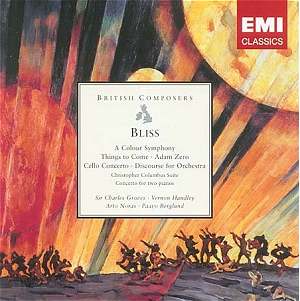

With at
least one work from each of Bliss's composing decades this
collection cuts a broad swathe through the composer's working
life rescuing often exceptional analogue recordings from
1970s. In doing so it presents some of his strongest and
most memorable works.
The older duffers amongst
us who experienced the quaintness of shopping for 12 inch
LPs presented in their laminated card sleeves will recall
them: Adam Zero from ASD 3687. The Colour Symphony and Things
To Come by Groves from ASD 3416. In fact EMI offer us
a nostalgia fix by reproducing the original LP sleeve for Colour
Symphony on the reverse of the booklet. Discourse is
from ASD 3878 (with Meditations on a Theme by John Blow and Edinburgh
Overture) and ASD 3342 which included the powerful Noras/Berglund
Cello Concerto and Miracle in the Gorbals. The Two
Piano Concerto was issued on ASD 2612 with works by Jacob
and Arnold. Miracle, Colour Symphony and Edinburgh have
been reissued on CD before now as CDM7 69388 2.
Bliss’s
music stands some way between the majesty of Elgar and the
brilliance of Stravinsky; an over-simplification and a distortion
but it gives a fair flavour, I think.
A Colour
Symphony, weighed
down with its programmatic associations with colour and
heraldry was written for and premiered at The Three Choirs,
Gloucester on 7 September 1922. The composer conducted
the LSO. Groves’ recording was the second since the composer's
1950s version (now on Dutton). None of the commercially
recorded versions is unrecommendable. You can try Wordsworth
on Nimbus, Handley and Hickox each on Chandos with Hickox's
being the most recent. Groves is not the slowest but gives
the impression of taking infinite care with each phrase
- allowing each note of a spasmodic rhythmic cell to register.
This works superbly and the recording wears its thirty
years supremely well. Woodwind sound honeyed, brass reach
out in golden waves and the strings retain their sweet
edge. The third movement Blue is lush with birdsong
and pastoral repose - an unusual RVW-style moment for Bliss.
Just as unusual is the Schoenbergian fugal element in the
finale. Otherwise the accent is on an awed grandeur - the
power of a massed force and a shocking agility and torque. A
Colour Symphony is one of the great works of the British
scene in the 1920s and none the worse for the not totally
resolved voices of the enfant terrible on one side
and Elgar on the other. Could anyone resist that measured
tread and lissom theme in the first movement? It has the
impact of the start of Elgar 1 and when Bliss was seized
by the spirit such inspiration placed him high in the world's
canon of composers. It was to grip him again in the John
Blow Meditations with its paschal sense of peace and
blessing.
On the
same 1970s LP as the Bliss symphony was an extended suite
from his music for the film Things to Come. It then
benefited from research and editorial work by Christopher
Palmer who provided new reconstructions. As we now know there
was more to come as can be heard on the Chandos Bliss British
film music volume. Groves captures every gramme of vitality
and those horns and trombones are again magnificently rendered
by John Willan and Stuart Eltham. Groves also makes
us hear the terror in The Attack. There is the same
element in what amounts to the foreword to the march; Bliss
had served in France and his brother had been killed on the
Western Front. Groves is a recognised master of the march
and the superb march benefits from the contrasting ruthlessness
and magnificence of the music. There is about this music
a bitter Soviet determination and the Stakhanovite work-ethic
in exceeding targets is there too. The raw-toned and roaring
Beethovenian Attack on the Moon Gun is all that survives
of the original film score performing material.
Two Finns
stand at the centre of this recording of the Cello Concerto
- the latest work in the collection. It was written for Slava
Rostropovich and premiered at Aldeburgh. It is a considerable
work but despite the emotional punch and the muscular vitality
of both Noras and Berglund its memorability is of a less
lofty order than the works of the 1920s-1950s. Fascinating
to hear the recycling from the drums of a theme from the
violin concerto in the finale and later for full orchestra
at 4:40 (tr. 15). The gutsiness of the solo part surely shows
the influence of Shostakovich's first Cello Concerto. Although
not a matter of influence you can hear portents of Shostakovich
in Bliss’s writing in Music for Strings.
The works
on disc 2 are not as well known and the mass selling power
of the set rests on CD1. Collectors however will bless EMI
for collecting these recordings from hither and yon. It's
just a shame they could not have fitted on the Handley-conducted Edinburgh
Overture - a favourite of mine.
Bliss considered Adam
Zero the most varied and exciting of his four ballets.
This 12 movement suite presents 33 minutes out of the 42
minute score. It is classic Bliss and has much greater
impact than the handful of movements the composer recorded
for Lyrita in the 1960s. Surely Bliss doing some unconscious
borrowing from Britten's Grimes in the upward-scoring
strings in Dance of Summer. Dance with Death dredges
up memories of Britten's Sinfonia da Requiem. The
ailing Constant Lambert who conducted the premiere at the
ROHO in April 1946 must have smiled at the Lambertian rhythm
in the finale (tr. 11). The Fanfare Coda recalls
de Falla's Le Tricorne.
Discourse originally
appeared on an LP in harness with Edinburgh and the Meditations -
the latter written for the CBSO who were recording it for
the second time; the first had been in the mid-sixties with
Hugo Rignold. Discourse is not top drawer Bliss but
it still has plenty of the life force we know from the works
of the 1920s and 1930s. Its original version was recorded
in mono by the Louisville Orchestra and Robert Whitney
and issued on LP LOU592. This reappeared on First Edition
FECD1904
in 2005 (see review).
The Two
Piano Concerto has a long and involved history and there
is I hope opportunity for the work in its various previous
versions to be recorded. The bright and gleaming Stravinskian
dimension to be heard here call to mind another work of the
1920s: the even stronger and desperately unfairly neglected
Walton Sinfonia Concertante. The Bliss Concerto is
bright-eyed but lacks a strong profile. Had it been warmed
over and reconstructed too many times, I wonder? It was first
issued on an LP of two piano concertos by Arnold and Gordon
Jacob.
Garnered
in from an anthology of British film music is the three movement Columbus film
music suite. Its central Grave is typically strong
and dignified Bliss while the outer movements shine with
Iberian life even if the final march cannot help but glance
at the march from Things to Come.
The notes
are newly written up for this collection by Andrew Achenbach
and are an engaging complement to the music. All credit to
EMI for not simply doing a cut-and-paste job on the original
texts. I hope they will go back to Mr Achenbach for further
work in this direction as he always writes well and makes
those unusual connections which make reading his work fascinating.
This is
a potent collection. EMI were always rich in Bliss material
and we can only hope that there will be no stopping the company
now.
They have
been amazingly diffident about the Charles Groves’ Morning
Heroes (SAN365) with a single CD reissue back in 1991
on CDM 7 63906 2 amongst the first batch of their British
Composers series. Why is it no longer available? Then
there’s the Handley/CBSO Blow Meditations, the latter
a sequel of sorts to Rignold’s still superb Lyrita recording
of the same work. The Meditations are no Meissen-fragile
effort; no prissy neo-baroque fancie. There’s nothing
of the ‘Let’s Dance Gay In Green Meadow’ smock-Tudor preciosity
of some 20th century reploughings of this material.
Instead we have a completely unacademic large-scale work
of transcendental and visionary inspiration – an orchestral
equivalent of RVW’s Tallis, fierce as well as tender.
New Bliss recordings are
still possible as we know from Chandos’s 2006 CD of the Violin
Concerto but what we need alongside forays into the vinyl
realm is a recording of the large-scale soli-choral-orchestral
epic The Beatitudes. That would be a recording
premiere and a very adroit move given the work’s indelibly
poetic-dramatic qualities. It was grievously overshadowed
by having to share the same Coventry Cathedral celebrations
as the premiere of Britten’s War Requiem.
The present
set offers an unmissable and generous two disc collection
- vitally essential Bliss.
Rob Barnett
|
Advertising
Rates
Visitor
stats
MusicWeb
International
has over 40,000 Classical CD reviews on offer
Discs
received
Having a problem
Donating?

Gerard
Hoffnung Concerts &
The
Bricklayer Story
MusicWeb
can now offer
you discs from the following catalogues:
Prices include postage
There will be NO
VAT Rises
Musicweb
Special
Offers
Monthly
Best Buys
New
Releases

New
Releases


MusicWeb
sells the Polish
catalogue CDAccord
£10.50 post free W-W

MusicWeb sells the
Arcodiva catalogue
£12.00 post free W-W

£11.75
post-free world-
wide
Google
Ads - for information about privacy matters, click here.
Amazon Musicweb International is a participant in the Amazon
EU Associates Programme, an affiliate advertising programme designed to provide
a means for sites to earn advertising fees by advertising and linking to Amazon.co.uk
and Amazon.com
|








