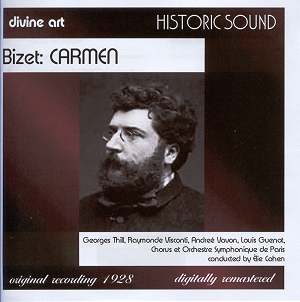
Sometimes
a reissue comes along to make one think; well, have I heard
this or not? The conductor is a recording regular, Elie Cohen,
an experienced and practised executant on the rostrum. And
then there is Thill the Magnificent. Surely one thinks to
oneself one must know it, if not just for Thill. Oddly however
this is a recording that has seemingly escaped the clutches
of wholesale restorers. So the simple answer is no, I've
not heard it before.
Thinking
of early Carmens reminds one that a light discographical
truffling might be of interest. The earliest Carmen was the
1908 German language recording with Emmy Destinn, Karl Jorn,
Minnie Nast and Hermann Bachmann and it's has been restored
by Marston. The next version was Parisian and made in 1912
with Marguerite Mérentié, Aline Vallandri, Marie Gantéri,
Jeanne Billa-Azéma and Agustarello Affre (see review of
Malibran's transfer, though a more recommendable transfer
is also on Marston). Then came an Italian Columbia set in 1920,
followed by a recording directed in 1927 - the first electric - by Coppola with Perelli,
Brothier, Trévi and Musy (on another Malibran CD). Then came
this one with Cohen, followed sharply by a Sabajno-led Italian
set in 1931 and another by Molajoli in 1933 with Pertile,
Buades, Tellini and Franci.
So we have never lacked for Carmens, and even
in pre-First World War days there were two very recommendable cast
recordings if one could afford it. This second electric recording has
strong claims on the collector. Its star is Thill, who tends
to eviscerate, in emotive terms, his fellow cast members.
Thill's versatility encompassed the ringing and declamatory
as well as the gently caressing - and all stops in between.
His is an impersonation of the fullest richness and the close
attention to consonants and vowel production of a native
French speaker brings its own inestimable colouristic advantages.
The text is ringingly alive when Thill is on hand. He is
elegant and he is charming, he is suave and commanding.
His
Carmen is Raymonde Visconti, seven years older than Thill.
She's perfectly acceptable but only really comes alive as
the opera reaches its close. The earlier scenes find her just a
touch metrical and overly straightforward. When she and Thill
share their Seguidilla and duet in the First Act one finds too
much of a buffer between his kaleidoscopic humanity and her
studiedly neutral competence. Michaëla
is Marthe Nespoulous, a soprano of considerable girlish refinement.
Hers is a typically French voice and I find it very persuasive.
It's well supported, unaffected and has theatrical presence,
though I wondered momentarily as to its carrying power on stage. I
also liked the Escamillo of Louis Guénot who also, in his own
very different, blustery way, has an effective
stage persona that manages to transcend the grooves. It wouldn't
do to suggest that he has the most imperishable of voices
but he's enjoyable and gives good value. So I think it would
be wrong to limit this to a one-man set. True, Thill is by
some considerable distance the most marvellous singer here
but there are at least two other performances of some stature.
The transfers sound very well. Andrew Rose seems to have done
something similar to his restoration work on E.J. Moeran's
symphony; he seems to have strengthened string tone, maybe by
strengthening the bass line, though without access to
the original set it's difficult for me to make any kind of
meaningful comparison. He notes the original recording was
"thin" and
this was corrected by reference to a modern recording. The
results, on a stand-alone basis, sound very acceptable.
The recording obviously is not complete - there are no recitatives
and no dialogue - but this was an almost invariable corollary
of recording at the time. We do have texts, a plot summary
and artist biographies. So all in all that early Carmen discography
is taking on an increasingly healthy look on CD, greatly
helped by this most worthwhile addition to the catalogue.
Jonathan
Woolf



 Raymonde
Visconti (mezzo) - Carmen
Raymonde
Visconti (mezzo) - Carmen