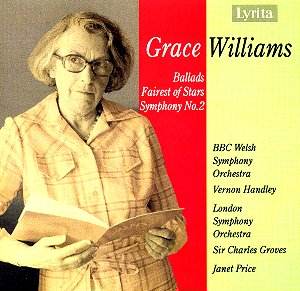
The Welsh composer
Grace Williams has been unfairly neglected
by concert promoters and record producers
alike. A pupil of both Vaughan Williams
and Egon Wellesz - and very nearly assistant
to Britten, declining his invitation
- she returned to her native town of
Barry, near Cardiff, after the Second
World War. It was there that she spent
the rest of her life, composing mainly
by commission from the National Eisteddfod
and Llandaff and Swansea festivals.
It is perhaps by placing herself out
of the British metropolitan musical
mainstream that Williams’ work has so
often been sidelined. On the strength
of the music on this disc - from BBC
and EMI originals - it is time for serious
reappraisal.
The earliest of the
three works, the Second Symphony
(1956, rev.1975), is also the most ambitious.
The first movement, Allegro marciale,
immediately proclaims debts to other
symphonic composers. The persistent
side-drum, trumpet fanfares and unison
wind accompanied by pizzi-staccato strings
are highly characteristic of Shostakovich’s
symphonic output. Likewise the violent,
militaristic quality harks back to Vaughan
Williams’ Sixth Symphony, whilst
the macabre waltz-like sections (replete
with swooning solo violin) recall the
shadowy world of Mahler’s Seventh.
Yet if the elements are suggestive of
others, the binding together of the
different strands are Williams’ achievement.
After the opening, she soon reveals
a romantic streak all of her own, without
ever being sentimental. The rhythmic
tension that the composer generates
grips like a vice, subtly changing from
4/4 to 6/8 and frequently adopting cross-rhythms.
The development section is tautly constructed,
throwing principal ideas together into
a complex but always lucid texture.
Indeed, the trumpet fanfares from the
opening permeate not only this section
but the movement in its entirety.
The Andante sostenuto
that follows is rather more gentle,
but no less bleak in its outlook. The
stark opening has a plaintive oboe melody
set against drone strings. Constant
fluctuations between major and minor
reflect the chromatic melody lines which
rarely open out but instead tug one
way or the other. Most of the melodic
movement is built upon simple stepwise
ascent or descent. The movement is immensely
compelling all the same and the orchestration
clearly helps-a prominent timpani rhythm
and quiet tam-tam are menacingly present
throughout. Williams provides some respite
in the conclusion to this movement,
coming to rest firmly in the major.
The ensuing Allegro
scherzando, however, returns to
the violently grim nature of the first
movement. Scurrying rhythmic motives
and frequent metric shifts generate
a huge amount of excitement. A fleeting,
slower central section is still incredibly
dark, with ominous slitherings in the
clarinets and biting trumpet interjections.
The rhythmic vitality
of the third movement is offset by the
Largo that follows. The opening
of this movement sees Williams in obvious
late Romantic guise; in both sonority
and harmony this is reminiscent of the
Adagio of Mahler’s (then) incomplete
Tenth Symphony. The simultaneous
sounding of major and minor chords reflects
the struggle of tonalities that has
permeated the whole symphony. Later,
the side drum and trumpet motives from
the first movement return, leading to
waves of climactic - though still troubled
- lyricism, before a sudden, quick ending.
Ballads (1968)
is unmistakeably the work of the same
composer yet, freed from the conventions
of symphonic forms, Williams seemed
less inclined to display her influences.
Three of the four movements take a single
melody and repeat it within different
orchestral and textural contexts. The
melodies often take on an improvisational
quality and the accompaniments show
the same sense of imagination as in
the Symphony. This is an essentially
dramatic work, designed to reflect different
aspects of Welsh culture and history.
Whether or not it succeeds on such a
level is unclear; nevertheless, it is
still highly compelling.
Both of these works
are exceptionally well played by the
(then) BBC Welsh Symphony Orchestra
under that tireless advocate of obscure
British orchestral music, Vernon Handley.
The sound is acceptable, though the
Llandaff studio acoustic is rather dry
and airless, resulting in some congestion.
‘Big’ works such as these should ideally
sound more expansive.
No such concerns apply
to the 1973 (EMI) recording of Fairest
of Stars. The sound here is as opulent
and expansive as one could wish. Indeed,
the work itself - composed specially
for the recording - is an even finer
piece than the Symphony. A setting of
lines from Milton’s Paradise Lost,
this is a rhapsodic, ecstatic work that
is totally distinctive from those of
other composers. The soaring, melismatic
vocal line is extremely well delivered
by Janet Price. Her rapid, flickering
vibrato only adds to the sense of wonder
and barely contained excitement, and
she is sensitively partnered by Groves.
This is a work that demands to be heard
and, given its highly idiomatic vocal
writing, one that certainly deserves
to be performed more often.
This disc is certainly
an ear-opener. If the idiom appeals
then much satisfaction will be gained
from exploring this fascinating repertoire.
As the only available recordings, they
would be a first choice even if the
performances were poor. Fortunately
the disc is both very well performed
and more than adequately recorded.
Owen E. Walton
see also review
by Colin Clarke



 for
details
for
details bJanet Price (soprano);











