I'll
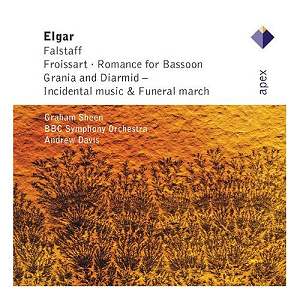
come clean right up front: I've never "gotten" Elgar's Falstaff.
I may well be in a minority there - various encomia, both online
and in print, suggest that many consider this tone poem a masterpiece
- but I've always found it long, shapeless and rambling. Once
past the statement of the two principal themes - the first
representing Falstaff, the second Prince Hal - the structure
of the piece is dictated exclusively by the extra-musical program
rather than by abstract formal considerations. In this respect
it resembles the more discursive Liszt tone-poems. The problem
is not inherent in the genre: Strauss's Don Quixote,
for example, is of comparable length and its program is similarly
detailed, yet its variation structure offers sufficient and
regular repetition of motifs to provide a sense of arching
coherence. Absent the program, it's hard to make sense of what
you're hearing. Yet it won't do to play against the score's
discursiveness: a tightly-paced reading merely scants the music's
pictorial element without compensation, with Solti's standing
among the more spectacular failures - Decca, perhaps fortunately
caught in digital limbo.
Warner's
- or, originally, Teldec's - producers seem to be aware of
these potential pitfalls, and do their best to smooth the listener's
way. Each episode of the score gets a separate track - twenty-nine
in all, some lasting for just a few seconds - and Anthony Burton's
booklet note provides a track-by-track synopsis of the program,
like a sportscaster's play-by-play. And the conductor, Andrew
Davis, is an experienced advocate of the score. His first,
Lyrita LP (SRCS77) recording of the piece - made long, long
ago, at the start of his international career - was clean and
well-organized, if short on sheer passion. Here, the warm tone
he draws from the BBC strings, while fuzzing the outline of
the phrases, draws the ear. Sonorous weight is balanced by
a springy, buoyant rhythmic impulse. Davis leans expressively
on Elgar's characteristic broad melodies, the better to set
off chipper, idiomatic woodwind staccati. I enjoyed
hearing the music, which is something, and appreciated the
composer's expert orchestration, even though a grayish recording
neutralizes its splashes of color. But I didn't actually like the
piece any better.
But
collectors may well value the rest of the recorded program.
The title of the Op. 62 Romance suggests a salonish
trifle, but the strings' anguished opening gesture - harbinger
of the deep emotions to follow - immediately dispels any such
impression. Daniel Barenboim's old Sony (originally CBS) account,
probably the most readily available of the older recordings,
offered a polished, responsive English Chamber Orchestra, but
here the use of a full string section adds to the sense of
weight. I can imagine a rounder, more supple bassoon timbre
than Graham Sheen's, but he deploys his narrower, more focused
sound sensitively.
The Grania
and Diarmid Funeral March is no stranger to disc - it
also turned up relatively recently on James Judd's Naxos
disc (8.557273 - see review) - but here it's preceded by
a brief, evocative introduction, which presumably constitutes
the
billed "Incidental
Music". The horns' quiet calls to attention, answered
by searching string chords, don't hold much interest melodically,
but nicely set up the Funeral March, which moves with a steady,
forthright tread.
I
suspect we'd hear Froissart more frequently in the concert
hall had Elgar not composed the masterful Cockaigne.
The earlier overture incorporates all the familiar Edwardian
melodic and rhythmic gestures, without quite cutting the strong
profile of the later piece. Davis's performance is sympathetic
and flowing; I remember the lyric themes emerging more affectionately
in Barbirolli's EMI account, but I haven't actually heard that
one in years.
The
BBC Symphony, shedding its customary workmanlike persona, plays
with splendid commitment. The violins whistle slightly in
altissima in Froissart, true; elsewhere, the aching,
liquid beauty of the clarinet solos, and the horns' poised
attacks on exposed high notes, are ample compensation.
Stephen Francis Vasta
BUY NOW
AmazonUK



 Graham Sheen
(bassoon) *
Graham Sheen
(bassoon) *











