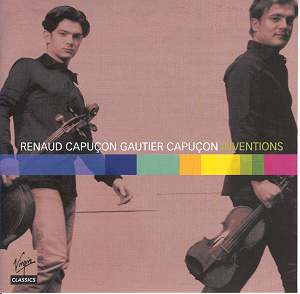
The
Brothers Capuçon undertake their responsibilities here aided
in the final track by their sister Aude. The programme wears
a curious look, opening with Bach transcriptions and including
the two Beffa Masques of which they are the dedicatees. Bartók
is more canonic, though here in the form of transcriptions
by Karl Kraeuter. Klein’s Duo is not well known though it
has been recorded by Daniel Hope and Paul Watkins on Nimbus
[NI 5702]. The Martinů is by now relatively well encountered
and companionable recordings have been made of it over the
years.
So
the mix is certainly interesting. The nineteenth century
Bach transcriptions had me in two minds. I wasn’t sure whether
Renaud Capuçon in particular was trying to emulate supposed
late nineteenth centurty performance style in his sparing
use of vibrato or making concessions to historically informed
practice. I presume the former, which would be far more pertinent
than the latter, given the sense of historical continuum
involved in adapting these works for a string duo. It works
relatively well and given that they only take on seven of
the twenty ennui has no chance to set in. The Inventions,
which open and close the selection, are buoyant but the Aria
disturbed me with its tonal paucity.
Eisler’s
mildly disagreeable Duo dates from 1924. Its slithery wit
touches expected expressionist points and this provokes both
players to up their vibrato usage to a silvery intensity.
Bartók’s Mélodies populaires hongroises, to give them
their French translation, emerge well via Kraeuter’s intercession.
The two players match robustness with rusticity; the high
point is the warmth of the Choral which is adeptly
and not too passionately done. Klein’s Duo is unfinished.
Tbe first movement is intact and is highly Bergian in its
profile, agitated as one would expect and unsettled. The
second movement ends after two and a half minutes.
Martinů’s
Duo dates from the year before his death. Cast in three movements
this is a work that cries out for tactile rhythmic assurance.
I can’t help feeling a lack of engagement with the Czech
rhythms here. The French duo certainly dig in but they just
don’t get airborne. And their collective sonority is too
brittle to do the work real justice. Contrast them with the
classic Suk-Navarra on Supraphon to hear what’s missing – a
natural sense of the flow and space of the melodies and a
deep commitment, especially on Suk’s part, to expressive
depth.
It’s
good to hear the two Beffa Masques which are traditional
sounding works. The First is romantic and explores the cell
theme with almost obsessive detail. Its second half is a
correspondingly slower setion. The second Masque is a basso
ostinato, cleverly constructed but overlong. The Kreisler
trio encore is rather unecessary and I wish the duo had stuck
to their guns and given us an all violin-cello disc.
No
complaints about the recorded sound at IRCAM nor concerning
the booklet documentation. The disc itself though, I found,
was only intermittently effective.
Jonathan
Woolf
BUY NOW
Crotchet ArkivMusic
|
Advertising
Rates
Visitor
stats
MusicWeb
International
has over 40,000 Classical CD reviews on offer
Discs
received
Having a problem
Donating?

Gerard
Hoffnung Concerts &
The
Bricklayer Story
New
Releases

New
Releases


MusicWeb
sells the Polish
catalogue CDAccord
£10.50 post free W-W

MusicWeb sells the
Arcodiva catalogue
£12.00 post free W-W

£11.75
post-free world-
wide
MusicWeb
can now offer
you discs from the following catalogues:
Prices include postage
Musicweb
Special
Offers
Monthly
Best Buys
Google
Ads - for information about privacy matters, click here.
Amazon Musicweb International is a participant in the Amazon
EU Associates Programme, an affiliate advertising programme designed to provide
a means for sites to earn advertising fees by advertising and linking to Amazon.co.uk
and Amazon.com
|