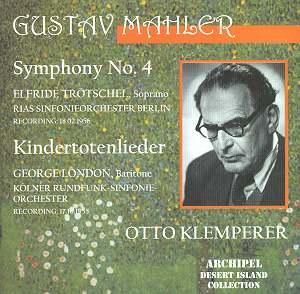
There’s a man who has over two hundred recordings
of this symphony not because he accumulates as such, but because
he keeps finding something new in most of what he hears.
Never will I reach that state of knowledge, but it’s an inspiration
to me, to keep listening and learning. This particular recording
is only one of many performances Klemperer conducted of this
symphony. There are better versions – the sound quality of
this is pretty ropey, for example – so it’s the top of no-one’s
list of favourites. But anything Klemperer has to say about
Mahler is going to be worth hearing, given that he’d known
the composer personally.
The Kölner
Westdeutschen Rundfunk Symphonie Orchester was a new orchestra,
founded in 1948 in the post-war reorganisation of German
radio broadcasting. It’s not quite in the league of London’s
Philharmonia, where Klemperer was shortly to become principal
conductor, but it isn’t bad by any means. These musicians
were immersed in the Austro-German tradition and could quickly
pick up on Mahler even if they hadn’t heard much of his music
in previous years. Unlike modern players, they hadn’t grown
up on Mahler, or assumed they “knew” the music, so working
with Klemperer, who’d known Mahler personally, must have
been an education. This perhaps accounts for the sense of
enthusiasm in their playing. They played quite a bit of Mahler
in those early years before the composer became fashionable.
They worked with Mitropoulos, Kleiber, Böhm and Szenkar,
and just missed, by a few weeks, making the first recording
of Mahler’s Third Symphony (see review).
One day, when and if the history of West German broadcasting
is written, their place in it will be interesting.
Listening past the boxy recording reveals playing in
the grand manner, rich and full-blown Romantic. This is Mahler
in the great tradition alright, so details like the chill
woodwinds, come over with a strangely modernist feel. It’s
rather a good, if perhaps unplanned effect. The solo violin
in the second movement is played with character, as befits
its personification of Freund Hein, the fiddler of death.
This gives a sinister underpinning to the ebullient string
passages. Vivid as they are, you don’t forget the image of
the fiddler as seen in medieval woodcuts, grinning with evil
intent. In the Ruhevoll, the slower sections are carefully
detailed, but overall, the recording makes the strings sound
so shrill, that they kept me on edge. In the final movement,
Trötschel sings with a measured pace. She was only in her
forties when she recorded this, but she favours a dignified,
matronly reading. Indeed, her voice shows some strain. It’s
a reminder of how relatively recent is the current taste
for transcendently luminous, “youthful” voices in this piece.
Walter’s use of Schwarzkopf, when heard in the context of
the times, was actually a good choice, even if it might not
be fashionable today.
George London’s Kindertotenlieder is pretty hard
to take. Although his timbre is dark, the voice lacks flexibility.
He seems to be engaged in getting the sound around the words,
rather than engaging with them on an emotional level. The
orchestral playing, however, is supportive, following his
pace, rather than leading. In the final song., where the
longer elegiac lines don’t stretch him too much, he has some
good moments. On this recording, stick to the symphony.
This isn’t a particularly imaginative or exciting interpretation
in itself, but mainly interesting as a measure of performance
history.
Anne
Ozorio
BUY NOW
AmazonUK Visit
our partner ArkivMusic



 Elfride
Trötschel (soprano), George London (baritone)
Elfride
Trötschel (soprano), George London (baritone)