|
BUY NOW
AmazonUK
|
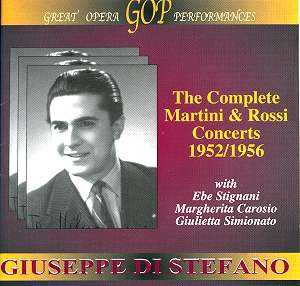
The Complete Martini & Rossi Concerts 1952-1956
 Ebe Stignani (mezzo) 1 Ebe Stignani (mezzo) 1
Giuseppe Di Stefano 2
Margherita Carosio (soprano) 3
Giulietta Simionato (mezzo) 4
CD 1
Giuseppe VERDI Un Giorno di
Regno: Un giorno dolce nel core - Piu che i vezzi e lo splendour [8.41] 1
Giacomo PUCCINI Turandot: Nessun dorma [3.11] 2
Camille SAINT-SAENS
Sansone e Dalila: S'apre per te il mio cor [6.47] 1
Gaetano DONIZETTI La
Favorita: Ah mio bene [7.28] 2
Orchestra Sinfonica di Torino della RAI/Oliviero de Fabritiis
rec. Turin, 8 December 1952
Pietro MASCAGNI Iris:
Apri la tua finestra [2.05] 1
Gioacchino ROSSINI Il
Barbiere di Siviglia: Una voce poco fa [6.37] 3
Umberto GIORDANO Andrea
Chenier: Come un bel di di maggio [3.03] 2
Vincenzo BELLINI La
Sonnambula: Ah! non credea mirati [4.21] 3
Giuseppe VERDI La
Forza del Destino: O tu che in seno agli angeli [6.24] 2
Giacomo PUCCINI Madama
Butterfly: Un bel di vedremo [3.52] 3
Vincenzo BELLINI I
Puritani: Vieni fra queste braccia [5.57] 2,3
Orchestra Sinfonica di Torino della RAI/Oliviero de Fabritiis
rec. Turin, Teatro Carignano 9 November 1953
Giuseppe VERDI
Un Ballo in Maschera: Ma se m'e forza perderti [5.27] 2
Gioacchino ROSSINI
L'Italiana in Algeri: Pensa alla patria [5.54] 4
CD 2
Umberto GIORDANO Andrea Chenier: Un
di all'azzurro spazio [5.07] 2
Gioacchino ROSSINI
Tancredi: Di tanti palpiti [6.32] 4
Giuseppe PIETRI Maristella:
Io conosco un giardino [2.42] 2
Gioacchino ROSSINI
Il Barbiere di Siviglia: Una voce poco fa [5.12] 4
Giacomo PUCCINI Turandot:
Nessun dorma [6.22] 2
Gioacchino ROSSINI
La Cenerentola: Nacqui all'affanno [5.57] 4
Orchestra Sinfonica di Milano della RAI/Nino Sanzogno
rec. Milan, 26 November 1956
BONUS TRACKS: Giuseppe Di Stefano
Mutteti de lu Paliu: Uje, Uje [3.47]; Chiovu: Abbalatti [2.27]; Cantu a Timuni
[2.12]; A la barcillunisa
[2.33]; A la vallelunghisa [3.13]
RCA Victor Orchestra
Renato Cellini
rec. New York, RCA Studios, 12 December 1950
Gaetano DONIZETTI Don
Pasquale: Com'e gentil [2.34] - OBA 7724
Argeo Quadri, dir.
rec. Milan HMV Studios, 15 June 1951
Giuseppe CIOFFI:
Na sera 'e maggio [4.44]
Raoul La Vista, dir.
rec. Mexico City, 22 June 1952
Osman PEREZ-FREIRE:
Ay, Ay, Ay [3.38]
Salvatore CARDILLO:
Core 'ngrato [5.31]
Raoul La Vista, dir.
rec. Mexico City, 29 June 1952
GREAT
OPERA PERFORMANCES GOP 66.361 [69.53 + 62.37]
|
Error processing SSI file
|















