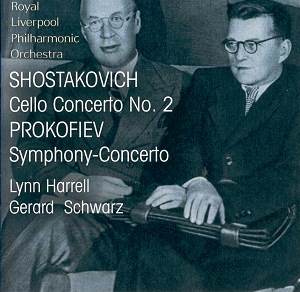
Both these works for
cello and orchestra were composed for
Mstislav Rostropovich, whose relationship
with these great Russian composers was
an important source of inspiration to
them. Having already composed a sonata
for the young cellist, Prokofiev decided
to create an orchestral piece for him
in 1951. This became the Symphony-Concerto,
but it was not exactly an original composition,
since he leaned upon the Cello Concerto,
Op. 58, which he had composed just before
he left Paris to return to Russia in
1933. That piece had suffered from an
unsuccessful premiere, but Prokofiev
believed in the music sufficiently to
revive it in a tauter organisation of
its material; hence the unusual title
Symphony-Concerto for the present piece,
composed afresh for the young Rostropovich.
The cello still has
an unequivocally concertante role, particularly
in the first movement, with its quasi-improvisational
stance. The finale too is at once distinctive
and unusual, being a carefully developed
theme-and-variations. Lynn Harrell proves
a committed advocate of the music, having
recorded it previously in 1994 for Decca
with Vladimir Ashkenazy conducting.
This new recording features the American
conductor Gerard Schwarz. Their close
artistic relationship is well suited
to this piece. The opening gesture is
particularly effective, beautifully
captured by the recording engineers
and stirring as a virtuoso statement
of intent. Thereafter Harrell tends
to be indulgent in his phrasing, attempting
to wring every ounce of expressiveness
out of the music. Opinions will differ
about his approach, but he does succeed
in conveying much intensity of feeling.
After the Andante
tempo that informs so much of the first
movement, the second is fast and rhythmic.
Now the technical command of Harrell
is the perfect response to the virtuosity
of the music, and he is supported by
some assured playing from the Liverpool
Orchestra. With indulgent portamenti
he makes the lyrical passages contrast
to the full. Again opinions may differ
as to whether this adds or detracts
from the experience. The finale ranges
more widely in mood and in some respects
this represents the most effective part
of the performance. The recorded sound
is always warm and atmospheric.
Philharmonic Hall in
Liverpool was also the venue for the
recording of the Shostakovich Cello
Concerto No. 2, in fact made just a
couple of days later. Dating from the
mid-1960s, this piece was amongst the
first to deal directly with the composer’s
obsessive concerns with fate and the
transience of life, coinciding as it
did with a period of ill health culminating
in the first of his major heart attacks.
The ending is extraordinary and memorable,
linking to the similar imageries of
the later Fifteenth Symphony as the
clock of life ticks away.
Harrell and Schwarz
take a romantically indulgent view of
the music, and why not? For it is an
indulgent piece, and extremes of tempo
and phrasing are not inappropriate.
While this may not be the top recommendation
in this music (still Rostropovich, surely),
it is a generous coupling of two masterworks,
both of which are delivered in performances
of distinction and personality.
Terry Barfoot



 Lynn Harrell (cello)