The first work on
this disc is a real treat. Ignore the long complicated compositional
history of Impressions de Music Hall – just sit back and
enjoy a fine bit of French pastiche. And this is certainly not
meant to disparage the work. The bottom line of this work is
that it explores much that was musically in the Parisian air at
the time of composition -1925.
The first movement
of the ‘suite’ is a brief but brassy prelude followed by an exuberant
piece entitled Chorus Girls and subtitled, rather mischievously
French Blues. This is full of jazz and things ‘American’
that were influencing Ravel and Milhaud at the time; look out
for the glissandi on the trombones! This is followed by a musical
dedication to the ‘famous’ Little Tich who had been a dancing
clown with the Belle Époque. Pierné uses a wide palette of instrumental
colour to portray the bitter-sweet movements of the clown. The
Le Numéro espagnol is another classic example of
how Frenchmen seem to be able to evoke the Spanish atmosphere
better than Iberian natives. This music is a synthesis of subtle
orchestration and ‘in your face’ guitar and castanet platitudes.
Perhaps it is easy to evoke the music of Ravel and Debussy in
response to this movement but Pierné does additionally bring a
genuinely French flavour to the Spanish scene. The final movement
of this suite is entitled Clowns musicaux (les Fratelli).
Here we have a wide variety of styles and references. Perhaps
Stravinsky is called to mind; there is a definite Petrushka
feel to some of this material. However look out for quotations
from the Ambroise Thomas opera Mignon and Delibes’ ballet
Sylvia! The movement and the piece ends with an extremely
lively coda complete with hunting horns.
This is an excellent
piece to introduce the listener to the music of 1920s Paris in
general and Pierné in particular. The attentive listener cannot
fail to be seriously impressed with the composer’s superb use
of orchestral colour and manipulation of musical themes.
As noted above Pierné
was no stranger to the Spanish musical influence. He had already
raided a publicly funded archive of Basque tunes for his incidental
music to Ramuntcho: he used the ‘zortzico’ rhythm in his
Quintet of 1919. However for his Fantaisie Basque
he turned to the work of Father José Antonio de Donostia who had
spent much time collecting material for books about Basque culture.
The Fantasia is an exploration of some seven tunes in different
moods and tempi. The violin soloist is given ample opportunity
to show off – both in a bravura sense and also with plenty of
opportunity to display the melodic shape and considerable depth
of these folk tunes. Pierné balances the orchestra and soloist
giving a satisfying structure and texture to this work. So often
‘Fantasias’ can be seen as being just ‘one tune following another’
– Pierné avoids this pitfall. Philippe Koch, the Belgian soloist
brings considerable ‘local’ colour to this Iberian music.
I had to listen to
the Izé˙l incidental music twice before being able to comment
sensibly for this review. I was not convinced as to the value
of this work on my first hearing. However I read somewhere that
some critics have compared this music favourably with Grieg’s
Peer Gynt so I felt I ought to see if I was missing something.
After a second listen I can safely say that the music does begin
to reveal itself – not only nodding to Grieg but perhaps also
Rimsky-Korsakov and his Scheherazade. Whether Pierné exceeds
the creativity of either of these two composers is debatable.
Some dozen numbers are extracted from the incidental music composed
in 1894 for a production of Izé˙l. This play was set in
India in the 6th century BC and exploited the late
nineteenth century taste for things oriental and esoteric. The
present suite has four movements – The Entry of the King;
The Entry of the Princesses; an Introduction and Lament
and finally a gorgeous Serenade.
The last piece on
this CD is a bit of an enigma. In fact in some ways it appears
to be two works ‘stuck’ together. The Divertissements on a
Pastoral Theme is formally divided into two main sections.
The first is effectively a theme followed with six variations
– or ‘doubles’ as Pierné refers to them, echoing French baroque
practice. Following on from the last variation without so much
as a break the second section presents stylistically contrasting
music. A ‘waltz’ is followed by a Cortčge-Blues which makes
uses of an attractive and languid melody for saxophone solo. It
is almost as if Pierné has deliberately opposed ‘academic’ music
with ‘jazz-inspired’ material in the same work. And I am not sure
if it works. Each section is satisfying but together the hiatus
is perhaps too marked and severe.
This is a good CD
– but as a French reviewer has remarked it is ‘unessential’ –
except to those who specialise in mid-20th century
French music. That being said it is certainly an enjoyable issue
with much that is attractive, interesting and even impressive.
What is not in doubt is the composer’s skill, especially in instrumentation
and harmonic colour.
John France
BUY NOW
AmazonUK



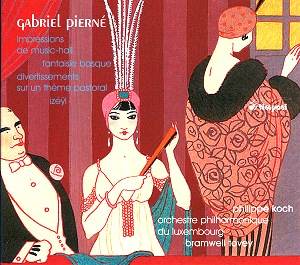
 Philippe Koch (violin)











