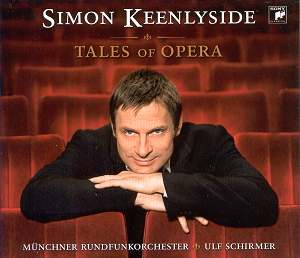
Simon Keenlyside has been around for quite some time now and
for the last decade or so has been firmly established as one
of the
leading lyrical baritones of his generation. He has appeared
on a substantial number of complete sets and has also made
some excellent Lieder recordings. This is, as far as I know,
his first operatic recital. It is a testing programme with
(mostly) standard arias sung throughout the history of the
phonograph by all the greats – and he stands up well against
comparison.
He opens, as so many before him, with Figaro’s Factotum-aria from Il
barbiere di Siviglia, where we first hear the excellent
orchestra impressively recorded in a generous but finely
detailed acoustic. Keenlyside’s first phrases are distanced
and I reached for my pen to make a note about recording
balance until I realised that he wasn’t on stage yet. When
he was I had no complaints. His voice sounds in mint condition,
no tear and wear in spite of the years gone by: a manly
sound with brilliant top and easy access to a mellifluous
pianissimo – so important for a Lieder artist. His Figaro
sparkles with joy and he executes the patter singing with
elegance and tongue-in-cheek. A fine cello solo opens the William
Tell aria, sung in the original French. There he adopts
a softer timbre, more French if you like but also in character. Vision
fugitive is wonderfully nuanced and the Don Carlo scene,
sung a bit inconsistently in Italian, is deeply felt. The
excerpt encompasses both the aria and the following death
scene. This is one of the best items on the disc. The Ballo aria
shows Renato’s dual feelings towards Riccardo: sorrow and
then intense fury. He sings O dolcezze perdute! With
a soft and inward quality. The Traviata aria is
warm and conversational, directed to Alfredo and not to
the audience as is so often the case. The concluding Dio
mi guidò is scaled down to a marvellously beautiful
pianissimo.
The Drinking song from Hamlet is ebullient and joyous
and the orchestral prelude and postlude are bucolic dances.
In the Puritani aria, with its fair share of florid
singing I would have liked more light and shade. As it is
it becomes unnecessarily monotonous. True, this isn’t one
of Bellini’s best creations and he still sings it with admirably
steady and beautiful tone, reminiscent of Ingvar Wixell in
his heyday with that quickly fluttering vibrato. He actually
sings the recitative before the aria proper, though the text
is omitted in the booklet.
Papageno’s second aria from Die Zauberflöte is on
the other hand as varied in tone and as full of word-pointing
as anyone
could wish. This is certainly a role that Keenlyside relishes.
Tonio’s prologue from Pagliacci is strong and confident,
with Schirmer’s conducting a positive factor; as it is throughout.
He sings un nido di memorie in a soft half-voice,
gradually growing to an impressive Il tempo gli battevano.
Cilea’s L’Arlesiana is today almost exclusively remembered
for the tenor aria É la solita storia but this wide-ranging
baritone aria is atmospheric in an impressionistic manner.
He sings the wonderful melody of the Pique Dame aria
with all the requisite heart-on-sleeve passion and judging
from this he must be a splendid Eugene Onegin as well. Don
Giovanni’s serenade is hushed and honeyed, the second stanza
close to a whisper with the voice shivering with suppressed
lust. The other rarity, Allazim’s first act aria from Zaide,
which I just recently came across in Harnoncourt’s complete
recording (see review),
is gloriously sung and the aria is a little gem that should
be heard more often.
Wolfram’s song to the Evening Star from Tannhäuser brings
the recital to a wonderful end, sung initially with grave
dignity, inward and nuanced and with a both warm and glowing O
du mein holder Abendstern.
A quality product from all points of view and the only criticism relates
to my usual hang-up: Why do they have to print the notes
in white, yellow and even light brown against a darkish background?
Thank God the texts and translations are readable.
A splendid well-filled, well-sung and well recorded recital with some
of the finest baritone arias and with two rarities as an
extra bonus. Not to be missed!
Göran Forsling



 Simon Keenlyside
(baritone)
Simon Keenlyside
(baritone)