The symphonies of Karl von Ordonez
have been studied and catalogued by A. Peter Brown - hence
the catalogue numbers
above.
Anyone wanting to know more of Ordonez’s work as a symphonist
should seek out Brown’s long article, ‘The Symphonies of
Carlo d’Ordonez: A Contribution to the History of Viennese
Instrumental Music during the Second Half of the Eighteenth
Century’, which was published in volume XII of the Haydn
Yearbook in 1981. This enterprising CD from Naxos has
very useful notes by Allan Badley.
Born in Vienna, Ordonez may have been the illegitimate
son of an aristocrat, and seems to have been able to live
and work as a member
of the minor nobility. He never became a professional musician – which
would have been inappropriate to his social standing – though
he was certainly an accomplished violinist and was associated
with a number of the musical societies of Vienna. His name
crops up quite frequently in detailed accounts of Haydn’s
life and works. As well as more than seventy symphonies,
Ordonez’s other compositions included string quartets,
a violin concerto and – particularly intriguing – a parody
opera, Alceste, which was frequently performed at
Esterhazy.
Manuscripts of Ordonez’s symphonies survive in quite a number of European
libraries, some of them well beyond Austria, testifying
to their relative popularity. Works by him have sometimes
been attributed to Haydn himself, to J.C. Bach or to Viennese
contemporaries such as Vanhal and Hofmann – which gives
a pretty good idea of the stylistic territory they occupy.
Most of his symphonic writing is dominated by the strings.
Occasionally he gives horns and oboes some relatively prominent
roles.
Most of his symphonies seem to have been written before
the mid-1770s. Though he did make some use of the four-movement
form, all five of the symphonies on this disc are in three
movements, and all employ two quicker movements framing
a slow movement. This is true even of the Sinfonia in C
major, though its first movement is misleadingly marked ‘adagio’ – when
only the introduction to the movement can sensibly be so
described.
On this showing Ordonez had no great gift for the creation
of distinctive or memorable melodies. Pleasure more often
comes from the
alertness of his rhythms and from a certain inventiveness
in his use of orchestral sonorities. In the Sinfonia in
C major, the attractive slow movement has concertante roles
for violin and cello; the second of the two G minor symphonies
(Brown Gm8) has some delightful writing for the oboes in
the outer movements and for the violas – of which he seems
to have been particularly fond – in its central andante.
None of this music digs very deep or challenges the listener. Elegance
and grace are more prominent features than power or passion.
But within its limitations this is attractive and charming
music which makes for pleasant listening. Kevin Mallon
and the Toronto Camerata give thoroughly sympathetic performances,
convincingly idiomatic and appropriately delicate and persuasive.
Glyn Pursglove
BUY NOW
AmazonUK AmazonUS



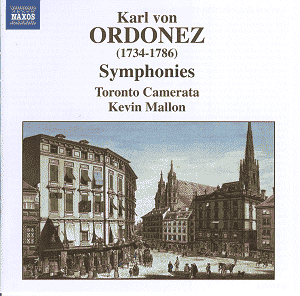
 Toronto Camerata/Kevin Mallon











