There were few Court appointments for
musicians in the precarious financial climate of the late
17th century
English Royal Court; not to mention the rather frequent
regime changes. But London was one of the richest cities
in Europe so there developed a lively musical culture catering
to the aristocracy and the burgeoning middle classes. As
a result, continental musicians frequently came to England
to try and make their fortunes and sometimes stayed. The
more adventurous or restless composer could eschew the
unexciting safety of a continental court appointment for
the opportunity of being a freelance musician in London.
Being some distance from the European centres of the
musical avant-garde, Londoners were often keen to learn
of new fashions and styles from musicians freshly arrived
from the continent. The history of baroque music in England
after Henry Purcell is very much the history of assimilation
of foreign musicians and foreign styles.
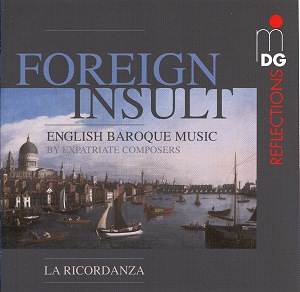
This new disc provides a brief survey of chamber music
written by foreign composers. The chamber music on this
disc was published in London to provide music for the keen
amateur market. This is not concert music, but music written
for the consumption of talented amateur musicians in their
own chambers.
La Ricordanza are an Early Music chamber ensemble founded
originally by musicians from the Royal Conservatory in
the Hague and the Hochschule for Music and Theatre in Hanover.
Their programmes often contain unpublished and forgotten
works. On this disc they consist of eight players (flute,
oboe/recorder, two violins, viola, cello, violone, harpsichord)
and the players come together in various combinations.
The earliest of the composers on the disc is Nicola
Matteis, who arrived in London in 1670. Roger North provides
most of the biographical information that we have; evidently
Matteis was instrumental in revolutionising English violin
playing. His book of ‘Ayres’ was extremely well received
and went into a second edition two years after its original
publication. His ‘Ground after the Scotch Humour’ is a
charming example of his attempts to adjust his works to
the British taste.
Godfrey Finger was a Moravian composer and gamba player.
In 1686 he was a member of James II’s Catholic chapel but
after 1688 he stayed on as a freelance impresario, composer
and performer. He published numerous chamber works as well
as music for the theatre. He left England in 1701 in high
dudgeon as his setting of Congreve’s ‘The Judgement of
Paris’ failed in the notorious competition; it is possible
that the outcome was rigged. On this disc La Ricordanza
play his Sonata Op. 5 No. 10 for the unusual combination
of recorder, obbligato cello and continuo. It is from a
set that Finger possibly used to finance his exit from
England.
The best known foreign composer resident in England
is of course Handel. La Ricordanza choose to play two of
his compositions for which we have no secure date, but
whose manuscripts may have come to England with Handel
on his first arrival. We lack an autograph manuscript for
the Oboe Concerto in G minor but it survives from a 1740
collection printed by John Walsh in London. Handel seems
to have revised the work for publication, something that
he did not always do. La Ricordanza successfully perform
the work in a chamber version with single strings that
makes charmingly convincing chamber music. It brings to
mind a picture of Handel’s supporters recreating music
from his concerts in their own homes by playing such pieces.
The other pieces, the trio sonata in F major for violin,
oboe and basso continuo is of more dubious parentage. An
oboist in the Haymarket Theatre orchestra in 1745/25 owned
a set of trio sonatas that included this piece. On being
shown it, Handel commented that it was a youthful work
and that he ‘wrote like the devil back then, and mostly
for the oboe, my favourite instrument’. So it may be one
of the rare surviving works from Handel’s Halle period,
or it may not. Still it is an attractive and effective
piece and deserves to be heard, especially in a performance
as ingratiating as this.
Francesco Barsanti was a colleague of Geminiani; they
both travelled to England in 1714 to seek their fortune
with the Italian opera. Barsanti emigrated to Edinburgh,
married a local girl and went native, integrating himself
fully into Scots musical life. In 1742 he published his
collection of thirty ‘Old Scots Tunes’. La Ricordanza have
recorded four of them, ‘Lochaber’, ‘Where Helen Lies’, ‘Clout
the Cauldron’ and ‘Corn Riggs are Bonny’. The arrangements
are charming and effective; the selection starts with a
wonderfully plangent flute solo before Barsanti goes on
to add accompaniment. His versions never overwhelm the
melodic charm of the songs.
Johann Christian Bach was enticed away from an uneventful
career as organist at Milan Cathedral by the prospect of
commercial success writing operas for the King’s Theatre
in London. He moved to London in 1762, initially for a
year but in fact he stayed until his death in 1782. His
six quintets op. 11 were dedicated to the Elector Palatine,
in Mannheim, who was a famous connoisseur of music. They
were performed by the Queen’s Band under Bach’s direction.
The Quintet has an easy grace and the obbligato keyboard
part is typical of Bach’s writing.
Carl Friedrich Abel fled Germany as a result of war.
Abel was employed in the court orchestra in Dresden at
the time it was invaded by Frederick the Great’s troops.
Once in London, he joined the fashionable circles around
Queen Charlotte - herself German speaking of course. Together
with Johann Christian Bach he produced an annual concert
series which ran for 26 years; each concert series being
of ten to fifteen concerts. It is via these concert series
that many foreign musicians were introduced to London.
This Flute concerto in E minor may well have been played
at one of these concerts.
La Ricordanza’s performances are enchanting; they make
the best possible case for this music. There is a very
real chamber feel about these performances, involving the
give and take of friends or well known colleagues, something
which helps us recapture the spirit of the original pieces.
They play crisply and cleanly with a good sense of line
and a nice feel for the articulation. More than that, you
feel that they are enjoying themselves.
Even with the disc’s catchy title, this repertoire can
seem a little forbidding. But don’t let that put you off.
Buy the disc and be caught up in the spell of these performances.
Robert Hugill
see also review by Jonathan Woolf
BUY NOW
AmazonUK AmazonUS



 La Ricordanza
(Brian Berryman – flute, Annette Berryman – oboe/recorder,
Christoph Heidemann and Katharina Huch-Kohn – violins,
Bettina Ihrig – viola, Dorothee Palm – cello, Barbara
Hormann – violone, Eckhart Kuper – harpsichord)
La Ricordanza
(Brian Berryman – flute, Annette Berryman – oboe/recorder,
Christoph Heidemann and Katharina Huch-Kohn – violins,
Bettina Ihrig – viola, Dorothee Palm – cello, Barbara
Hormann – violone, Eckhart Kuper – harpsichord)