RECORDING OF THE MONTH


RECORDING OF THE MONTH

BARGAIN OF THE MONTH

VAUGHAN WILLIAMS
A London Symphony
Oboe Concerto
£11 post free World-wide


RACHMANINOV Elegy, Preludes, Piano concerto 3
£12 post free World-wide

CHAUSSON, DEBUSSY
RACHMANINOV
TRios
2CDs £16 post free World-wide

Search
What's New
Classical CD Reviews
Live Reviews
Jazz CD Reviews
Composers
Resources
Contact Us

Every Day we post 10 new Classical CD and DVD reviews. A free weekly summary is available by e-mail. MusicWeb is not a subscription site and it is our advertisers that pay for it. Please visit their sites regularly to see if anything might interest you. Purchasing from them keeps MusicWeb free.
  Classical Editor: Rob Barnett  
Founder Len Mullenger   


BUY NOW 

AmazonUK  

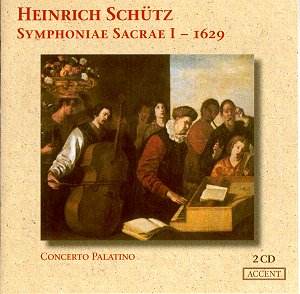
Heinrich SCHÜTZ (1585-1672)
Symphoniae Sacrae I (1629)
CD 1
Domine, labia mea aperies (SWV 271) [04:32]
Cantabo Domino in vita mea (SWV  260) [04:28]
Fili mi, Absalon (SWV 269) [06:28]
Paratum cor meum, Deus (SWV 257) [03:30]
Anima mea liquefacta est (1. Pars) (SWV 263) [04:20]
Adjuro vos, filiae Jerusalem (2. Pars) (SWV 264) [04:11]
Jubilate Deo omnis terra (SWV 262) [05:48]
In lectulo per noctes (1. Pars) (SWV 272) [04:49]
In venerunt me custodes civitatis (2. Pars) (SWV 273) [04:48]
O quam tu pulchra es (1. Pars) (SWV 265) [04:03]
Veni de Libano (2. Pars) (SWV 266) [04:06]
In te, Domine, speravi (SWV 259) [05:18]
CD 2
Benedicam Dominum in omni tempore (1. Pars) (SWV 267) [03:23]
Exquisivi Dominum (2. Pars) (SWV 268) [03:15]
Attendite, popule meus (SWV 270) [08:06]
Venite ad me omnes qui laboratis (SWV 261) [07:15]
Veni, dilecte mi (SWV 274) [05:34]
Exultavit cor meum in Domino (SWV 258) [04:30]
Buccinate in neomenia tuba (1. Pars) (SWV 275) [03:23]
Jubilate Deo (2. Pars) (SWV 276) [02:51]
Barbara Borden, Nele Gramß (soprano), Rogers Covey-Crump (counter-tenor), John Potter, Douglas Nasrawi (tenor), Harry van der Kamp (bass)
Concerto Palatino: (Bruce Dickey, Doron David Sherwin, cornett, cornetto muto; Johani Listo, trumpet; Peter Van Heyghen, Marcel Ketels, recorder; Thomas Albert, Irmgard Schaller, violin; Charles Toet, Sue Addison, Harry Ries, Wim Becu, trombone; Bernhard Junghänel, Regina Sanders, Birgit Siefer, curtal; Stephen Stubbs, chitarrone; Klaus Eichhorn, organ)
rec. October, November 1991, Doopsgezinde Kerk, Haarlem, The Netherlands. DDD
ACCENT ACC 30078 [57:38 + 38:50]


In the first half of the 17th century Italy - and in particular Venice - was the place to be. Musicians who could afford it travelled to the city to study the newest developments in music, or - when they were in the service of a court - were sent over the Alps to increase their knowledge and skills. Heinrich Schütz was one of many composers from the northern part of Europe who stayed a number of years in Venice. From 1609 to 1613 Schütz lived in Venice and became the pupil of Giovanni Gabrieli, the chapel master of the San Marco in Venice. He held his teacher in the greatest esteem all his life, for personal and musical reasons. The meetings with Claudio Monteverdi, which are assumed to have taken place during Schütz's second visit to Venice, from 1628 to 1629, didn't change that. When in 1629 he published his collection of Symphoniae Sacrae he didn't mention the successor of Gabrieli as chapel master of San Marco in his preface. He referred again to Giovanni Gabrieli: "Gabrieli, o immortal gods, how great a man!" Although he went to Italy for a second time to study the latest trends he didn't adopt everything that was on offer. In his preface he mentions the changes which had taken place: "I learned that the long unchanged art of composition had changed somewhat: the ancient rhythms were partly set aside to tickle the ears of today with fresh devices." And he presents his collection as the result of his studies of the new style of composing: "I directed my mind and my energies, to the end that, in accordance with my purpose, I might offer you something from the store of my industry."

But these compositions demonstrate that Schütz was very selective in what he adopted from the new Italian style. There are very few traces of the Monteverdian 'stile concitato', for instance. And the extreme expression of affects in both vocal and instrumental parts Italian composers used is rather rare in the Symphoniae Sacrae. The most Italianate piece of the collection is the solo concerto 'Fili mi Absalon'. The differences are most striking in the concertos on texts from the Song of Songs: here there is none of the strong passion of Italian compositions on these texts. The expression in these Symphoniae Sacrae is also much more sober and restrained.

In these concertos Schütz uses a wide range of instruments, both strings and wind. They have different functions. Sometimes they serve as additional voices, as in 'Benedicam Dominum' or 'Veni, dilecte mi'. Many pieces begin with a sinfonia, in which the instruments play motifs which are later picked up by the voices. Instrumental passages are also used to divide a piece into contrasting sections. Sometimes they illustrate the text, for example cornett, trumpet and curtal in 'Buccinate in neomenia tuba': "Blow up the trumpet in the new moon (...) With trumpets and sounds of cornett, make a joyful noise before the Lord". And in 'In lectulo per noctes' Schütz prescribes low instruments - bass viols or bassoons (here curtals) - to illustrate the dark mood in this text from the Song of Songs: "By night on my bed I sought him whom my soul loveth".

In this collection all but one of the texts are from the Old Testament; mainly from the Book of Psalms, and also a number on passages from the Song of Songs. The inclusion of these texts as well as a strongly madrigalian piece like 'Fili mi Absalon' raises the question of the purpose Schütz had in mind when he composed the sacred concertos. The subtitle is 'Opus ecclesiasticum secundum'. The word 'ecclesiasticum' suggests a performance in churches, but in the Lutheran liturgy there was no place for pieces on texts from the Song of Songs or for a concerto like 'Fili mi Absalon'. Therefore these pieces were probably intended for private use at court.

Schütz studied the Italian style, but only used it as far as it suited him. One of the strengths of this performance is that the interpreters are fully aware of that: they never exaggerate the text expression, the word painting or the affect in the instrumental parts. In this performance the text is always at the centre of attention, not only for the singers - who excel in diction and articulation - but also for the instrumentalists. I am very pleased that this splendid recording is available again. It has not been surpassed since it was first released.

Johan van Veen


Advertising Rates
Visitor stats
MusicWeb International
has over 40,000 Classical CD reviews on offer

Discs received

Having a problem Donating?


Gerard Hoffnung Concerts &
The Bricklayer Story

MusicWeb can now offer you discs from the following catalogues:
Prices include postage

There will be NO VAT Rises

[Acte Préalable £13.50]
[Arcodiva £12.00]
[Avie from £6.25]
[British Music Society £12.00]
[CDACCORD from £13.50 ]
[ClassicO £12.50]
[Hallé from £11]
[Heritage £10]
[Hortus £14.99 ]

[Lyrita ONLY £11.75 ]
[Nimbus Special prices]
[Northern Flowers £13.50]

[REDCLIFFE £11 ]
[Sheva £11]
[Tactus £11.50 ]
[Talent from £12.00 ]
[Toccata Classics £10.50 ]

Musicweb
Special Offers

Monthly Best Buys


Naxos Classical


New Releases

Hyperion


New Releases


MusicWeb sells the Polish
catalogue CDAccord
£10.50 post free W-W


MusicWeb sells the
Arcodiva catalogue
£12.00 post free W-W


£11.75
post-free
world- wide


Google Ads - for information about privacy matters, click here
Amazon Musicweb International is a participant in the Amazon EU Associates Programme, an affiliate advertising programme designed to provide a means for sites to earn advertising fees by advertising and linking to Amazon.co.uk and Amazon.com


Return to Index

Untitled Document


Reviews from previous months
Join the mailing list and receive a hyperlinked weekly update on the discs reviewed. details
We welcome feedback on our reviews. Please use the Bulletin Board
Please paste in the first line of your comments the URL of the review to which you refer.








