This
recording was originally issued on Da Capo 8 224003 and thoroughly
merits its reissue now. These sonatas are amongst the few pieces
which Buxtehude published during his lifetime. His Op. 1, containing
seven sonatas for violin, viola da gamba and harpsichord is
undated but was probably published in 1694. Op. 2, recorded
here, contained a further seven sonatas and appeared in 1696.
The two collections were clearly conceived as complementary
sets. In its dedication the Op. 1 set is said to be the “first
part” of his sonatas; Op. 1 and Op. 2 each contains seven sonatas.
The
excellent and detailed booklet essay by Per Bærentzen points
out that Buxtehude’s sonatas owe much to the stylus phantasticus
– that is, what Sebastian de Brossard, writing in 1703, described
as “a special instrumental style or manner where the composer
is not subject to any formal restrictions, as the generic terms
‘Fantasia’, ‘Ricercare’, ‘Toccata’, and ‘Sonata’ imply”. The
illusion of improvisation is carefully created in some passages
of these sonatas, though such passages are securely based within
meticulously composed musical structures and exist alongside
eruditely ‘correct’ counterpoint. The music communicates, as
a result, a joyous juxtaposition of the (seemingly) free alongside
the carefully structured.
“Seven
corresponds to the seven days of the week, the seven planets,
seven rungs of perfection, seven spheres or celestial stairs
... The Heavens are seven in number and so, according to Dante,
are the planetary spheres ... [In the Old Testament] through
the changes which it ushers in, the number seven itself possesses
powers and is a magic number ... According to St. Augustine
[the number seven] measures the length of history and the period
of humanity’s earthly pilgrimage” (Jean Chevalier and Alain
Gheerbrant, The Penguin Dictionary of Symbols, 1996).
Or, to put it more briefly, it is no accident that Op. 1 and
Op. 2 each contain seven sonatas. The touchingly human quality
of so much of what we hear coexists with an evident awareness
of larger symbolic significances, significances which add to
its - lightly carried - weight of meaning.
The
music itself is lyrical and expressive, both beautifully formal
and full of unexpected turns. It is sad and joyous, playful
and solemn; it dances and it grieves. Take, for example, the
way in which Sonata No. 4 begins with a beautiful self-contained
slow introduction, which is succeeded by a brilliantly conducted
fugal allegro, with telling switches between violin and
viola da gamba, a movement closed by some lyrical writing marked
lento. There follows a powerful dialogue, in ¾,
between violin and viola gamba, beautiful and richly emotional,
and a concluding vivace which dancingly reprises much
of what has gone before.
In
truth, I find it hard to contain my enthusiasm for this music.
Sonata No. 5 – the longest of the sonatas in Op. 2 – seems to
me to be one of the great trio sonatas of the baroque era, full
of virtuoso writing, of wonderful variational solo writing for
violin and viola da gamba; of complex fugues and canons - a
complex construction on a repeated four-note motif. The whole
is both perfectly shaped and idiosyncratically expressive.
John
Holloway and his colleagues do not give ‘definitive’ performances;
no really great music can be reduced to a once-and-for-all definitive
version. But they do provide a compelling, richly enjoyable
interpretation of this brilliant, glowing, sprightly, profound
music.
Wonderful
music, very well performed. I have listened to the disc repeatedly
since it came into my hands. It gets better every time.
Glyn Pursglove



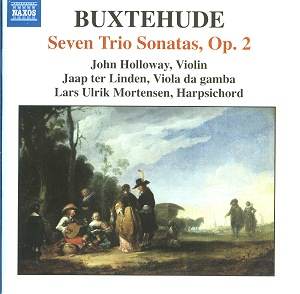
 John Holloway (violin), Jaap ter Linden (viola da gamba), Lars Ulrik Mortensen
(harpsichord)
John Holloway (violin), Jaap ter Linden (viola da gamba), Lars Ulrik Mortensen
(harpsichord)











