‘What, another recording
of "Winterreise"?’ Klaus Mertens
writes at the heading of an essay entitled
"About this interpretation"
in the booklet. Between the lines one
can draw the conclusion that Mertens
and Tini Mathot, both of them schooled
and mainly active within the baroque
tradition, wanted to approach Schubert’s
masterpiece from, so to speak, the opposite
direction. Most other interpreters have
the Classicist and Romantic repertoire
as their backbone. Another, more concrete
reason was that they tried the songs
out on Tini Mathot’s fortepiano, and
that definitely makes a difference when
it comes to the actual sound: the frail
tones from the 1802 Rosenberger instrument
(5½ octaves) as opposed to a full-size
modern Steinway. A while ago I reviewed
a recording of Die schöne Müllerin
with the young tenor Jan Kobow, also
accompanied by a fortepiano and it was
the same experience [review
Recording of
the Month Oct05].
Mathot’s instrument is even more brittle
and the end-result is narrower dynamics
and a more staccato delivery with more
air between the notes. In a way it gives
a cleaner sound, just as baroque music
played on period instruments paradoxically
often sounds more "modern"
than when played on modern instruments.
The drier sounds and the lack of vibrato
of the old instruments don’t smooth
out the textures. In this respect the
present recording functions much the
same way as a restorer washing away
centuries of dirt from an old painting.
Anyone seeing the frescos of the Sistine
Chapel before and after knows what I
mean.
Intimacy with baroque
practice means that Klaus Mertens adopts
a voice that is far less vibrato-laden
than the average Lieder-singer. Like
many baroque-specialists he sports a
straight tone that is very attractive
but it has a tendency to sound flat.
Birgit Nilsson, a singer with a superb
sense of pitch, was sometimes castigated
for singing under the note. She had
no vibrato to mask discrepancies of
pitch. In reality she was the most infallible
of singers, and Klaus Mertens has the
same problem. His is an extremely ‘straight’
voice and when, in slow music, he hits
a fairly high note, the impression at
first is that it is ever so slightly
flat. This can create a feeling of uncertainty,
but it is rather a question of adaptation.
In reality there are few singers who
give a cleaner rendition of this inexhaustibly
rich cycle. It is small-scale in the
sense that there are no breast-beating
histrionics and larger-than-life gestures.
Within these confines Mertens presents
a reading just as many-faceted and rich
as any of the alternatives. The two
artists have also gone to some pains
to ponder the tenor of Schubert’s tempo
indications. Browsing through my Breitkopf
& Härtel edition of the song
cycle I find Mässig (Moderate),
Langsam (Slow), Nicht zu geschwind
(Not too fast), Etwas langsam
(Fairly slow) and Sehr langsam (Very
slow) time and again. With no metronome-markings
these are of course inexact directions
and different times interpret them differently.
Mertens-Mathot have come to their own
conclusions and the result is a bit
slower than the accepted modern view,
resulting in the longest version in
my collection. Going through almost
a dozen baritones from the last forty
or so years I found Hermann Prey/Wolfgang
Sawallisch in 1973 to be the fastest
at 67:29 as against Mertens/Methot at
75:35, with Fischer-Dieskau/Brendel
in 1986 clocking in also at under 70
minutes. True, Matthias Goerne, Roman
Trekel and Olaf Bär are also on
the slow side, only a few seconds faster
than Mertens. The total timing is one
thing; there are also differences for
individual numbers. Gute Nacht,
the first song of the cycle, sets the
seal on the whole performance by being
extremely slow, a whole minute longer
than Goerne’s. It is also interesting
to note that Die Nebensonnen (tr.
23) is marked Nicht zu langsam
(Not too slow) and Mertens observes
this and sings it with more forward
movement than many.
In comparison with
any of Fischer-Dieskau’s many recordings
Mertens is less detailed which doesn’t
mean that he is inexpressive. Instead
he trusts Schubert’s expressiveness
and this pays dividends in the shape
of a more unforced melodic flow and
obedience to Schubert’s dynamic markings.
He sings very often with a delicious
half-voice, used with nice discrimination,
carefully grading the volume of sound.
He can also be darkly intense, as in
Rückblick (tr. 8).
Once or twice an accent
on a singular syllable can feel too
strong, obtruding from the surroundings
like a sore thumb. In Gute Nacht
(tr. 1) in the second stanza, on the
words ‘muss selbst den Weg mir
weisen’ selbst is unduly
accentuated, but this is very much an
exception. I mention it only because
the rest is so well-balanced. I had
reason to make the same comment on his
recent disc with Telemann songs (review),
where I also mentioned his elegant handling
of trills and grace notes. Some of the
songs are done very freely – the well-known
Der Lindenbaum (tr. 5) pensively,
almost hesitant. The song feels newly
discovered and makes a fascinating alternative.
Another favourite, Frühlingstraum
(tr. 11) is given a more vernal lighter
aura than usual, not least through the
brittle birdsong-like quality of the
prelude. Mathot’s accompaniment throughout
is at one with the singing. The transparency
of the fortepiano highlights the inventiveness
of the piano writing, Letzte Hoffnung
(tr. 16) standing out as one of Schubert’s
most wilful creations.
As so often it is not
possible, in as rich and competitive
a field as Winterreise, to pick
a clear winner. Fischer-Dieskau/Moore
(DG) from the early 1970s has always
had an honoured place on my shelves
and so has Olaf Bär/Geoffrey Parsons,
but there is such a plethora of good
versions. It is a privilege to be able
to pick and choose the version that
feels most in tune with the mood of
the moment. Mertens/Mathot now join
that select group of versions that I
want easily available. Produced by Tini
Mathot’s husband, Ton Koopman, who has
collaborated with Klaus Mertens on innumerable
occasions, everything is on the highest
possible level. The liner notes are
in three languages, including detailed
commentaries on each individual song
by Mertens and of course the sung texts
and translations.
To sum up: a fresh,
personable and individual reading that
shows these well-known songs in part
in a new light.
Göran Forsling



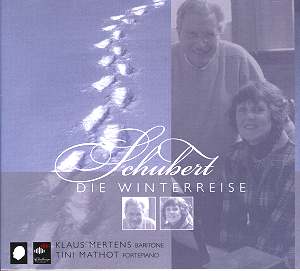
 Klaus Mertens (baritone)











