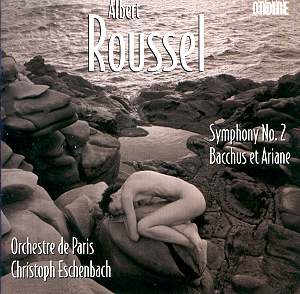
There’s
no doubt what the main draw of this superb new Ondine disc
is Roussel’s Second Symphony has always been overshadowed
by the Third and Fourth, which have quite a few competing
versions in the catalogue. By contrast, the only real rival
to Eschenbach in No.2 is the 1969 Martinon performance with
the ORTF Orchestra, currently still listed on mid-price Erato.
I have the original LP and there’s no doubting the calibre
of Martinon’s conducting – he did, after all, study with
the composer for a time. But there’s also no doubting the
power of this latest version, with tidier orchestral playing
and obviously superior sound quality.
Eschenbach
is on record as stating that the Second Symphony was something
of a musical revelation to him. This has evidently spurred
him to give a deeply considered and thoroughly well prepared
account of this dark, in places disturbing score. It has
been easy to read into the music depictions of war-torn Europe
and old certainties shattered. In fact, the composer – admittedly
reluctantly – eventually added a programme that related each
of its movements to the three ages of man. Thus, the first
movement ‘expresses the ardour and enthusiasm of young people
en route to life; the second…undemanding pleasures and the
third pain, bitterness, revolt and, finally, the sense of
peace that comes with a feeling of serenity as man rises
above his passions’
You
may feel, as I do, that these notes are almost as unhelpful
as the war scenario, and that the best thing is to do what
Roussel originally wanted, ‘for listeners to find their own
way around the work without the help of a programme’. It
certainly seems to me that Eschenbach treats it as ‘absolute’ music,
and he seems aware of the experiments that Roussel was making
in terms of orchestral balance and colouring. Tempos and
phrasing are marginally more relaxed than Martinon, something
which allows the detail to shine through without losing any
sense of symphonic purpose. The delicious, typically French,
pastoral scoring of the central scherzo is a good case in
point, where Roussel’s rather thick textures are given light
and air by Eschenbach. The deft, pointed dashes of harp,
flute and celesta that permeate the movement like little
rays of light are beautifully judged, as is the contrasting
string sonority, which in the finale particularly, emerges
with a dark, sinewy sobriety reminiscent of Shostakovich.
There are plenty of moments where the more neo-classically
inclined Roussel comes to the fore, to be sure, such as the
driving allegro of the first movement, but overall the impression
this symphony leaves, at least to me, is of an almost Brucknerian
intensity leavened by some ravishingly diaphanous orchestration.
As Damien Top’s note makes clear, it may have struck some
contemporary listeners as formless, but the ever prescient
André Caplet noted that the music conveyed ‘a message of
rare quality’.
After
such a riveting version of the symphony, it would have been
a shame if the much more famous Bacchus et Ariane ballet
had not been up to scratch. Luckily, all is definitely well,
with a marvellous blend of pulsating excitement and intoxicating
sensuality. There is an almost electric charge in the concluding ‘Bacchanale’,
yet one could hardly ask for more tenderness in the evocative
end to Act 1, where Bacchus puts Ariadne to sleep. It’s always
amazed me that conductors could opt just for Act 2 when the
whole ballet contains so much wonderful music. I’ve always
had a soft spot for Georges Prêtre’s EMI recording from 1984
which, like Jan Pascal Tortelier’s recommendable Chandos
release from 1996, has Le festin de l’araignée (The
Spider’s Feast) as its coupling. At least Tortelier opts
for virtually the complete feast, but it still can’t match
the Ondine disc for rarity and plain value for money. Audio
quality is excellent and though this may be full price, it’s
worth every penny.
Tony Haywood



 Orchestre
de Paris/Christoph Eschenbach
Orchestre
de Paris/Christoph Eschenbach