Comparison
Recordings of Fantasia Contrappuntistica:
Geoffrey
Douglas Madge, (solo version) Philips [OP]
Isabel
and Jürg von Vintschger, pianos. [ADD] Jecklin-Disco JD 579-2
Peter Serkin, Richard Goode, pianos CBS LP MS
6891
Nicolas
Danby, organ Virtuoso LP TPLS 13024
When Ferruccio Busoni announced to the world that
he was going to finish Bach’s final unfinished fugue, nobody
had ever heard the original work since the first public performance
of Bach’s “Unperformable” Art of the Fugue would not
occur until a year after Busoni’s death. The work was generally
considered a scholarly puzzle, some may even have thought
that Bach deliberately left the final fugue unfinished as
a challenge to future musicians to equal or better him. The
first draft of the solo piano version was written at the
behest of Bernard Ziehn and Wilhelm Mittelschulte, in 1910
during a concert tour of America, between Chicago and Dayton,
Ohio. Busoni himself described the work as “between a composition
by César Franck and the Hammerklavier Sonata.”
The first edition was published in New York in
1910, a revised edition in Germany later that same year.
The organ arrangement was by Mittelschulte in 1912. In 1922,
when Busoni published his completed effort, the work had
become a fugal fantasia based on the Bach work but not in
any sense working out a completion. He worked and reworked
the composition, and the two piano version heard here is
generally considered the best one. Busoni worked his completion
into variations on the chorale “Ehre zei Gott in der Höhe,” but
curiously neither Tovey nor Busoni seem to have noticed that
the motif of Art of the Fugue is “Wie schön
leuchtet der Morgenstern”. Both Tovey and Busoni - and Helmut
Walcha - rework Bach using harmonies that only became popular
more than a hundred years after Bach’s death. Perhaps the
final word on completing Bach’s fugue will be written by
Erich Bergel c and Paul Jordan d.
But Busoni’s public relations campaign was so
effective that Donald Francis Tovey, who was working on his
own completion of Bach’s fugue, made a point of avoiding
the Busoni work until his own was finished. He needn’t have
bothered, there is no relationship between their two approaches.
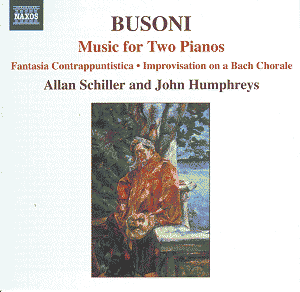
The von Vintschgers play exactly the same program
as Schiller and Humphries, however they play it in the order
Busoni himself suggested, to form a gigantic sonata for two
pianos, whereas Schiller and Humphries move the last movement
of the putative “sonata,” the Fantasia Contrappuntistica to
opening position rather than the finale. The von Vintschgers
are recorded more closely, which allows at times a feeling
of intimacy, and play with more poetry and drama, attested
to by their significantly longer timings on all works except
the Mozart. The von Vintschgers preserve more of Busoni’s
lyricism and grand gestures, whereas Schiller and Humphries
reveal more of the intellectual structure of the works, and
include no small amount of lyricism and drama of their own.
Schiller and Humphries are recorded with a little more distance
which allows them to expand the heroic qualities of the music;
they play with more zest and flourish, but both sets of players
are equally skilled and virtuosic. It is entirely a matter
of taste as to which you would prefer.
The Serkin/Goode performance from the 1966 Marlboro
Festival eschews any kind of feeling or beauty; it is the
ultimately analytical version, even to the point of having
the two pianos clearly separated one to each channel. It
is the one to have if you want to follow the score. The young
Glenn Gould would have loved it.
In the end Busoni’s genius turned out to be sharply
limited and he worked and worked over a few compositions,
content to leave a handful of masterpieces to honor his name,
which they most certainly do. Fantasia Contrappuntistica is
such a masterpiece, as is the Second Violin Sonata featuring
the variations on the Bach chorale “Wie wohl ist mir, O Freund
der Seele,” of which this piano work is a later, much reworked,
version. Also his Piano Concerto, and his operas, and the
memory of various students who with little success have attempted
to reproduce the astounding sound Busoni could wring from
a piano, the secret of which did not survive him.
Paul Shoemaker
BUY NOW
AmazonUK AmazonUS
Footnotes
a. Full title: Choral-variationen über «Ehre zei
Gott in der Höhe» gefolgt von einer QuadrupelFuge über ein
Bachsches Fragment.
b. The finale of the Piano Concerto #19 in F,
K 459 (1784), which contains occasional quotes from the Magic
Flute.
c. Bachs Letzte Fuge, Erich Bergel, Max
Brockhaus Musikverlag, 1985.
d. In his completed organ performance of the
final fugue on Brioso CD.



 Allan Schiller
and John Humphries (duo pianists)
Allan Schiller
and John Humphries (duo pianists)