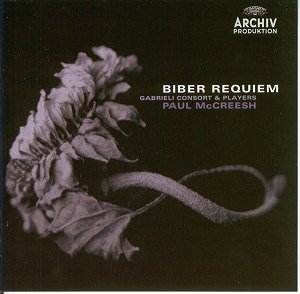
The front page of the booklet for this disc simply says: "Biber
- Requiem". But the rear insert is more specific: "A
Requiem for Biber". This recording was made in commemoration
of the death of Heinrich Ignaz Franz von Biber in 1704. The
theme of the project is the first line of an antiphon from
the 8th century: "Media vita in morte sumus" -
In the midst of life we are in death. This, as Dorothee Schröder
explains in the booklet, was a harsh reality in Biber's time.
And he himself got a share of it: seven of his eleven children
died prematurely. The disc refers to both life and death:
the first part is entitled "Vita" (life), and brings
the Mass in B flat, performed within a liturgical context.
The second part is devoted to "Mors" (death), and
contains Biber's Requiem in f minor.
In our time Biber is mainly known as composer of virtuosic music for
string ensemble and in particular for solo violin. And it
was his own violin playing which brought him his reputation.
But he was also active in the field of church music. In 1678
he became vice-Kapellmeister and in 1684 Kapellmeister in
the archbishopric of Salzburg. In this capacity he composed
a large number of works to be performed in Salzburg Cathedral.
Among them are two large-scale works that for a long time
were attributed to Orazio Benevoli: the 53-part Missa Salisburgensis
and the Missa Bruxellensis in 23 parts. The two mass settings
on this disc are more modest in scoring.
The Mass in B flat was probably written for a smallish parish church,
which is reflected by the performance on this disc: solo
voices with the organ playing the basso continuo part, supported
by a bass violin. The interpretation raises some questions.
In Biber's time it was common practice to play instrumental pieces
during mass. But it is unlikely all churches had instrumentalists
at their disposal to do so. So when this mass was indeed
written for a relatively small parish church, is it very
likely instruments were available to play sonatas as in this
recording? And if so, why would they remain silent for the
largest part of the mass instead of playing colla parte with
the voices, which also was often practised in Biber's days?
It seems to me this recording is rather inconsistent in this
regard.
In his 'Performance notes' in the booklet Paul McCreesh writes: "We
have chosen to sing this piece with doubled soprano parts
and single male voices (...)". I am a little puzzled
by this decision: why should the soprano parts be sung by
two singers each? It results in an unsatisfying balance within
the vocal ensemble, where the sopranos tend to dominate.
That is not the only aspect of this performance that I find
disappointing: some singers also use too much vibrato, in
particular the tenor Daniel Auchinschloss, which seriously
damages the blending of the voices. And although this mass
setting is rather old-fashioned, more connected to the 'prima'
than the 'seconda prattica', I don't think it should be sung
with so much legato.
Unlike the Mass ex B the Requiem is linked to Salzburg Cathedral,
but even so it is relatively modest in its scoring as well.
Here McCreesh has opted for the addition of ripieno forces
of ten singers, trombones and an organ to the scoring of
five voices and six-part string ensemble. This performance
is much more satisfying: in particular the ripieno sections
are very well done. The problems in the performance of the
Mass regarding the use of vibrato and the lack of blending
return only in the sections for the solo voices.
The addition of music by other composers in liturgical 'reconstructions'
may reflect common practice in those days, the choice of
specific compositions is pure speculation. Pieces by Schmelzer,
Muffat and Megerle are logical options, as all of them were
active during Biber's life - Schmelzer being probably his
teacher. The only odd choice is Lassus, but it is argued
in the booklet that Lassus's reputation was such that his
music still belonged to the standard repertory in Biber's
time. That may be true, but I sincerely doubt if his music
would have been performed differently from the way the music
of Biber and his contemporaries was interpreted. When a Requiem
is performed with six-part strings, as is the case here,
would Lassus's motet 'Media vita in morte sumus', which concludes
this disc, have been played without them?
To sum up: this recording represents mixed baggage. I liked the performance
of the Requiem, but that work has been recorded several times
before. It is a shame that it is precisely the far less known
Mass in B flat that draws the unsatisfactory performance.
Johan
van Veen
BUY NOW
AmazonUK AmazonUS



 Gabrieli Consort
and Players/Paul McCreesh
Gabrieli Consort
and Players/Paul McCreesh 











