It's always an event when Bernard Haitink conducts Mahler.
At seventy-five, he has decades of experience at the highest
levels and will always have something to say. He has worked
with the best Mahler orchestras in the world who understand
his approach and have produced wonders for him. The Orchestra
National de France isn't in the same league. It's not a
bad orchestra, by any means, being a Radio France orchestra.
In the past they've had conductors like Jochum, and currently
their musical director is Kurt Masur. This certainly isn't
a bad recording. But neither is it state of the art. It's
useful to listen to nonetheless to figure out what makes
it tick ... or not, as the case may be.
The Trauermarsch is decidedly stately, as if each marcher's
foot had to be drawn up to the other before taking the next
step. There is validity for this approach, for formal military
marches can be exceedingly slow. But this is the beginning
of a symphony. The contrast between the fanfare theme and
the quieter parts of the movement don't come over with the
sense of forward trajectory they need to keep the symphony
moving. Mahler does write that the movement should be “at
a measured pace, like a cortege” but played with such formal
impersonality it doesn't convey the idea that something
or someone is being laid to rest, which is the whole point
of a cortège. As for the second movement, which Mahler described
as “Stürmisch bewegt” (violently agitated, with utmost vehemence),
this sense of formality again stymies the passion that underlies
nearly everything Mahler wrote. About nine minutes into
the movement things begin to pick up, with swirling textures
and the crashing of drums. The dramatic peaks of sound at
the end, almost Wagnerian in character, should be the culmination
of the movement, rather than an afterthought. The Scherzo
sounds promising enough, the “nicht zu schnell” instruction
being carefully observed. I quite liked the entry of the
trumpets here, and the precision of the violin passages
that follow. But again, there is no sense of urgency, of
heading forth towards a resolution. Haitink and his players
linger over details like the rat-a-tata-tat of percussion
and bells, but they are there for a purpose: to echo, perhaps,
a vehicle speeding along relentlessly. As for the Adagietto,
the shimmering textures and subtleties are achieved at the
expense of muscle and vigour. The Rondo, however, is played
with real vivacity and lightness, and is quite pleasant.
This is perhaps the most “classical” of Mahler's symphonies
and a formal, “classical” interpretation has its merits.
For me, however, an interpretation that leads somewhere
matters more. How do we get from the cortège to the cheerfuless
of the Rondo-finale? In many versions, the trajectory is
achieved by a sense of forward thrust and tension that this
version downplays. I don't believe that musicians as good
as Haitink deliberately play “just the notes”, and there's
always something to learn, even from a performance that
doesn't please as some of the greatest do. From this I got
a sense of formal structure, but little sense of development
or inner direction. This recording has its merits, but in
a market as full of superb Mahler Fifths, it's not one to
rush out for.
Anne Ozorio



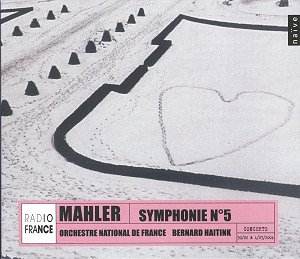
 Orchestre Nationale de France/Bernard Haitink











