The Newberry Consort
are a group of American musicians who
have been making recordings of early
music since about 1990 when they recorded
for Harmonia Mundi ‘Musick of Severall
Friends’ - English songs of the 17th
Century. Mary Springfels has always
directed them and her work is marked
by meticulous scholarship and, most
recently, fine presentation.
The title of this CD
takes its name from the period in musical
history when, due to the swift development
of notational techniques, composers
began to be able to write down anything
they wanted. This led to experimentation
especially in the realm of highly complex
rhythm. The last decades of the 14th
century have been termed ‘The 14th
century avant-garde’ (David Munrow)
and the ‘Ars subtillior’ (Gustave Reese).
This is a period when all artists became
obsessed by puzzles and patterns. In
English architecture you can see how
masons, by using the compass on paper,
discovered astonishingly varied and
complex patterns which they were able
to turn into a wide variety of delicate
church window tracery in what we now
call the ‘Decorated style’ and in France
the ‘Flamboyant’. So in Mary Springfels’
notes she says that this CD shows how
artists "indulged in games and
puzzles - anagrams, secret canons and
notational conundrums. They preferred
three and even four part textures and
ornately syncopated polyphonic structures."
This music demonstrates all of these
points.
Not all the composers
are Italian but French and several of
the pieces are in French. However, intercourse
between the two cultures was common
practice and composers especially moved
freely and worked in several different
countries.
It is quite probable
that Gherardello da Firenze was a generation
or so earlier than Anthonella da Caserta
and Matteo da Perugia but even if you
had no dates at your finger tips then
by simply listening you can easily discern
a development in the style and language
of the music.
The disc opens with
a lively rendering of the earliest piece,
the simple monodic ‘I’vo bene’ by Gherardello
accompanied by percussion and a drone
for colour. It tells of a lover who
spurns one who only loves himself. The
percussionist Najib Bahri is brilliant
throughout, playing a very Eastern-sounding
bongo which fits with the rather oriental
melody.
The CD continues with
a more than usually Arabic-sounding
instrumental version of a balleta by
Lorenzo (c.1370). The contrast with
the Perugia which follows (‘Se je me
plang’) is startling. Incidentally the
crusaders would have been fascinated
by the music they heard in the middle
east. They bartered beads for instruments
bringing them back home. They also used
them in their own dance music. In the
Perugia, Drew Minter is accompanied
by lute (which is actually an Arab instrument),
citole and vielle. In the next track,
the beautiful and highly complex ‘Sus
un fontaine’ by Ciconia, we have a superb
a capella performance with Minter,
Ellen Hargis and Mark Rimple. This made
me yearn for more tracks which were
instrument-less. How much better this
is than that by Malla Punica (Arcana
A23). Here we have a more natural rhythmic
flow and attention to phrasing. I feel
that another couple more tracks like
this would have worked wonders especially
in the graceful and playful ‘En ce gracieux
temps’, on which Mary Hargis is delightfully
double-tracked in the Cucus.
The same can be said of the long solos
given to Drew Minter, perhaps ‘En attendent’.
I was surprised to find that on this
recording this song is attributed to
Senleches. It is normally attributed
to Philipoctus da Caserta. Perhaps recent
scholarship has left me behind. The
only redeeming factor in the attribution
is that some of the lines sound a little
like Senleches’ famous and curious ‘la
harpe de sa melodie’.
As much as I like Drew
Minter’s firm and ideal counter-tenor
I would have liked, for the sake of
repertoire balance, to have had at least
one more item for voices only. Also
one more item featuring the gorgeous
soprano voice of Ellen Hargis and perhaps
a re-jigging of the track order would
have been welcome. The instrumental
participation is certainly colourful
and always superbly rendered. Springfels
tells us that Howard Mayor Brown has
posited instrumental participation in
14th century Italian music
to be more of likelihood than recent
English scholars have suggested. She
adds that "French instrumentalists
... left no music specifically intended
for instruments. Whereas from Italy
we have the Faenza Codex which "gives
ample testimony to the abilities of
Italian instrumentalists". Food
for thought here.
Despite these caveats,
I have enjoyed this CD and can recommend
it with just a few nagging reservations.
The CD is inscribed
‘In memory of the life and work of Howard
Mayer Brown’
Gary Higginson



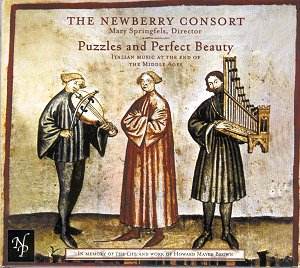
 The Newberry Consort/Mary Springfels











