Honegger was involved
in some forty film scores ranging from
his earliest essays (Abel Gance’s La
Roue in 1922 and Gance’s Napoleon
in 1926) through to his last work in
this genre in 1951. He was exclusively
responsible for around half of these
scores, the remainder, due to pressure
of time, he wrote in tandem with other
colleagues including Jolivet and Milhaud.
Honegger regarded his
work on La Roue and Napoleon
as apprentice work; some other scores,
such as Mermoz and Regain
he arranged into concert suites. At
the urging of Miklós Rózsa,
who was deeply impressed by the score,
Honegger arranged five movements from
Les Miserables into a concert
suite. This suite, along with those
from Napoleon, La Roue
and Mermoz, has been recorded
by the same forces on another Marco
Polo disc.
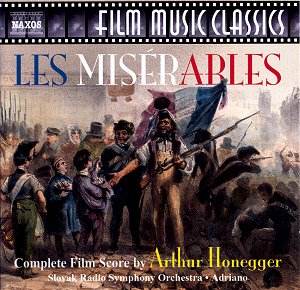
What this disc attempts
to give us is Honegger’s complete score.
This runs to around an hour of music
which is not much for a film whose three
parts originally lasted for a total
of around five hours. There are some
23 cues which means that some of the
music is of relatively short duration.
The score has been edited by the Swiss
conductor Adriano. He has combined some
of the shorter cues into rather effective
single movements. One scene had to be
reconstructed from the original sound-track,
and other scenes are recorded complete
where the film uses them in truncated
form or omitted them entirely. On the
debit side, they miss out some very
short cues, described as being of no
interest, and Gavroche’s death scene
which seems to have been omitted mainly
because it required a singing voice.
Couldn’t this have been arranged for
a wind instrument?
Honegger scored the
music for full symphony orchestra, with
piano, saxophone, harp and percussion,
but omitting double basses. He uses
the full orchestra in only four movements.
The remainder are written for various
flexible and more chamber-like combinations.
A major factor in Honegger’s thinking
was probably the rather primitive recording
technology of the time. This also led
Honegger to use single woodwind, but
Adriano has the usual wind doublings
as he is using a rather larger ensemble
of strings. Various other retouchings
have been done and the tempi used are
those of Maurice Jaubert, the conductor
on the original sound-track, rather
than Honegger’s own metronome markings.
All in all, this is an extremely welcome
release although it is not quite a complete
recording of the score as Honegger wrote
it.
Though Honegger did
utilise some leitmotifs, his view of
film writing was that film relies on
contrasts, rather than continuity and
logical development. So his music reflects
this, adapting itself to the visual
element to create a whole. Each movement
is a vivid evocation of mood or action.
Adriano obviously has a good feel for
this score and the Slovak Radio Symphony
Orchestra respond well. The result is
attractive and involving. But more could,
perhaps, have been made of it. The packaging
includes an illuminating article by
Adriano, but the 17 different movements
are given a title only. A listener who
is unfamiliar with Hugo’s novel will
struggle to divine the action that the
music is complementing. A little more
help would have been very useful. Though
the disc was originally issued on Marco
Polo, it has now resurfaced at budget
price on Naxos so we cannot complain
too much.
Charles Koechlin considered
this score to be ‘one of the best film
scores hitherto created’. Honegger’s
film work is still relatively unknown
and this disc enables us to explore
in detail one of his major scores in
the genre.
Robert Hugill
see also review
by Patrick Gary



 Slovak Radio Symphony Orchestra/Adriano